If you are a D Pharma or B Pharma graduate, you have probably typed “pharmacist salary in government hospital” into Google more than once. It’s a fair question. Government pharmacist jobs come with something the private sector rarely offers: a fixed pay scale, job security, a pension, and yearly increments you can actually plan your life around. But the amount you take home is not the same in every state. A pharmacist working in Telangana can earn almost ₹18,000 more per month than one doing the same job in West Bengal. This guide breaks down exactly how much government hospital pharmacists earn, state by state, and why the numbers differ so much.
What Does a Government Hospital Pharmacist Do?
Before we get into numbers, it helps to know what the job involves. A pharmacist in a government hospital does a lot more than hand out tablets over a counter. The role usually includes:
- Dispensing medicines to in-patients and out-patients as per the doctor’s prescription
- Keeping stock records and placing indents for fresh medicine supply
- Storing drugs correctly, including cold-chain items like vaccines and insulin
- Checking expiry dates and removing expired stock from the shelf
- Guiding patients on how and when to take their medicine
- Maintaining records as required under the Drugs and Cosmetics Act
What Decides a Government Pharmacist’s Salary
Every government pharmacist salary in India is built on the same foundation: the pay commission structure. Most states and central departments follow the 7th Pay Commission pay matrix, where a pharmacist is placed at Pay Level 5, with a basic pay that starts at ₹29,200. On top of this basic pay, the government adds a few allowances, and these allowances are what actually change from state to state.
Pay Scale Basics: Which Pay Level Do Pharmacists Fall Under?
Most government hospital pharmacist posts, whether central or state, sit under Pay Level 5 of the pay matrix that came out of the 7th Pay Commission. You can check the full official pay matrix on the Government of India’s 7th Central Pay Commission report if you want to see the exact numbers for every level.
| Component | Details |
| Pay Band (old structure) | ₹5,200 – ₹20,200 |
| Grade Pay | ₹2,800 |
| Pay Level (7th CPC) | Level 5 |
| Entry Basic Pay | ₹29,200 per month |
| Maximum Basic Pay | ₹92,300 per month |
| Applies To | Central posts (ESIC, Railways, CGHS) and most state health department posts |
A few states place pharmacists one notch higher, at Level 6, especially after a promotion or in autonomous medical college hospitals. Basic pay is just the starting point, though. Add Dearness Allowance (DA), House Rent Allowance (HRA), and Transport Allowance (TA), and the gross pay looks quite different. Here’s how that plays out for someone posted in a small town compared to a big city.
Pay Level and Grade Pay Explained
Think of “Pay Level” as a slot in a big salary chart used by every government department. A pharmacist usually sits at Level 5, which used to be called Grade Pay ₹2,800 under the older system. After a few years of service, many pharmacists move up to Level 6, which brings a noticeably higher basic pay. The final in-hand number depends on three things: your basic pay, the Dearness Allowance rate in your state, and the House Rent Allowance for your city category.
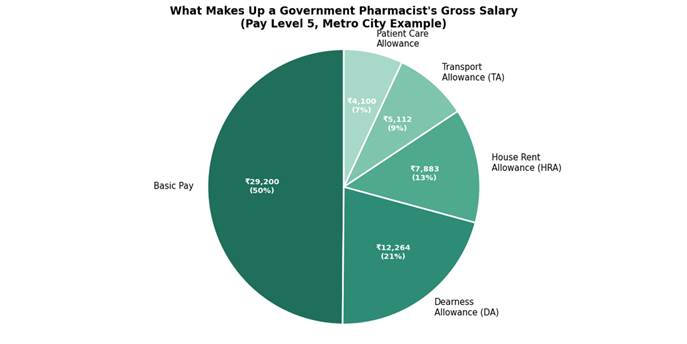
How a government pharmacist’s gross salary is built up from basic pay and allowances.
State-Wise Government Pharmacist Salary Breakdown
Here is a simple comparison of what a fresh government pharmacist can expect to take home every month across major states. These are approximate in-hand figures after standard deductions like NPS and professional tax.
| State | Pay Level | Approx. In-Hand Salary/Month |
| Telangana | Level 5–6 | ₹52,000 – ₹56,000 |
| Delhi (DSSSB) | Level 5 | ₹50,000 – ₹54,000 |
| Karnataka | Level 5 | ₹50,000 – ₹54,000 |
| Punjab | Level 5 | ₹49,000 – ₹52,000 |
| Maharashtra | Level 5 | ₹48,000 – ₹52,000 |
| Andhra Pradesh | Level 5 | ₹42,000 – ₹46,000 |
| Madhya Pradesh | Level 4–6 | ₹40,000 – ₹43,000 |
| Himachal Pradesh | Level 5 | ₹40,000 – ₹43,000 |
| Chhattisgarh | Level 4–5 | ₹37,000 – ₹40,000 |
| West Bengal | Level 5 | ₹35,000 – ₹38,000 |
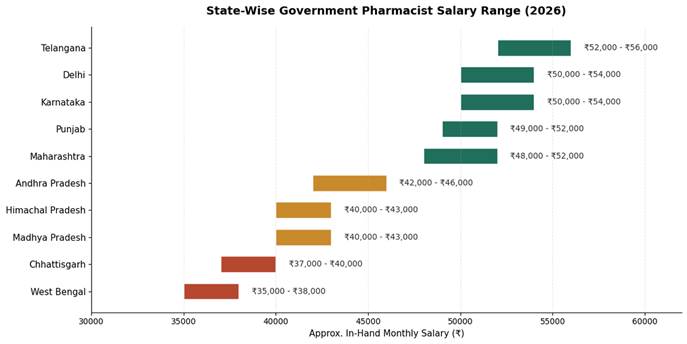
In-hand monthly salary range for government pharmacists across ten major states.
States That Pay Government Pharmacists the Most
A few states stand out for offering noticeably better pay than the rest of the country. The main reason usually comes down to one thing: the Dearness Allowance rate, which the state revises on its own schedule.
Telangana
Telangana currently has one of the highest DA rates among all Indian states, which pushes the in-hand salary of a fresh government pharmacist to around ₹52,000 to ₹56,000 a month. The Telangana State Public Service Commission runs regular recruitment drives for Pharmacist Grade II posts in government hospitals and primary health centres.
Delhi
Pharmacist posts in Delhi government hospitals, filled through DSSSB, follow the central pay structure. Because Delhi falls under the X-city HRA category, along with CGHS medical cover, pharmacists here take home roughly ₹50,000 to ₹54,000 per month even at entry level.
Karnataka
Karnataka runs its own state pay commission, which has kept the starting basic pay for pharmacists on the higher side. Combined with a decent DA rate, in-hand pay lands between ₹50,000 and ₹54,000 a month.
Why the Numbers Differ From State to State
Four things mostly decide where a state lands on this list:
- DA rate: Some states revise Dearness Allowance in step with the centre. Others lag behind by a few percentage points.
- HRA city classification: Pharmacists posted in metro cities like Mumbai, Bengaluru, or Hyderabad get a higher HRA slab than those in smaller towns.
- State pay commission decisions: A few states run their own pay commission and revise scales on a separate timeline from the central 7th CPC.
- Years of service: Every year in the job adds roughly 3% to basic pay, so someone with ten years of service earns noticeably more than a fresher on the same post.
States With Lower Starting Pay
On the other end, states like West Bengal, Chhattisgarh, and Madhya Pradesh offer noticeably lower starting salaries. West Bengal has struggled to keep its DA rate in line with the central rate for several years now, which is the single biggest reason pharmacists there earn ₹35,000 to ₹38,000 a month, well below the national average. Chhattisgarh and Himachal Pradesh both fall into lower HRA city categories, which also pulls the final number down.
Central Government Jobs vs State Government Jobs
Pharmacists don’t have to stick to state recruitment alone. Central government bodies like AIIMS, ESIC, Railways, and CGHS also hire pharmacists, and these posts usually pay better because central DA rates tend to run higher than many state DA rates. A fresh pharmacist joining AIIMS or ESIC can expect an in-hand salary of roughly ₹50,000 to ₹62,000 a month, especially in metro postings.
- AIIMS Pharmacist Grade II — accepts both D Pharma and B Pharma graduates with valid state council registration
- ESIC Hospitals — strong medical benefits along with standard Level 5 pay
- Railways and CGHS — steady postings with regular DA revisions
- DSSSB (Delhi) — state-level recruitment but central-style pay structure
Does D Pharma or B Pharma Change Your Salary?
This is one of the most common doubts among pharmacy students, so let’s clear it up. In almost every state government recruitment, D Pharma and B Pharma graduates start at the exact same Pay Level 5, with identical in-hand pay. The qualification does not change your starting salary. What it does change is your promotion speed — B Pharma holders are often eligible for faster promotion to Senior Pharmacist roles, and some central government posts specifically require a B Pharma degree. If long-term growth matters more to you than the first paycheck, B Pharma gives you a slight edge.
Allowances and Benefits Beyond Basic Pay
A government pharmacist’s payslip is never just basic pay. Here are the common additions that make up the rest of the gross salary:
- Dearness Allowance (DA) — revised twice a year to offset inflation
- House Rent Allowance (HRA) — varies by city category, higher in metro postings
- Transport Allowance (TA) — fixed monthly amount for commuting
- Patient Care Allowance — extra pay for pharmacists posted in hospital wards
- Medical benefits — free or subsidised treatment for self and dependents
- Leave Travel Concession (LTC) — travel benefit available once every two years
- Pension and gratuity — long-term retirement benefits under NPS or old pension rules
Career Growth and Promotion
Government pharmacy is a slow but steady climb. Most pharmacists spend their first few years at Level 5, then move to Senior Pharmacist at Level 6 after five to eight years of service. With more experience, some go on to become Pharmacy Officers or Drug Inspectors, roles that come with a much higher basic pay and added administrative responsibility.
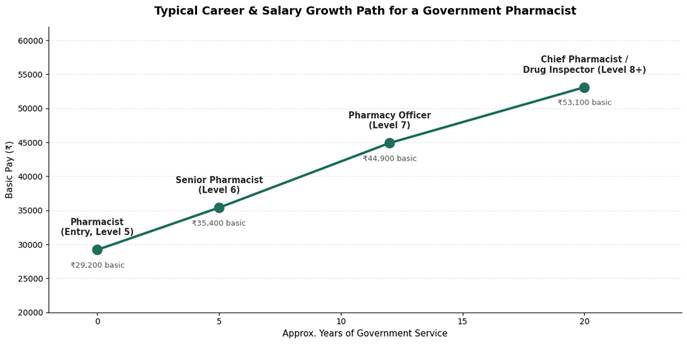
How basic pay typically grows across a government pharmacist’s career.
Tips to Land a Higher-Paying Government Pharmacist Job
- Track recruitment notifications from central bodies like AIIMS and ESIC, since they generally pay more than most state boards.
- Register with your State Pharmacy Council early, as valid registration is mandatory before you can even apply.
- Prefer metro or X-category city postings when you have a choice, since HRA alone can add several thousand rupees a month.
- Consider a B Pharma degree if you’re still studying, as it opens up more central government vacancies.
- Stay updated on your state’s DA revision dates, since this is the biggest lever affecting your in-hand pay.
Central Government vs State Government Pharmacist Jobs
Not every government pharmacist job runs through a state health department. Central bodies such as ESIC, Indian Railways, and AIIMS also recruit pharmacists, and their pay pattern is more uniform across the country because DA and HRA rules are set centrally rather than by each state.
| Recruiter | Pay Level | Approx. In-Hand (Entry) | Posting Pattern |
| ESIC | Level 5 | ₹45,000 – ₹50,000 | Anywhere in India |
| Indian Railways (RRB) | Level 5 | ₹42,000 – ₹48,000 | Railway zones, with travel pass benefits |
| AIIMS | Level 5 | ₹40,000 – ₹50,000 | Campus-based, varies by AIIMS location |
| State Health Department | Level 5 / 6 | Varies by state (see table above) | Within the state, often rural first |
Contract and NHM Pharmacist Pay: A Different Story
A large share of pharmacist vacancies advertised today are actually contract posts under the National Health Mission (NHM) or urban health schemes. These don’t carry the pay matrix benefits listed above. Pay is fixed, usually somewhere between ₹17,000 and ₹25,000 a month, with no DA, HRA, or pension attached. Many pharmacists take these roles anyway, just to get government experience, and later move to a regular post through a departmental exam or fresh recruitment.
Career Growth: How Salary Increases Over Time
A government pharmacist post is not a dead-end job. There’s a clear path upward, and every step brings a real jump in pay and responsibility.
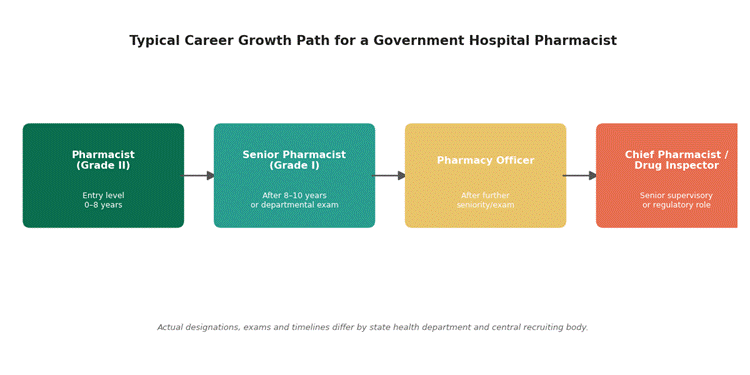
The usual promotion ladder for a pharmacist working in a government hospital.
The Promotion Ladder in Detail
Time-Based Promotion
Most states move a pharmacist from Grade II to Grade I, also called Senior Pharmacist, after 8 to 10 years of service, based on seniority and a clean service record.
Exam-Based Promotion
Some states, and most central departments, also allow faster promotion through a departmental exam. This can push a pharmacist into a Pharmacy Officer or supervisory post earlier than the seniority route would.
Later in the career, options open up for Chief Pharmacist, Store Officer, or even Drug Inspector roles for those who clear the relevant state or UPSC exam.
Do You Need to Register With the Pharmacy Council?
Yes. Every practising pharmacist in India, government or private, must hold a live registration with their State Pharmacy Council, which functions under the Pharmacy Council of India. Without an active registration, even a selected candidate can be turned away at the document verification stage. It’s worth checking your registration status well before you apply for any post.
Tips to Increase Your Pay as a Government Pharmacist
- Apply for central posts (ESIC, Railways, AIIMS) if you’re open to relocating — central pay tends to be more stable across postings
- Keep your registration and continuing education certificates updated, since some states link increments to this
- Start preparing for the departmental promotion exam early instead of waiting on seniority alone
- Accept rural postings if offered — many states add a rural or hardship allowance on top of regular pay
- Keep an eye on DA revision news every January and July, since it directly changes your take-home pay
Frequently Asked Questions
Which state pays government pharmacists the most?
Based on current pay patterns, pharmacists in Telangana, Karnataka, and Delhi tend to take home the highest gross salary, mainly due to higher DA rates and metro HRA.
Is B.Pharm or D.Pharm required for a government hospital pharmacist post?
Most posts accept either a D.Pharm or a B.Pharm degree, and the pay level is usually the same either way. B.Pharm holders sometimes get an edge during promotions or in central recruitments that specifically ask for a degree.
Do government pharmacists get a pension?
Employees who joined before 2004 generally fall under the old pension scheme. Most pharmacists who joined after that are covered under the National Pension System (NPS), where both the employee and the government contribute.
How often does DA change for government pharmacists?
Dearness Allowance is normally revised twice a year, once in January and again in July, based on inflation data.
What is the starting salary of a government pharmacist in India?
A fresh government pharmacist usually starts at Pay Level 5, with a basic pay of ₹29,200. After adding DA, HRA, and other allowances, the in-hand salary generally falls between ₹35,000 and ₹56,000 a month, depending on the state and city.
Which state pays government pharmacists the most?
Telangana currently offers the highest in-hand pay for government pharmacists, largely because of its high Dearness Allowance rate, followed closely by Delhi and Karnataka.
Is a central government pharmacist job better than a state government one?
Central postings at AIIMS, ESIC, or Railways usually pay a bit more and come with strong medical benefits. State jobs, though, often mean working closer to home and can still offer solid pay in states like Telangana and Karnataka.
Conclusion
Government hospital pharmacist salaries are far from uniform across India, and the gap between the top and bottom states is bigger than most aspirants expect. If pay is your main priority, Telangana, Delhi, and Karnataka are worth watching closely, while central government recruitments like AIIMS and ESIC remain strong options regardless of which state you’re from. Whichever path you pick, make sure your Pharmacy Council registration is in place before you start applying.
For the official rules on pharmacist registration and recognised qualifications, visit the Pharmacy Council of India website. To see the full government pay matrix that decides Level 5 and Level 6 salaries, you can refer to the official 7th Central Pay Commission report published by the Department of Expenditure.