Walking into an interview room can feel scary. Your palms get sweaty. Your mind goes blank. And then the interviewer asks the simplest question of all: “Tell me about yourself.” This one question sets the tone for everything that follows. Get it right, and you start the interview with confidence. Get it wrong, and you spend the rest of the interview trying to recover. The good news is that introducing yourself well is a skill. Anyone can learn it. In this post, we will break it down into easy steps you can practice today.
Why Your Introduction Matters So Much
Interviewers often decide their first impression of you within the first minute. That impression shapes how they listen to the rest of your answers. A clear, confident introduction tells them you are prepared, organised, and easy to talk to. A messy one, full of “umm” and long pauses, makes them doubt you before you even reach the real questions. This is why it is worth spending real time preparing this one small part of the interview.

The Simple 3-Part Formula
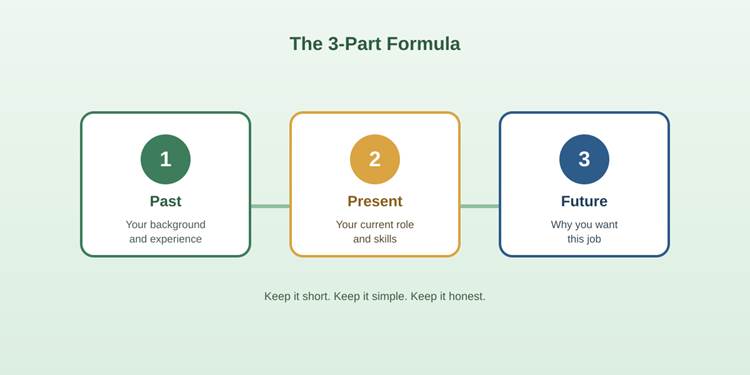
You do not need a fancy script. You just need a simple structure that you can remember under pressure. The easiest one to use is Past, Present, and Future.
- Past: A short line about your background, education, or earlier job.
- Present: What you are doing right now and what skills you use daily.
- Future: Why you are excited about this role and this company.
That’s it. Three parts, one flowing answer. Most good introductions last between thirty seconds and one minute. Anything longer starts to feel like a speech, not a conversation.
Step 1: The Opening Hook
Reality check:
Most interviewers have already heard 5 boring intros today. They’re silently begging you not to make the same mistakes.
What kills interest:
- Starting too far back: “Well, I was born in…”
- Being too personal: “I’m a father of three…”
- Sounding rehearsed: “I’m a dynamic professional who…”
- Rambling: “There’s so much to tell…”
- Being too humble: “I’m not sure where to start…”
What hooks attention:
- Start with your current role: “Currently, I’m leading…”
- Open with your specialty: “I specialize in…”
- Lead with your passion: “I’ve spent the last X years…”
- Show your impact: “I help companies…”
- Frame your expertise: “My focus has been…”
Example:
✗ Bad: “Well, I’ve been working in this field for about 10 years, and I’ve done various things…”
Interviewer thinks: *Another vague intro. When will they get to the point?*
✓ Good: “I specialize in solving [specific problem] for growing organizations…”
Interviewer thinks: *Clear value proposition. Let’s hear more.*
Remember this:
Your first sentence predicts
your last impression
Step 2: The Professional Identity
Reality check:
They’re mentally matching your identity against their ideal candidate profile. Every word either strengthens or weakens that match.
What kills interest:
- Being vague: “I’m a professional with various skills…”
- Underselling: “I just do regular marketing…”
- Overselling: “I’m the best at everything in…”
- Using jargon: “I leverage synergistic solutions…”
- Being generic: “I’m a hard worker who…”
What hooks attention:
- Define your specialty: “I’m a marketer who specializes in…”
- Show your niche: “My expertise is in…”
- Frame your value: “I help companies achieve…”
- State your focus: “My core strength is…”
- Name your impact: “I’m known for…”
Example:
✗ Bad: “I’m a dedicated professional who’s passionate about making a difference…”
Interviewer thinks: *Generic buzzwords. Nothing memorable.*
✓ Good: “Currently, I lead a team of [X] at [Company], where we focus on [specific outcome]…”
Interviewer thinks: *Clear role, clear impact. Getting interested.*
Remember this:
Your professional identity is judged by how you describe it,
not just what it is
Step 3: The Key Achievement
Reality check:
Their eyes are searching for proof that you can deliver. They’ve heard plenty of claims today – they’re waiting for evidence that sets you apart.
What kills interest:
- Being abstract: “I made significant improvements…”
- Using buzzwords: “I drove innovative solutions…”
- Telling not showing: “I’m great at leadership…”
- Being modest: “We had some good results…”
- Overcomplicating: “Through a multi-faceted approach…”
What hooks attention:
- Lead with numbers: “I increased revenue by 47%…”
- Show scale: “Led a team of 30 across 5 countries…”
- Name brands: “Launched projects for [known company]…”
- Give timeframes: “In 6 months, I delivered…”
- Show progression: “Promoted twice in 18 months…”
Example:
✗ Bad: “I’ve made lots of improvements and achieved great results in my current role…”
Interviewer thinks: *Everyone says this. Where’s the proof?*
✓ Good: “In my current role, I improved our key metrics by 40% in six months, which translated to [specific business impact]…”
Interviewer thinks: *Real numbers. This person measures their value.*
Remember this:
Concrete numbers build concrete trust
Step 4: The Career Journey
Reality check:
They’re not just hearing your path – they’re looking for red flags, patterns, and signs of growth. Every transition needs to make sense in 10 seconds.
What kills interest:
- Apologizing: “I know I’ve moved around…”
- Being defensive: “Let me explain each change…”
- Showing confusion: “I wasn’t sure what I wanted…”
- Adding fluff: “Then after that, I decided…”
- Being too detailed: “In 2018, I started as an assistant…”
What hooks attention:
- Show progression: “Each role built my expertise in…”
- Highlight growth: “I took on increasing responsibility…”
- Connect dots: “This experience led naturally to…”
- Frame transitions: “I moved specifically to gain…”
- Show purpose: “I’ve focused my career on…”
Example:
✗ Bad: “I’ve tried different things, moved around a bit, then found my way into this field…”
Interviewer thinks: *Sounds unfocused. No clear direction.*
✓ Good: “I’ve built my expertise through progressive roles, starting in [foundation role], advancing to [bigger role], and now leading [current scope]…”
Interviewer thinks: *Logical progression. Each move adds value.*
Remember this:
Your career story needs to sound like a plan,
even if it wasn’t one
Step 5: The Relevant Skills
Reality check:
They’re mentally ticking boxes against their requirements list. Every skill you mention either solves their problems or wastes their time.
What kills interest:
- Listing everything: “I’m skilled in A, B, C, D, E…”
- Being generic: “I have great people skills…”
- Using buzzwords: “I’m a thought leader in…”
- Claiming too much: “I’m an expert in everything…”
- Being vague: “I know various software…”
What hooks attention:
- Match their needs: “My core skill in [their requirement]…”
- Show application: “I use [skill] to achieve…”
- Prove mastery: “I’m known for my ability to…”
- Connect to results: “This expertise led to…”
- Demonstrate growth: “I’ve developed strong…”
Example:
✗ Bad: “I’m good with people, great at problem-solving, and have strong leadership abilities…”
Interviewer thinks: *Generic skills. Nothing stands out.*
✓ Good: “My core strength is combining [specific skill] with [complementary skill], which has helped me consistently deliver [specific outcome]…”
Interviewer thinks: *Relevant expertise. Clear connection to our needs.*
Remember this:
Perfect skills for wrong problems
don’t get offers
Step 6: The Why This Role
Reality check:
They’re wondering if you’re genuinely interested or just using them as a backup option. Every word either builds or breaks their confidence in your commitment.
What kills interest:
- Being desperate: “I really need this opportunity…”
- Staying generic: “Your company seems great…”
- Focusing on self: “This would be perfect for my career…”
- Being vague: “I’m excited about the potential…”
- Showing ignorance: “I’d love to learn more about what you do…”
What hooks attention:
- Show research: “I was impressed by your recent [project]…”
- Connect dots: “My experience in [X] aligns with your need for…”
- Demonstrate fit: “What excites me specifically is…”
- Show vision: “I see an opportunity to contribute by…”
- Build bridges: “Your challenge with [X] is exactly where I…”
Example:
✗ Bad: “I think this role would be perfect for my career development…”
Interviewer thinks: *All about them, not about us.*
✓ Good: “What attracts me to this role is your focus on [company priority], where my experience in [relevant achievement] could add immediate value…”
Interviewer thinks: *They’ve done their homework. See the connection.*
Remember this:
Generic interest gets generic consideration
Step 7: The Strong Close
Reality check:
They’re making a quick mental decision about your entire answer. These final moments either cement your impression or waste everything you’ve built.
What kills interest:
- Fading out: “So… yeah, that’s about it…”
- Apologizing: “Sorry if that was too long…”
- Getting nervous: “Did I cover everything?”
- Being passive: “That’s my background…”
- Showing doubt: “I hope that’s what you wanted to hear…”
What hooks attention:
- Bridge to role: “That’s why I’m excited about bringing [skill] to [their challenge]…”
- Show confidence: “I’m confident I can deliver similar results here…”
- Connect threads: “These experiences have prepared me perfectly for…”
- Add value: “I see three specific ways I can contribute…”
- Open dialogue: “I’d love to discuss how this aligns with your needs…”
Example:
✗ Bad: “So that’s basically my background. Any questions?”
Interviewer thinks: *Weak ending. Lost momentum.*
✓ Good: “That’s why I’m confident I can bring similar results to your team, particularly in addressing [their current challenge]. I’m excited to discuss how my approach could work here.”
Interviewer thinks: *Strong finish. Clear value proposition.*
Remember this:
Strong starts die with weak endings
Bonus points: How to Build Your Introduction
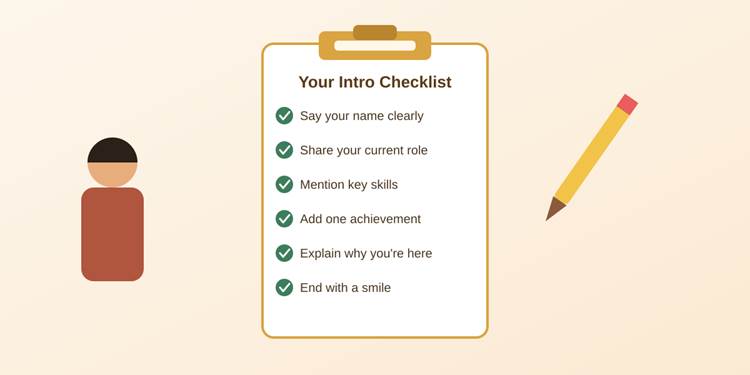
1. Start with your name and a friendly greeting
Say your name clearly and add a simple, warm greeting. Something like, “Good morning, I’m Priya, thank you for having me today.” This small step calms your nerves and shows good manners.
2. Share your current role or study
Mention what you do right now. If you are working, say your job title and company in one short line. If you are a student or fresher, mention your course and what you have been learning.
3. Add your key skills
Pick two or three skills that matter most for this job. Do not list everything you know. Choose the ones that connect directly to the role you are applying for.
4. Mention one achievement
A short, real example builds trust fast. It could be a project you finished, a target you hit, or a problem you solved. Keep it to one or two sentences.
5. Explain why you are here
End by connecting your goals to the company. Say why this role fits your skills and where you want to grow. This shows the interviewer that you have done your homework.
A Sample Introduction You Can Copy and Adjust
“Good morning, I’m Arjun. I recently finished my degree in computer science, where I focused on web development and worked on two group projects using React and Node. I later did a three-month internship where I built and tested small features for a live website. I enjoy solving small bugs and learning new tools quickly. I’m excited about this role because it lets me keep growing as a developer while working on products that real people use every day.”
Notice how short and natural this sounds. There are no big words, no long sentences, and no rambling. You can use this same pattern and simply swap in your own details.
Common Mistakes to Avoid
- Reading your introduction word-for-word from memory, which sounds robotic.
- Repeating everything already written on your resume.
- Talking for more than a minute without a pause.
- Sharing personal details that have nothing to do with the job.
- Sounding too rehearsed instead of natural and relaxed.
Tips to Sound Calm and Confident
Practice out loud, not just in your head. Your voice needs to get used to saying the words, not just thinking them. Record yourself on your phone and listen back. You will notice filler words like “umm” and “like” much faster this way. Slow down when you speak. Most people rush their introduction because they are nervous, but a slower pace actually sounds more confident. Finally, smile. It is a small thing, but it changes how your voice sounds and how the interviewer sees you.
Final Thoughts
Introducing yourself well is not about memorising a perfect script. It is about knowing your own story and telling it in a simple, honest way. Use the Past, Present, Future formula to stay organised. Practice out loud until it feels natural. And remember that the interviewer is not looking for perfection, they are looking for someone real, prepared, and easy to talk to. With a little practice, your next introduction could be the moment