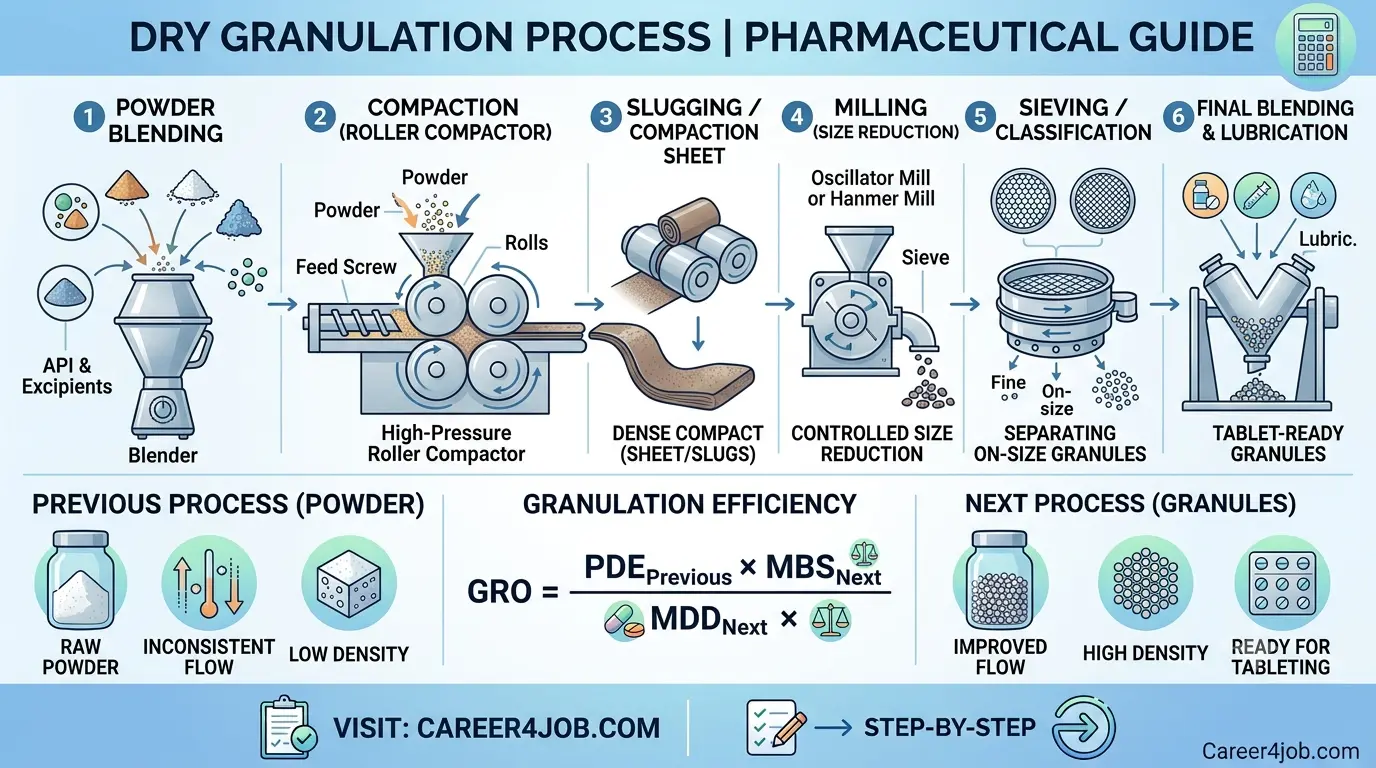
Learn how dry granulation works in pharmaceutical manufacturing, including its process, equipment, advantages, disadvantages, and comparison with wet granulation.
If you have ever swallowed a tablet, there is a good chance it went through a granulation step before it ever reached a compression machine. Plain powder is hard to work with. It sticks to metal surfaces, it does not flow well through machines, and it often separates into layers instead of staying mixed. Granulation fixes this problem by turning fine powder into small, free-flowing grains called granules.
There are two main ways to make granules: wet granulation and dry granulation. This article focuses on dry granulation, a method that many pharmaceutical companies rely on when water or heat could damage the drug. We will walk through what dry granulation actually is, how the process works step by step, which machines are used, and why manufacturers choose it over other methods. We will also compare it side by side with wet granulation and answer some of the questions people ask most often about this topic.
What Is Granulation, and Why Does It Matter?
Before we get into the “dry” part, let’s talk about granulation itself. In tablet manufacturing, raw powders are rarely compressed as they are. Most active pharmaceutical ingredients (APIs) and excipients are fine, dusty powders. On their own, these powders:
- Do not flow smoothly through tablet press hoppers
- Stick together unevenly, which leads to weight variation between tablets
- Separate by particle size during handling, a problem known as segregation
- Create too much dust during production
Granulation solves all of this. By binding smaller particles into larger, uniform granules, manufacturers get a material that flows evenly, compresses well, and produces tablets with consistent weight and drug content. Without this step, tablet quality would be almost impossible to control at a large scale.
What Is Dry Granulation?
Dry granulation is a method of making granules without adding any liquid binder, water, or solvent. Instead of moisture, this process uses mechanical pressure to bind the powder particles together. The powder is compacted under high force, either into large tablets called slugs or into thin sheets called ribbons, and then broken down into smaller granules of the right size.
Because there is no water involved, there is also no need for a drying step afterward. This makes dry granulation a shorter, simpler process compared to wet granulation, and it is especially useful for drugs that break down or lose potency when exposed to moisture or heat.
Dry granulation is sometimes called direct compaction granulation, and it includes two common techniques: slugging and roller compaction. We will explain both shortly.
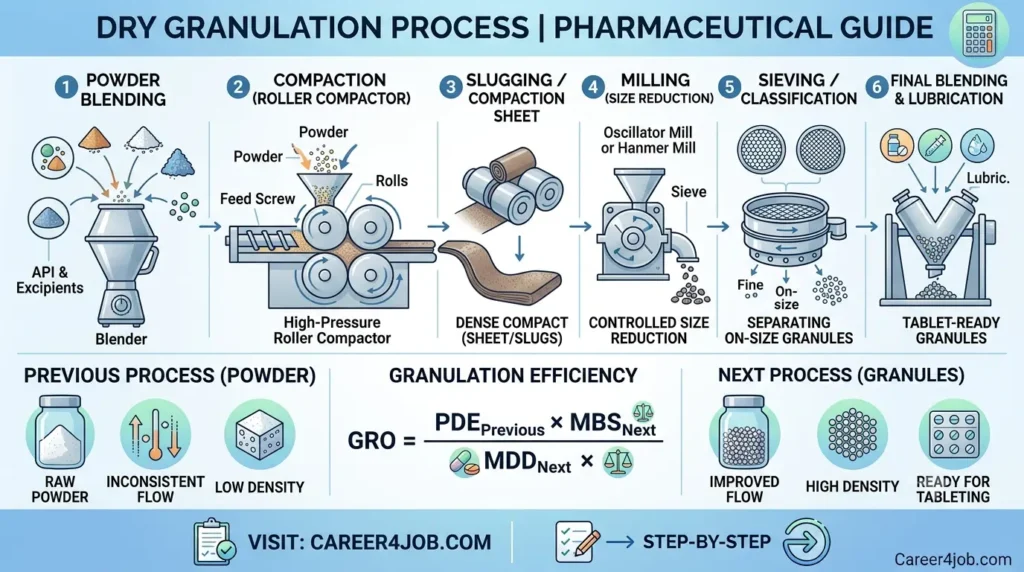
Here is a visual overview of how the full process flows from raw powder to tablet-ready granules.
Step-by-Step Dry Granulation Process
Dry granulation generally follows five main stages. Each stage plays a specific role in turning loose powder into granules that are ready for tablet compression.
1. Powder Blending
The process starts with mixing the active pharmaceutical ingredient with excipients such as fillers, binders, and disintegrants. This blend needs to be as uniform as possible, since any unevenness here will carry through the entire process. A poorly mixed batch means some tablets could end up with more or less drug than intended, which is a serious quality issue.
2. Slugging or Roller Compaction
This is the heart of dry granulation, and it happens in one of two ways.
Slugging: The blended powder is fed into a heavy-duty tablet press fitted with large, flat punches. The press compresses the powder into big, thick tablets called slugs. These slugs are not meant to be swallowed; they exist only to compact the powder into a solid mass.
Roller Compaction: The powder is fed between two rollers that rotate toward each other, squeezing the material under high pressure. This produces a continuous solid sheet called a ribbon, rather than individual tablets. Roller compaction is now the more common method in industrial settings because it is faster, continuous, and easier to control.
Both methods aim for the same result: a dense, solid mass that can later be broken down into granules of the right size.
3. Milling or Size Reduction
Once the slugs or ribbons are formed, they are far too large and irregular to be used in a tablet press. A milling machine, often an oscillating granulator or a rotary mill, breaks this solid mass down into smaller pieces.
4. Screening
After milling, the material passes through sieves of a specific mesh size. This step separates granules that are the correct size from ones that are too coarse or too fine. Oversized pieces are usually sent back through the mill for another pass, while very fine powder, sometimes called fines, may be recycled into a new batch or discarded depending on company standards.
5. Final Blending and Compression
The properly sized granules are then blended with a lubricant, such as magnesium stearate, which prevents the granules from sticking to the tablet press punches. Once this final blend is ready, it moves to the tablet press, where it is compressed into the finished tablets.
Below is a quick summary table of these five stages.
| Stage | What Happens | Goal |
|---|---|---|
| Powder Blending | API mixed with excipients | Uniform composition |
| Slugging / Roller Compaction | Powder compacted under pressure | Form slugs or ribbons |
| Milling | Slugs or ribbons broken down | Reduce to granule size |
| Screening | Material passed through sieves | Sort granules by size |
| Final Blend & Compression | Lubricant added, then pressed | Ready-to-compress mix |
Slugging vs Roller Compaction: Which One Is Used More?
Since these are the two main dry granulation techniques, it helps to understand how they differ.
| Factor | Slugging | Roller Compaction |
|---|---|---|
| Equipment | Heavy-duty tablet press | Roller compactor |
| Output Form | Individual slugs | Continuous ribbon |
| Process Type | Batch (stop and start) | Continuous |
| Speed | Slower | Faster |
| Common Use Today | Smaller facilities | Large-scale production |
Roller compaction has largely replaced slugging in modern pharmaceutical plants because it works continuously, produces more uniform ribbons, and needs less manual handling. Slugging is still used in smaller facilities or for smaller batch sizes where investing in roller compaction equipment does not make financial sense.
Equipment Used in Dry Granulation
Dry granulation depends on a handful of key machines, each designed for a specific stage of the process. Here is a closer look at the main equipment involved.
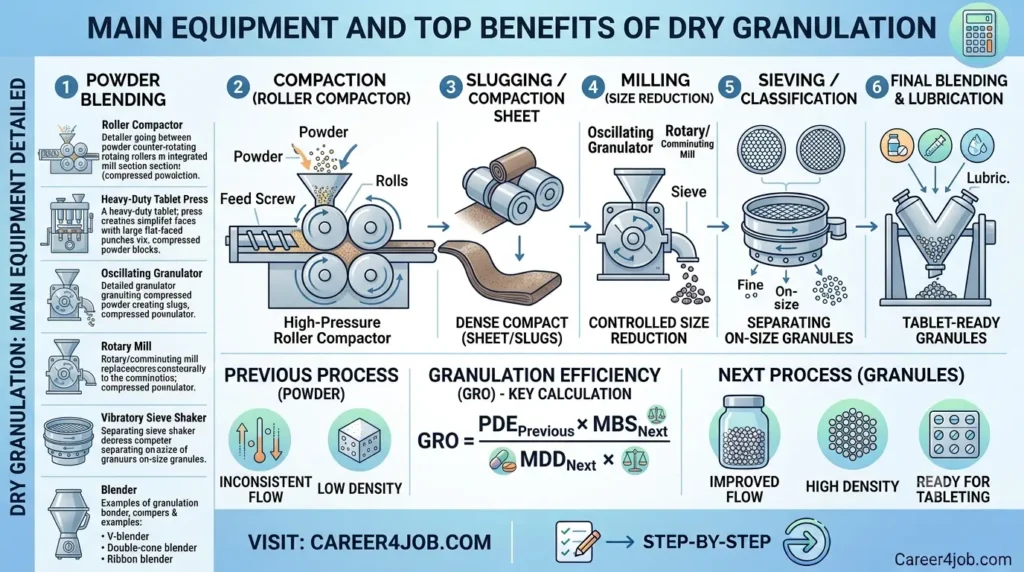
- Roller Compactor: This machine forces powder between two counter-rotating rollers under high pressure, forming a solid ribbon. Most roller compactors also include a built-in mill, so the ribbon can be broken into granules right away without moving to a separate machine.
- Heavy-Duty Tablet Press (for Slugging): A standard tablet press fitted with large flat-faced punches, used to compress powder into slugs. It needs to handle much higher compression force than a normal production press.
- Oscillating Granulator: A machine with a rotating, oscillating blade that pushes the compacted material through a screen, breaking it into granules of a fairly consistent size.
- Rotary Mill or Comminuting Mill: An alternative to the oscillating granulator, often used for finer control over particle size. It uses rotating blades or hammers to reduce particle size quickly.
- Vibratory Sieve Shaker: Used during the screening stage to separate granules by size using stacked mesh screens of different openings.
- Blender or Mixer: A V-blender, double-cone blender, or ribbon blender is used both at the start (mixing API with excipients) and near the end (adding lubricant to the sized granules).
Critical Process Parameters to Control
Getting good, consistent granules is not just about having the right machines. A few process settings make a real difference in the final product, and operators keep a close eye on them during production.
- Roll pressure (for roller compaction). Too little pressure, and the ribbon comes out weak and crumbly. Too much pressure, and the granules end up so dense that tablets made from them do not dissolve properly. Finding the right pressure is usually done through small trial batches before full production begins.
- Roll speed and gap width. These two settings control how thick the ribbon is and how long the powder stays under pressure. A narrower gap generally produces a denser ribbon, while roll speed affects how much material passes through per minute.
- Mill screen size. The size of the openings in the milling screen decides how big or small the final granules will be. A finer screen gives smaller granules but can also generate more dust and fine powder.
- Powder feed rate. If powder is fed into the roller compactor too fast or too slow, the ribbon density can become inconsistent, leading to variation between batches.
- Moisture content of the starting powder. Even though dry granulation avoids adding water, the powder blend still needs to start with a low and consistent moisture level. Powder that is too dry can be hard to compact, while powder with slightly higher moisture may bind a little too well and clog the mill.
Manufacturers usually run these settings through a validation study, testing different combinations until they find the sweet spot that gives strong, consistent granules batch after batch.
Quality Checks Performed on Dry Granules
Once granules are produced, they don’t go straight to the tablet press without testing. A few standard quality checks confirm the batch is fit for compression.
| Quality Test | What It Measures | Why It Matters |
|---|---|---|
| Bulk and Tapped Density | How loosely or tightly granules pack together | Predicts flow and die-fill behavior |
| Flow Rate / Angle of Repose | How easily granules move through equipment | Poor flow leads to uneven tablet weight |
| Particle Size Distribution | Spread of granule sizes in a batch | Ensures granules are not too coarse or fine |
| Friability of Granules | How easily granules break apart | Weak granules can turn back into dust |
| Moisture Content | Residual moisture in the granules | Confirms batch stability and specification |
These checks are usually done on a small sample pulled from each batch, following standard procedures set out in pharmacopeias like the USP or the IP, depending on the region.
Common Problems in Dry Granulation and How to Fix Them
Even with the right equipment, things can go wrong during dry granulation. Here are a few issues manufacturers run into, and how they are typically resolved.
Problem: Ribbons or slugs are too soft and crumble easily. This usually points to insufficient roll pressure or a powder blend that does not compress well on its own. Increasing pressure slightly, or adding a small amount of a dry binder to the formulation, often solves it.
Problem: Granules are too hard, and tablets take too long to dissolve. This is the opposite problem, caused by too much compaction force. Lowering the roll pressure or widening the roller gap usually brings dissolution times back into an acceptable range.
Problem: Too much fine powder after milling. This can happen if the mill screen is too fine or if the ribbon was over-compacted. Switching to a coarser screen, or adjusting roll settings, typically reduces the amount of fine powder generated.
Problem: Uneven tablet weight during compression. Poor granule flow is often the root cause. Checking the bulk density and flow rate of the granules, and adjusting the lubricant level in the final blend, can improve consistency.
Dry Granulation vs Wet Granulation
Wet granulation is the other major method used in tablet manufacturing, and it works quite differently. In wet granulation, a liquid binder, often water or a solvent mixed with a binding agent, is added to the powder to form a wet mass. This wet mass is then dried and milled into granules. It’s a reliable method, but it takes longer and involves more equipment, including drying ovens or fluid bed dryers.
Here is how the two methods stack up against each other.
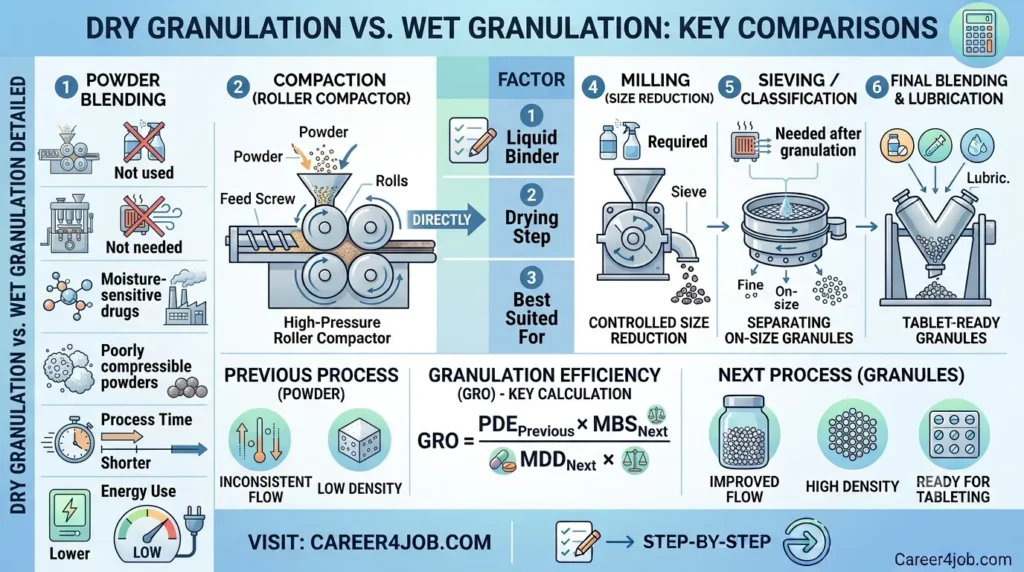
| Factor | Dry Granulation | Wet Granulation |
|---|---|---|
| Liquid Binder | Not used | Required |
| Drying Step | Not needed | Needed after granulation |
| Best Suited For | Moisture-sensitive drugs | Poorly compressible powders |
| Process Time | Shorter | Longer |
| Energy Use | Lower | Higher |
Neither method is universally “better.” The right choice depends on the properties of the drug, the equipment available, and the production scale. A formulation scientist typically decides which method fits a specific drug based on lab testing and stability studies.
Benefits of Dry Granulation
Dry granulation has become a preferred method for many pharmaceutical products, and for good reason. Here are the main advantages it offers.
- No water or solvent needed. This makes it the go-to choice for drugs that degrade when exposed to moisture, such as aspirin, certain vitamins, and effervescent formulations.
- No drying step required. Skipping the drying stage saves time, energy, and floor space, since large drying ovens or fluid bed dryers are not needed.
- Fewer processing steps overall. With fewer stages, there are fewer chances for something to go wrong, and batches can move from raw powder to finished tablet faster.
- Lower production cost. Less equipment, less energy consumption, and shorter cycle times all add up to reduced manufacturing costs over time.
- Better for heat-sensitive drugs. Since roller compaction and slugging do not involve baking or heating the powder, drugs that break down under heat stay stable.
- Improved tablet uniformity. The granules produced tend to have consistent density, which helps tablets compress evenly and hold a steady drug content from batch to batch.
- Simple scale-up. Roller compaction, in particular, is easy to scale from a small lab batch to a full production run because the process itself does not change much, only the throughput does.
Limitations of Dry Granulation
Dry granulation is not perfect for every situation, and it’s worth knowing where it falls short.
- It does not work well for powders with very poor compressibility. If the powder does not bind well under pressure alone, the slugs or ribbons may crumble instead of holding together.
- Achieving a very fine or specific granule size can be harder compared to wet granulation, where the liquid binder gives more control over particle formation.
- Some active ingredients need a binder solution to distribute evenly through the batch, something dry granulation cannot fully replicate.
- Dust generation can be higher during milling, requiring proper containment systems, especially for potent or hazardous compounds.
When Should You Choose Dry Granulation?
Manufacturers typically lean toward dry granulation when:
- The API is sensitive to moisture, such as certain antibiotics or vitamin formulations.
- The API is sensitive to heat and cannot go through a drying process.
- The drug is present in a high dose, where minimizing excipients (including binders) is a priority.
- Production speed and lower operating costs matter more than fine control over granule size.
- The powder blend already has reasonably good compressibility on its own.
If none of these apply, or if the powder simply does not compact well under pressure, wet granulation or even direct compression (skipping granulation entirely) might be a better fit.
Why the Pharmaceutical Industry Relies on This Method
Dry granulation has grown in popularity over the past few decades, largely because manufacturing plants are under constant pressure to cut costs while still meeting strict quality standards set by regulatory bodies like the FDA, EMA, and various national health authorities. A process that removes an entire drying stage, while still producing tablets that pass content uniformity and dissolution testing, is naturally appealing.
Roller compaction technology, in particular, has improved a lot over the years. Modern roller compactors come with sensors that monitor roll pressure, gap width, and ribbon thickness in real time, feeding this data back into the control system automatically. This level of monitoring, often called process analytical technology or PAT, helps manufacturers catch problems early and keep every batch within specification without relying purely on end-of-batch testing.
Regulatory filings for new drug products also need to include justification for the chosen manufacturing method. When a company selects dry granulation, they typically present stability data showing the API would degrade under wet granulation conditions, or economic data showing the cost benefit at commercial scale. This documentation becomes part of the drug’s approved manufacturing process, meaning any future changes to the method require additional regulatory review.
Common Examples of Drugs Made Using Dry Granulation
Several well-known drug categories rely on dry granulation because of moisture or heat sensitivity. Some examples include:
- Aspirin and other salicylate-based pain relievers, which break down quickly in the presence of water
- Certain effervescent tablets, where any moisture during processing could trigger the fizzing reaction early
- Some vitamin and mineral supplements that lose potency when exposed to heat or humidity
- High-dose tablets where adding extra liquid binder would make the tablet size impractically large
Frequently Asked Questions
Is dry granulation the same as direct compression?
No. Direct compression skips granulation entirely and compresses the powder blend straight into tablets. Dry granulation still forms granules first, using pressure instead of liquid, before compression happens.
Which is more common in the industry: slugging or roller compaction?
Roller compaction is now used far more often in large-scale pharmaceutical manufacturing because it is faster, continuous, and produces more consistent granules. Slugging is mostly limited to smaller operations.
Does dry granulation work for all drugs?
No. It works best for powders that already compress reasonably well under pressure. Powders with poor natural compressibility usually need wet granulation instead.
What is the biggest advantage of dry granulation over wet granulation?
The biggest advantage is that it avoids water and heat entirely, which protects moisture- and heat-sensitive drugs, while also cutting out the drying step and saving production time.
What machines are essential for dry granulation?
At minimum, a roller compactor or heavy-duty tablet press, a mill or granulator, a sieve shaker, and a blender are needed to complete the full process.
Why do granules matter so much in tablet manufacturing?
Granules give powder better flow and more even compression. Without them, tablets would vary too much in weight and drug content, which is not acceptable for a regulated medicine.
Can dry granulation be used for nutraceuticals and supplements, not just drugs?
Yes. Many vitamin and mineral supplement makers use dry granulation for the same reasons pharmaceutical companies do, mainly to protect heat- or moisture-sensitive ingredients and to keep production costs down.
How long does a typical dry granulation batch take compared to wet granulation?
It varies by batch size and equipment, but dry granulation is generally faster since it skips the drying stage, which can take anywhere from thirty minutes to a few hours in wet granulation depending on the dryer used.
Conclusion
Dry granulation offers a practical, efficient path for turning powders into tablet-ready granules, especially when water and heat are not an option. By relying on mechanical pressure through slugging or roller compaction, this method skips the drying stage entirely, cuts down on production time, and keeps sensitive drugs stable. While it is not the right fit for every formulation, it remains one of the most widely used granulation techniques in pharmaceutical manufacturing today, valued for its simplicity, speed, and lower operating cost.
Understanding when and how to apply dry granulation, along with the equipment it requires, helps manufacturers make better formulation decisions and ultimately produce more reliable, higher-quality tablets.
Related Articles
- Wet Granulation Process in Pharmaceutical Manufacturing: A Complete Guide
- Direct Compression Method: When to Skip Granulation Entirely
- Roller Compaction Technology: How It Works and Why It’s Growing in Popularity
- Tablet Manufacturing Process: From Raw Material to Finished Product
- Excipients in Tablet Formulation: Types, Functions, and Selection Criteria
- Granule Flow and Compressibility: Key Factors in Tablet Quality
- Fluid Bed Drying in Pharmaceutical Manufacturing Explained
- Common Tablet Defects and How to Prevent Them During Production
- Process Analytical Technology (PAT) in Pharmaceutical Manufacturing
- Pharmacopeia Standards for Granule and Tablet Testing (USP vs IP)
- Blending and Mixing in Pharmaceutical Manufacturing