If you work in a pharmaceutical, biotech, or medical device plant, you have probably heard the term “cleaning validation” more times than you can count. It sounds technical, but the idea behind it is simple: prove that your cleaning process actually removes what it is supposed to remove, every single time. This guide walks you through what cleaning validation is, why it matters, how the process works step by step, and what the FDA and other health authorities expect to see.
What Is Cleaning Validation?
Cleaning validation is documented proof that a cleaning procedure removes product residue, cleaning agents, and microbial contamination from equipment down to a safe and agreed level. It is not just about equipment looking clean. It is about having data that shows the equipment is clean, using tests that anyone can repeat and check.
In simple words, cleaning validation answers one question: “How do we know our cleaning method works, and works the same way every time?” Regulators such as the U.S. Food and Drug Administration (FDA) require this proof because leftover residue from one product can contaminate the next batch made on the same equipment. This is called cross-contamination, and it can put patients at risk.
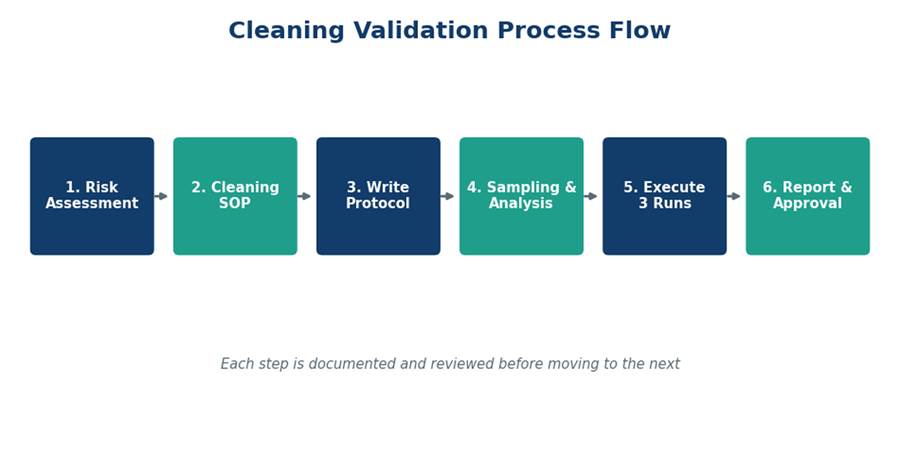
The cleaning validation process moves through clear, documented stages.
Who Needs to Follow Cleaning Validation Rules?
Cleaning validation is not just for large pharmaceutical companies making tablets and capsules. It applies to a wide range of manufacturers, including:
- Pharmaceutical and generic drug manufacturers
- Active pharmaceutical ingredient (API) producers
- Biotech and biologics companies
- Contract manufacturing organizations (CMOs)
- Medical device manufacturers, especially reusable devices
- Nutraceutical and dietary supplement makers, in some regions
If your equipment touches more than one product, batch, or patient, chances are a regulator somewhere expects you to have a cleaning validation program.
Why Cleaning Validation Matters in Pharma Manufacturing
Shared equipment is common in pharmaceutical plants. The same tank, mixer, or tablet press may be used for several different products in the same week. Without proper cleaning validation, small amounts of one drug could end up in the next batch. This can cause:
- Harm to patients from unwanted drug exposure
- Product recalls and lost batches
- Regulatory warning letters or plant shutdowns
- Damage to a company’s reputation and trust
Cleaning validation is a core part of Good Manufacturing Practice (GMP). Health authorities around the world, including the FDA, the European Medicines Agency (EMA), and the World Health Organization (WHO), all expect manufacturers to have a solid cleaning validation program in place.
Cleaning Validation vs Cleaning Verification
People often mix up these two terms, so let’s clear it up in a simple table.
| Point | Cleaning Validation | Cleaning Verification |
| Purpose | Proves the cleaning method works over time | Checks a single cleaning event was successful |
| Number of runs | Usually three consecutive successful runs | One-time check |
| Used for | Routine, repeated production processes | New products, rare campaigns, or changes |
| Documentation | Full protocol and validation report | Simple test record |
Types of Cleaning Validation
Not every cleaning validation project looks the same. Depending on when it is done and why, it falls into one of these categories.
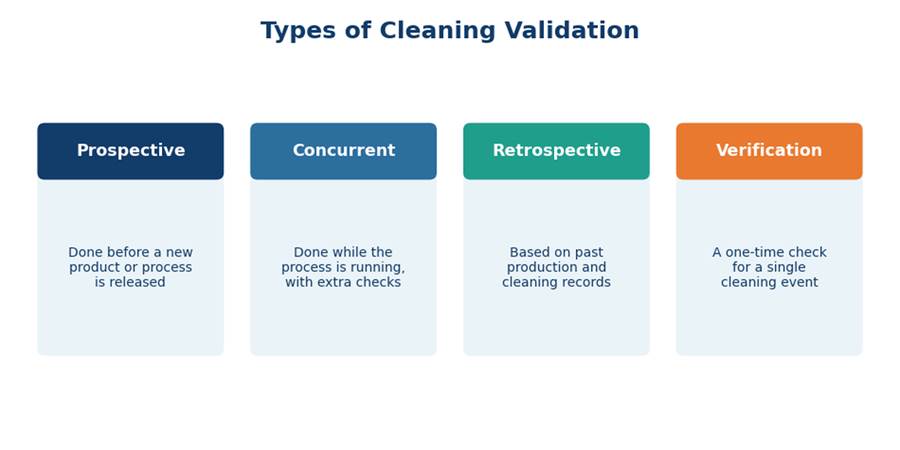
The four common types of cleaning validation used across the industry.
Prospective Cleaning Validation
This is done before a new product, process, or piece of equipment goes into regular use. It is the most common and most preferred approach because it proves the method works before any real batches depend on it.
Concurrent Cleaning Validation
Sometimes a company needs to start production while validation runs are still ongoing. In this case, cleaning validation happens alongside real production, with extra sampling and checks to make sure nothing is released without proof of a clean surface.
Retrospective Cleaning Validation
This method uses historical data from past cleaning and production records. It is rarely accepted anymore by regulators because it does not involve fresh, planned testing, but it may still come up during older equipment reviews.
Cleaning Verification
As shown in the table above, this is a one-off check rather than a full validation study. It is common for new molecules, clinical trial batches, or rarely used equipment.
Regulatory Guidelines for Cleaning Validation
Several health authorities have published guidance on cleaning validation. While the wording differs, the core message is the same: show proof, use science-based limits, and keep good records.
FDA Guidelines on Cleaning Validation
The FDA does not have one single document called “cleaning validation guidance,” but its expectations are built into the FDA Process Validation guidance, the Code of Federal Regulations (21 CFR 211.67), and inspection guides. The FDA expects a written cleaning procedure, a validation protocol, scientific limits for residue, and documented proof that the process works consistently.
ICH Q7 Guidelines
For active pharmaceutical ingredient (API) manufacturers, ICH Q7 sets out GMP expectations, including cleaning procedures, equipment dedication, and validation of cleaning methods for shared equipment.
WHO Guidelines
The World Health Organization GMP guidelines include a dedicated annex on cleaning validation, widely used by manufacturers in countries that follow WHO prequalification standards.
PIC/S Guidelines
The Pharmaceutical Inspection Co-operation Scheme (PIC/S) publishes guidance that many national regulators follow, giving detailed advice on setting acceptance limits and handling shared manufacturing lines.
EMA and Health-Based Exposure Limits
The European Medicines Agency published a guideline on setting health-based exposure limits, which introduced the Permitted Daily Exposure (PDE) approach that is now used worldwide, including by the FDA and WHO.
The Cleaning Validation Process, Step by Step
Now let’s break the process down into steps you can actually follow. Every plant will adjust the details, but the overall flow stays close to this.
Step 1: Risk Assessment
Before writing anything, the team looks at what products share the equipment, how toxic or potent each one is, and which cleaning method is currently used. This step decides which products are the “worst case” for cleaning, meaning the hardest to clean or the most harmful if left behind.
Step 2: Develop the Cleaning Procedure (SOP)
A Standard Operating Procedure (SOP) is written to describe exactly how the equipment should be cleaned: what detergent to use, water temperature, contact time, scrubbing method, rinse steps, and drying method. This SOP is what the validation study will actually test.
Step 3: Write the Cleaning Validation Protocol
The protocol is the master plan. It states the objective, scope, equipment involved, sampling method, acceptance criteria, and how many runs will be done. Nothing in the validation study should happen without first being written into this protocol.
Step 4: Choose the Sampling Method
Teams decide how they will collect samples from equipment surfaces to test for leftover residue. More on this in the sampling section below.
Step 5: Validate the Analytical Method
The lab method used to detect residue (such as HPLC, TOC, or a simple visual check) must itself be proven accurate, sensitive, and repeatable before it is trusted for cleaning validation results.
Step 6: Execute the Validation Runs
Typically, three consecutive cleaning cycles are performed and tested. All three must pass the acceptance criteria for the validation to be considered successful.
Step 7: Review Data and Issue the Report
Once testing is complete, the data is reviewed, compared against the acceptance criteria, and summarized in a final validation report. This report is signed off by quality assurance and kept on file for inspections.
How to Write a Cleaning Validation Protocol
A strong protocol should always include the following sections:
- Purpose and scope of the study
- Equipment and product details covered
- Roles and responsibilities of each team
- Cleaning procedure reference (SOP number)
- Sampling plan and sampling locations
- Analytical method and its validation status
- Acceptance criteria with scientific justification
- Number of runs and pass/fail rules
- Deviation handling process
- Approval signatures
Sampling Methods Used in Cleaning Validation
Once cleaning is done, someone has to check the surfaces. There are three sampling methods used most often.
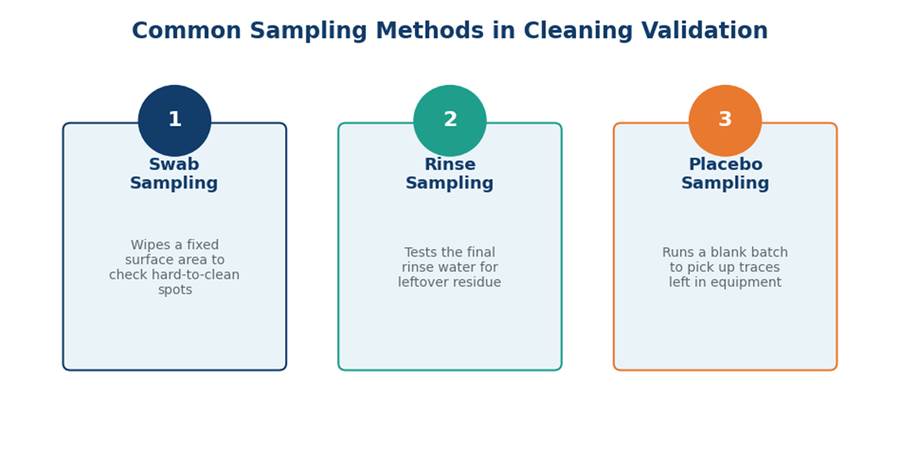
Swab, rinse, and placebo sampling are the three most common methods.
Swab Sampling
A swab is wiped over a set, measured area of the equipment surface, usually a spot that is hard to clean, like a corner or seam. The swab is then tested in the lab. Swab sampling is direct and very good at finding residue in tricky spots, but it can only cover small areas at a time.
Rinse Sampling
Instead of touching the surface, this method tests the final rinse water that flows through or over the equipment. It is useful for covering large or hard-to-reach surfaces such as pipework, but it will not tell you exactly where residue is located.
Placebo Sampling
A dummy batch, made without active ingredient, is run through the equipment after cleaning. Any residue picks up traces from the equipment surface into the placebo batch, which is then tested. This method is less common because it uses extra materials and time.
Acceptance Criteria for Cleaning Validation
Acceptance criteria are the pass or fail lines for a cleaning validation study. Without clear numbers, there is no way to say if a cleaning method “passed” or “failed.” Most companies use a mix of these three approaches and apply whichever one gives the tightest, safest limit.
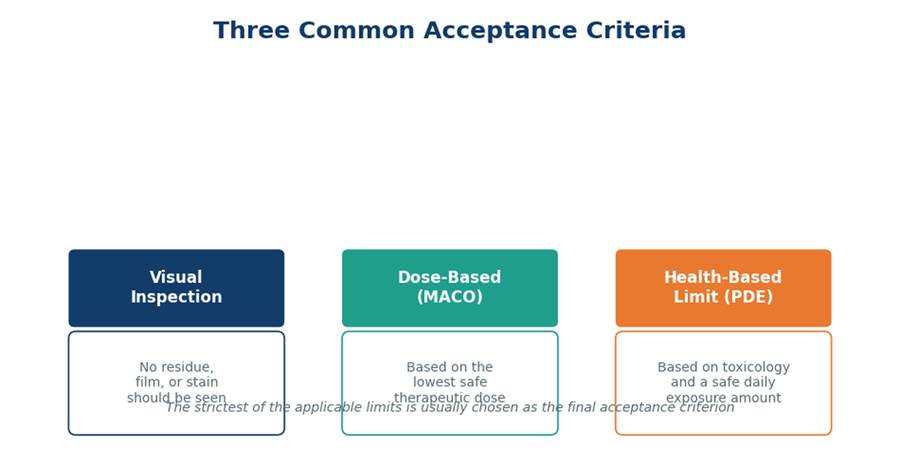
The three most widely used acceptance criteria approaches.
Visual Inspection Criterion
The simplest check: no visible residue, film, spots, or discoloration should remain on the equipment surface. This is always required, even when other numeric limits are also used, because a surface that looks dirty should never pass, no matter what the lab results say.
Dose-Based Criterion (MACO)
MACO stands for Maximum Allowable Carryover. It is based on the smallest therapeutic dose of the next product made on the same equipment, making sure any leftover residue from the previous product stays well below a level that could affect a patient.
The 10 ppm Rule
This older, simple rule says no more than 10 parts per million of the previous product should carry over into the next product. It is easy to calculate but is now mostly used as a backup check alongside more scientific limits.
Health-Based Exposure Limit (PDE/ADE)
This is the modern, preferred approach. It uses toxicology data to calculate a Permitted Daily Exposure (PDE) or Acceptable Daily Exposure (ADE), the highest amount of a substance a person can be exposed to daily without harm. Regulators now favor this method because it is based on real safety science rather than a fixed percentage.
How MACO Is Calculated
While the exact formula can vary, a common way to calculate MACO using the dose-based method looks like this:
MACO (mg) = (Smallest therapeutic dose of next product ÷ Largest daily dose of previous product) × Minimum batch size of next product × Safety factor
Here is a simplified example to show how the numbers might work in practice.
| Factor | Example Value |
| Smallest daily dose of next product | 5 mg |
| Largest daily dose of previous product | 500 mg |
| Minimum batch size of next product | 100,000 tablets |
| Safety factor | 1/1000 |
| Result (MACO) | 1 mg total carryover allowed |
This number is then divided by the shared surface area to get a per-swab or per-surface limit, which becomes the final acceptance criterion for the study.
Grouping and Bracketing Approach
Large plants may make dozens of products on the same line. Testing every single product combination would take forever, so most companies use a grouping or bracketing approach instead. Products are grouped by how similar they are in formulation, dose, solubility, and toxicity. From each group, the “worst case” product, the one hardest to clean or most harmful if left behind, is chosen to represent the whole group in the validation study.
If the worst case product passes cleaning validation, the assumption is that every other product in that group will also be safely cleaned by the same procedure. This saves time and resources while still giving strong scientific proof, as long as the grouping logic is well documented and justified.
How to Choose the Worst Case Product
Several factors are usually scored and compared across all products sharing the equipment:
- Solubility of the active ingredient in the cleaning agent
- Toxicity or potency of the active ingredient
- Difficulty of physically removing the residue from equipment surfaces
- Dose strength and daily therapeutic dose
- Batch size and surface area involved in manufacturing
A simple scoring matrix is often used, where each product gets a rating for these factors, and the product with the highest overall risk score becomes the worst case for that equipment train.
Selecting the Right Cleaning Agent
The cleaning agent, whether it is plain water, a detergent, or a solvent, has a big effect on how well cleaning validation results turn out. Choosing the right agent is not just about what removes residue best; it is also about what is safe, easy to rinse away, and compatible with the equipment material.
Things to Consider When Choosing a Cleaning Agent
- Does it fully dissolve or break down the product residue?
- Is it easy to rinse off completely, leaving no residue of its own?
- Is it compatible with gaskets, seals, and equipment surfaces?
- Is there a simple, sensitive test method to detect it if any is left behind?
- Is it safe for operators to handle and store?
Many plants use purified water alone for simple, water-soluble products, and reserve stronger detergents for stubborn or oily residues. Whatever is chosen, the cleaning agent itself must also be tested for and shown to be below a safe limit during the validation study, not just the product residue.
Documentation and Record Keeping
Good documentation is the backbone of any cleaning validation program. Inspectors do not just look at whether equipment is clean; they look at whether there is a clear paper trail proving it was cleaned, tested, and approved the right way, every time.
A well-run program usually keeps the following records organized and easy to find:
- Approved cleaning SOPs, including revision history
- Signed cleaning validation protocols and final reports
- Raw data from sampling and lab testing
- Equipment cleaning logs for each batch
- Training records showing operators are qualified to clean equipment
- Deviation and investigation reports, if any results fell outside limits
Many companies now use electronic systems to track cleaning records instead of paper logs. This makes it easier to spot trends, flag missed cleanings, and pull records quickly during an inspection, but the same level of detail and sign-off is still expected either way.
Cleaning Validation in Biotech and Medical Device Manufacturing
While most cleaning validation guidance is written with pharmaceutical tablets and liquids in mind, the same basic ideas apply to biotech and medical device manufacturing too, with a few extra points to keep in mind.
Biotech and Biologics
Biotech products often involve large protein molecules and cell culture processes. Cleaning validation here focuses heavily on removing biological residues, host cell proteins, and any cleaning agents used on single-use or reusable bioreactor systems. Bioburden and endotoxin testing are usually added alongside chemical residue testing.
Medical Devices
For medical devices, especially reusable surgical instruments, cleaning validation focuses on removing blood, tissue, and other biological soil, along with any residue from the manufacturing process itself, such as machining oils or polishing compounds. Standards like ISO 17664 guide how device manufacturers write cleaning instructions that can later be validated by hospitals and sterilization centers.
Common Challenges in Cleaning Validation and How to Handle Them
- Choosing the correct “worst case” product when many products share equipment
- Getting consistent swab recovery rates from rough or hard-to-reach surfaces
- Keeping analytical methods sensitive enough for very low limits
- Managing cleaning validation for highly potent or hormonal products
- Re-validating after equipment changes, new products, or SOP updates
- Maintaining consistent training so operators clean the same way every time
These challenges rarely show up one at a time. A change in raw material supplier, for example, can quietly shift how a product dissolves during cleaning, which then affects swab recovery, which then affects whether the lab result meets the acceptance criterion. This is why many quality teams review cleaning validation data on a regular schedule rather than only when something goes wrong. Catching a small drift early is far easier than explaining a failed batch later.
Highly potent products deserve special mention. When the therapeutic dose is measured in micrograms rather than milligrams, the acceptance criteria for cleaning become extremely tight, sometimes near the limit of what standard lab equipment can even detect. In these cases, many companies choose to dedicate equipment entirely to that product line rather than relying on cleaning validation alone. Dedication removes the cross-contamination risk completely, though it comes at the cost of extra equipment and floor space.
Cleaning Validation Lifecycle Approach
Modern guidance encourages a lifecycle view of cleaning validation, similar to the approach used for process validation. Instead of treating validation as a one-time event, it becomes an ongoing cycle.
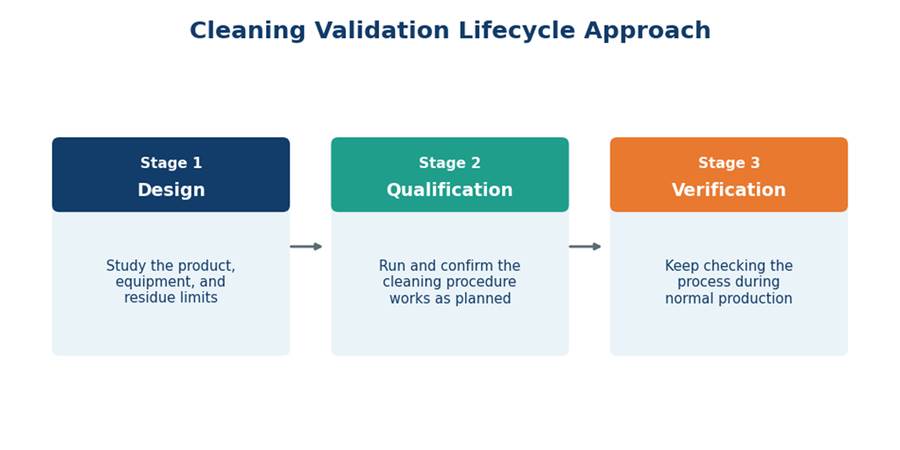
The three-stage lifecycle approach to cleaning validation.
Stage 1: Design
The team studies the product, the equipment, and sets the scientific basis for residue limits before any testing begins.
Stage 2: Qualification
This is the classic validation stage, where cleaning runs are executed and tested to prove the method works as designed.
Stage 3: Continued Verification
Even after validation, cleaning performance is periodically checked during normal production to make sure it keeps meeting the same standard over time.
Cleaning Validation Checklist
Before closing out any cleaning validation project, it helps to run through a simple checklist. Use this as a quick sanity check before submitting a report for approval.
| Item | Confirmed? |
| Risk assessment completed and worst case product identified | Yes / No |
| Cleaning SOP written, reviewed, and approved | Yes / No |
| Protocol approved before execution began | Yes / No |
| Sampling method chosen and locations mapped out | Yes / No |
| Analytical method validated for sensitivity and accuracy | Yes / No |
| Acceptance criteria calculated and justified | Yes / No |
| Three consecutive runs executed and passed | Yes / No |
| Deviations, if any, investigated and closed | Yes / No |
| Final report reviewed and signed by quality assurance | Yes / No |
Tools and Software Used in Cleaning Validation
Many manufacturers now use digital tools to plan and track cleaning validation instead of relying only on paper files. These tools do not replace the science behind validation, but they make the process faster and easier to manage.
MACO Calculation Software
Spreadsheets or dedicated software can automatically calculate MACO and PDE-based limits once product data such as dose, batch size, and toxicology values are entered. This cuts down on manual calculation errors.
Electronic Batch and Cleaning Records
Electronic systems track when equipment was cleaned, by whom, and whether it passed inspection, replacing paper logbooks. This makes it much easier to spot a missed cleaning step or an overdue re-validation date.
Laboratory Information Management Systems (LIMS)
LIMS software stores and organizes lab results from swab and rinse samples, linking them directly back to the batch and equipment being tested, which speeds up data review and report writing.
Best Practices for a Strong Cleaning Validation Program
- Base your acceptance limits on solid, documented science, not guesswork
- Keep cleaning SOPs detailed enough that any trained operator gets the same result
- Train and re-train staff regularly on cleaning steps
- Use validated analytical methods, not shortcuts
- Review and update your cleaning validation program whenever equipment or products change
- Keep records organized and ready for inspection at any time
Frequently Asked Questions (FAQ)
What is the main goal of cleaning validation?
The main goal is to prove, with real data, that a cleaning method removes product residue, cleaning agents, and microbial contamination down to a safe and agreed level, protecting patients from cross-contamination.
How many runs are needed for cleaning validation?
Most companies run three consecutive successful cleaning cycles to demonstrate consistency, though this can vary based on risk assessment and company policy.
What is the difference between cleaning validation and cleaning verification?
Cleaning validation proves a method works consistently over multiple runs, while cleaning verification checks that a single cleaning event was successful. Validation is for routine processes; verification is for one-off events.
What is MACO in cleaning validation?
MACO stands for Maximum Allowable Carryover. It is the highest amount of residue from one product that can safely carry over into the next product made on the same equipment.
Why is health-based exposure limit (PDE) preferred over the 10 ppm rule?
PDE is based on actual toxicology data for each specific product, making it more scientific and accurate than the older 10 ppm rule, which applies the same fixed percentage to every product regardless of its toxicity.
How often should cleaning validation be repeated?
Cleaning validation should be reviewed whenever there is a change in product, equipment, cleaning agent, or procedure, and periodically re-checked as part of ongoing lifecycle monitoring even without changes.
Can cleaning validation fail? What happens next?
Yes, a cleaning run can fail if test results come back above the acceptance criteria. When this happens, the deviation is investigated, the root cause is identified, the cleaning procedure may be adjusted, and the validation runs are repeated until three consecutive passes are achieved.
Does every piece of equipment need its own cleaning validation study?
Not always. Equipment that is similar in design, material, and use can sometimes be grouped together using a bracketing approach, where validating the worst case equipment train covers the rest of the group, as long as the similarity is well justified and documented.
Conclusion
Cleaning validation is one of those behind-the-scenes activities that patients never see, but it plays a direct role in keeping medicines safe. It is not just paperwork; it is proof, backed by real testing, that your equipment is truly clean before the next batch begins. By following a clear process, choosing the right sampling method, setting science-based acceptance criteria, and staying aligned with FDA and other global guidelines, manufacturers can build a cleaning validation program that protects patients and stands up to any inspection.
Similar Post
- Pharma QA vs QC Difference
- Top 100 Pharma QA Interview Questions and Answers
- How to Introduce Yourself in Job Interviews
- Gas Chromatography: Principles, Working, Components, Applications, Advantages & Limitations
- UV Spectroscopy: Principle, Instrumentation, Working, Applications, Advantages & Limitations (Complete Guide)
- Fluid Bed Dryer (FBD): Working Principle, Diagram, Operation, Advantages, and Disadvantages
- Table Compression Machine: Complete Guide to Working Principle, Types, Parts, Applications, and Maintenance
- Tablet Coating Machine Explained: Benefits, Working Principle & Applications