Learn how pharmaceutical capsule manufacturing works, from raw materials to filling, sealing, and quality control, plus the equipment and GMP rules behind it.
Introduction
Every time you swallow a capsule, you’re holding the result of a highly controlled manufacturing journey. Pharmaceutical capsule manufacturing is the process of turning raw gelatin or plant-based materials, active drug ingredients, and precise engineering into a small, safe, and easy-to-swallow dosage form.
It sounds simple from the outside. Pop open a capsule shell, fill it with medicine, and seal it shut. But behind that simple idea sits a tightly regulated system of equipment, raw material testing, environmental controls, and quality checks.
I’ve spent years around pharmaceutical production floors, and one thing always stands out: capsules look identical on the shelf, but a huge amount of science goes into making sure every single one matches the last. A half-milligram difference in fill weight, a tiny crack in a shell, or a moisture problem during drying can turn into a serious quality issue.
In this guide, we’ll walk through the entire pharmaceutical capsule manufacturing process step by step. You’ll learn about the different types of capsules, the raw materials used, the machines that do the work, and the quality control checkpoints that keep patients safe. Whether you’re a pharmacy student, a quality assurance professional, or just curious about how your daily supplement is made, this article breaks it all down in plain English.
What Is Pharmaceutical Capsule Manufacturing?
Quick Answer: Pharmaceutical capsule manufacturing is the industrial process of producing empty capsule shells and filling them with a measured dose of an active drug ingredient. It covers shell formation, drying, filling, sealing, polishing, inspection, and packaging, all performed under strict GMP guidelines to ensure safety and dosage accuracy.
Pharmaceutical capsule manufacturing combines two separate industries working together. One side makes the empty capsule shell, usually from gelatin or a plant-based polymer. The other side, often a different company entirely, fills that shell with the actual medicine.
Capsules are popular because they’re easy to swallow, mask bad tastes, and can hold powders, granules, pellets, or liquids. They also allow drug makers to combine multiple ingredients inside one shell, something tablets can’t always do as easily.
The entire process sits inside a pharmaceutical manufacturing environment that follows Good Manufacturing Practice (GMP) rules. These rules exist to protect patients, and regulators like the U.S. Food and Drug Administration (FDA) inspect facilities to confirm they’re being followed.
Types of Pharmaceutical Capsules
Not all capsules are built the same way. The type of capsule shell determines how it’s manufactured and what it can hold.
Hard Gelatin Capsules
Hard gelatin capsules are the two-piece capsules most people picture when they hear the word “capsule.” They have a cap and a body that slide together, similar to a tiny telescope.
These capsules are made mostly of gelatin, water, and sometimes coloring agents. They’re used to hold dry powders, granules, tiny pellets, or even mini-tablets.
Hard gelatin capsules are popular in generic drug manufacturing because they’re cost-effective and can be filled at very high speeds.
Soft Gelatin Capsules
Soft gelatin capsules, often called softgels, are one-piece, sealed capsules. Unlike hard capsules, the shell and the fill are formed and sealed in a single step.
Soft gelatin capsules are the go-to choice for oils, suspensions, and liquid-based medicines. Think fish oil, vitamin E, and many cough and cold liquid-filled capsules.
Because the shell material is more flexible, it can be shaped into ovals, rounds, or twist shapes, which is why softgels look so different from brand to brand.
Vegetarian and HPMC Capsules
Not every patient can or wants to take gelatin, which comes from animal sources. That’s where vegetarian capsules come in.
These are made from HPMC (hydroxypropyl methylcellulose) or pullulan instead of gelatin. They behave similarly to hard gelatin capsules but appeal to vegetarian, vegan, and religious dietary needs.
HPMC capsules also tend to have lower moisture content, which can help with moisture-sensitive drugs.
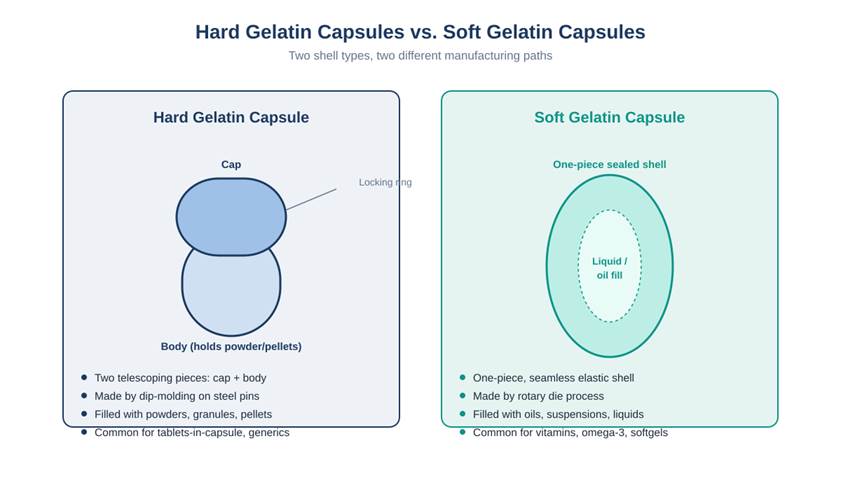
Hard gelatin capsule versus soft gelatin capsule structure comparison diagram
Raw Materials Used in Capsule Manufacturing
Every batch of empty capsules starts with a specific mix of raw materials. Getting this mix right affects the strength, clarity, and stability of the final shell.
The main raw materials include:
- Gelatin – derived from animal collagen (bovine or porcine), the traditional shell-forming material
- HPMC or pullulan – plant-based alternatives for vegetarian capsules
- Purified water – used to dissolve the gelling agent into a workable solution
- Plasticizers – like glycerin or sorbitol, added mainly to soft gelatin capsules for flexibility
- Colorants – FDA or EMA-approved dyes and pigments used for branding and identification
- Opacifiers – such as titanium dioxide, used to make capsules opaque and protect light-sensitive drugs
- Preservatives – added in small amounts to soft gelatin capsules to prevent microbial growth
Every raw material must be tested against pharmacopeial standards, such as those published by the United States Pharmacopeia (USP), before it’s approved for use.
Callout: Why Raw Material Testing Matters A single contaminated batch of gelatin can affect thousands of finished capsules. That’s why incoming raw materials are quarantined and tested before they’re ever released to production.
Step-by-Step Pharmaceutical Capsule Manufacturing Process
Now let’s walk through the full pharmaceutical capsule manufacturing process, from raw material to finished, packaged product.
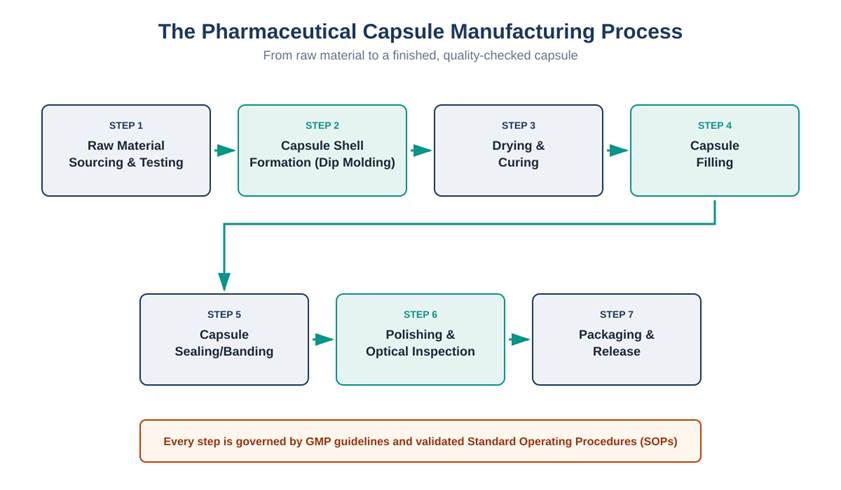
Seven-step pharmaceutical capsule manufacturing process flow diagram
Step 1: Raw Material Sourcing and Testing
Manufacturing starts long before any equipment turns on. Raw materials arrive at the facility, get sampled, and go through identity and quality testing in the lab. Nothing moves forward until it passes.
Step 2: Capsule Shell Formation
For hard gelatin capsules, this happens through a dip-molding process. Stainless steel pins are dipped into a warm gelatin solution, coated, and slowly rotated to spread the coating evenly.
For soft gelatin capsules, a rotary die process is used instead. Two continuous ribbons of gelatin film come together around a liquid fill, and rotating dies cut and seal the capsule in one motion.
Step 3: Drying and Curing
Freshly formed capsule shells contain a lot of moisture. They pass through a controlled drying tunnel where temperature and humidity are carefully managed.
Dry too fast, and the shells crack. Dry too slow, and you risk microbial growth. This is one of the most delicate steps in the capsule manufacturing process.
Step 4: Capsule Filling Process
Once the empty shells are ready (or, for softgels, once the shell and fill happen together), it’s time for the capsule filling process.
A capsule filling machine takes empty hard capsules, separates the cap from the body, and doses a precise amount of powder, pellets, or liquid into the body before rejoining the cap.
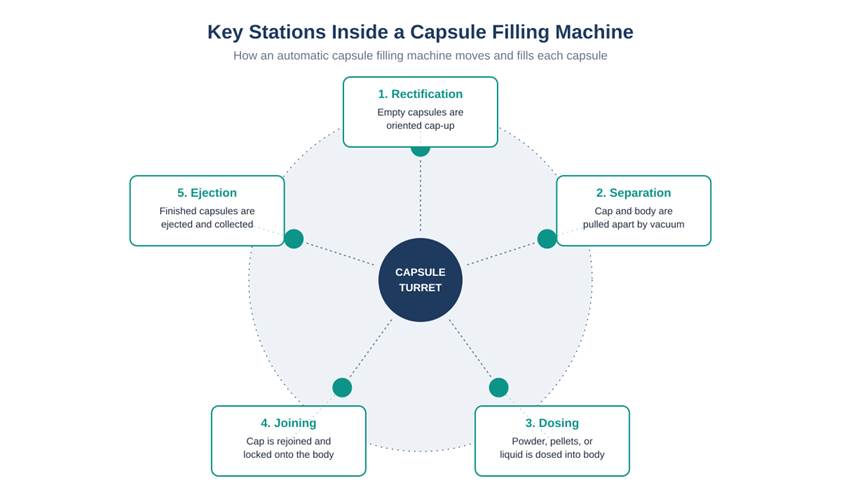
Diagram of the main stations inside a capsule filling machine
Quick Answer: Pharmaceutical capsules are manufactured by forming empty shells through dip-molding or rotary die processes, drying them, then filling them on a capsule filling machine that doses powder, pellets, or liquid before sealing, polishing, inspecting, and packaging the finished capsules.
Step 5: Capsule Sealing and Banding
Hard gelatin capsules need a way to stay closed after filling. Manufacturers use liquid gelatin banding or a heat-sealing method to lock the cap and body together, preventing them from separating during shipping or accidental tampering.
Step 6: Capsule Polishing
Filled capsules often carry a light dusting of powder on the outside. A polishing machine gently tumbles the capsules to remove excess powder and give them a clean, glossy finish.
Step 7: Capsule Inspection
Every batch goes through capsule inspection, either by automated optical sorting machines or, in smaller facilities, trained visual inspectors. This step catches cracks, dents, discoloration, and underfilled or overfilled capsules.
Equipment Used in Pharmaceutical Capsule Manufacturing
Quick Answer: Common equipment includes capsule filling machines, dip-molding shell-forming lines, drying tunnels, banding and sealing machines, polishing drums, and automated optical sorting systems. Together, this pharmaceutical equipment turns raw materials into inspected, ready-to-package capsules.
Capsule Filling Machines
These range from small semi-automatic tabletop units used in research labs to fully automatic rotary machines that can fill over 150,000 capsules per hour in large-scale drug manufacturing plants.
Polishing and Dedusting Machines
These machines use soft brushes or rotating drums to clean the outer surface of each capsule without damaging the shell.
Sorting and Inspection Systems
Modern facilities use camera-based vision systems that photograph every single capsule from multiple angles, comparing it against a reference image in milliseconds.
Printing Machines
Many capsules are printed with a logo, strength, or identification code. Offset or laser printing machines apply this branding after the polishing stage.
Automation in Capsule Production
Automation has changed capsule production dramatically over the last two decades. Older facilities relied heavily on manual filling and visual inspection. Today, most mid-to-large manufacturers use fully integrated lines.
Automated systems bring several benefits:
- Higher speed – automatic lines can outproduce manual filling by ten times or more
- Better consistency – machines don’t get tired, so fill weight stays more uniform
- Data logging – every batch parameter is recorded automatically for audits
- Reduced contamination risk – less human handling means fewer contamination points
That said, automation isn’t a replacement for good quality systems. It’s a tool that works alongside trained operators, validated processes, and strong quality control in pharmaceuticals.
Quality Control in Pharmaceutical Capsule Manufacturing
Quick Answer: Quality control is important in capsule manufacturing because it confirms every capsule contains the correct dose, is free of physical defects, and is safe for patients to consume. Without it, dosing errors, contamination, or shell defects could reach the market and put patient health at risk.
Quality doesn’t happen at the end of the line. It’s built into every stage of the process, from the raw material warehouse to the final packaged carton.
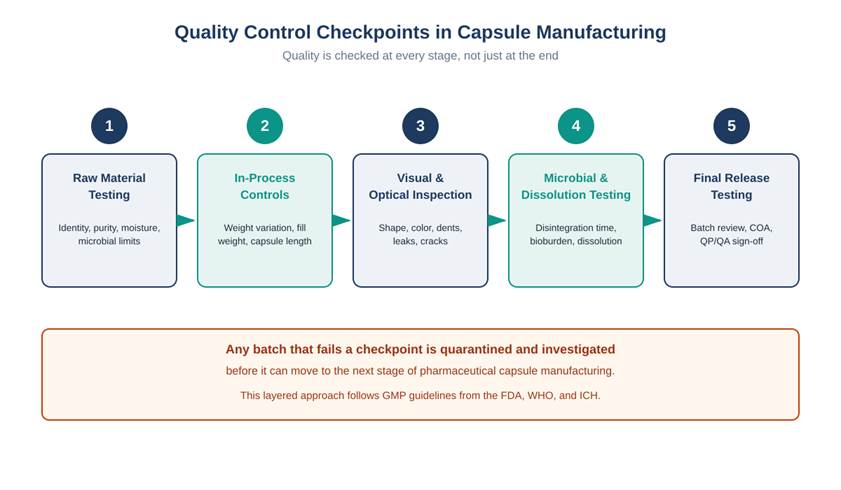
Quality control checkpoints across the capsule manufacturing process
In-Process Quality Checks
During production, operators pull samples at regular intervals to check:
- Fill weight variation – making sure each capsule contains the correct dose
- Capsule length and locking – confirming the cap and body are properly joined
- Disintegration time – testing how quickly the shell breaks down in simulated stomach conditions
- Moisture content – too much or too little moisture affects shell stability
Finished Product Testing
Once a batch is complete, the quality control lab runs a full set of finished-product tests, including dissolution testing, microbial limit testing, and assay testing to confirm the correct amount of active ingredient is present.
GMP and Regulatory Requirements
Pharmaceutical capsule manufacturing must follow GMP guidelines set out by regulators. In the United States, this means following the FDA’s current Good Manufacturing Practice (cGMP) regulations. Internationally, many companies also align with guidance from the World Health Organization (WHO) and the International Council for Harmonisation (ICH).
These manufacturing standards cover everything from facility design and cleanroom classification to operator training, equipment calibration, and document control. Regulators such as the European Medicines Agency (EMA) conduct inspections to confirm ongoing compliance.
Callout: The Cost of Skipping Quality Control A single unreported deviation can lead to a product recall, regulatory warning letters, or worse, patient harm. Quality control isn’t a formality. It’s the backbone of trust in drug manufacturing.
Common Manufacturing Problems and Solutions
Even well-run facilities run into production challenges. Here are some of the most common ones, and how manufacturers usually solve them.
| Problem | Likely Cause | Common Solution |
| Capsule shells crack | Drying too fast or humidity too low | Adjust drying tunnel temperature and humidity curve |
| Capsules stick together | Excess moisture or static charge | Improve dedusting and control ambient humidity |
| Fill weight variation | Poor powder flow or worn dosing parts | Improve powder flow with excipients; recalibrate machine |
| Capsules split open | Weak banding or seal | Increase banding solution quality and sealing temperature |
| Visible specks or spots | Contaminated raw material or dust | Strengthen incoming material testing and cleanroom controls |
| Print smudging | Incorrect ink drying time or machine speed | Adjust printing machine speed and ink formulation |
Practical example: A mid-size manufacturer noticed a spike in split capsules during a humid summer month. After tracing the issue, the quality team found the banding solution’s viscosity had drifted outside spec due to warehouse temperature swings. Moving the banding solution to a climate-controlled storage area solved the problem within two batches.
Capsule Packaging Methods
Once capsules pass inspection, they move into capsule packaging. This stage protects the product from moisture, light, and physical damage.
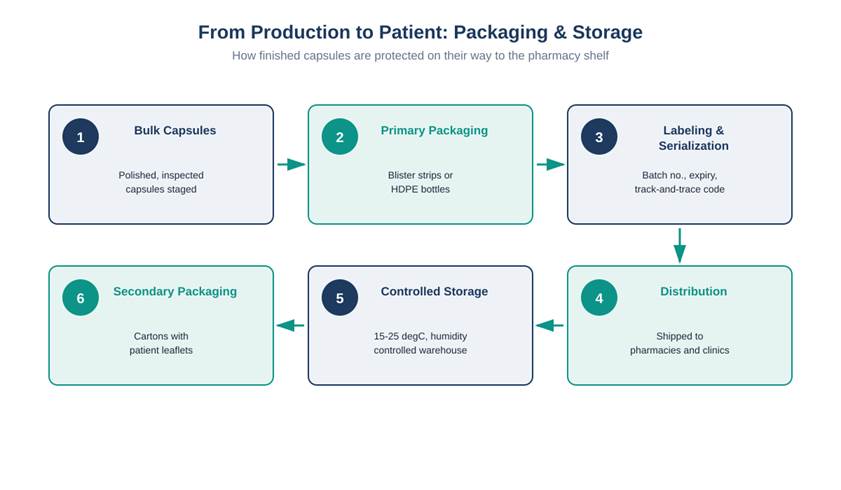
Packaging and storage flow from bulk capsules to distribution
Common packaging formats include:
- Blister packaging – individual capsules sealed between foil and formed plastic, popular for prescription drugs
- HDPE bottles – rigid plastic bottles, often used for over-the-counter supplements and generics, sometimes with a desiccant packet
- Strip packaging – similar to blisters but made from foil-to-foil sealing, common in many international markets
- Unit-dose packaging – individually wrapped capsules used in hospitals for controlled dispensing
Labeling is a critical part of this stage. Batch numbers, expiry dates, and increasingly, serialization codes for track-and-trace requirements, are all applied here.
Storage Recommendations
How capsules are stored after packaging affects how long they stay effective. Most capsules should be stored:
- Between 15°C and 25°C (room temperature), unless otherwise specified on the label
- Away from direct sunlight and heat sources
- In a low-humidity environment, since gelatin shells absorb moisture from the air
- In their original container, which is often designed to block light and moisture
Some capsules, especially certain probiotics or biologics-based products, require refrigeration. Always follow the storage instructions on the product label or package insert.
Sustainability in Pharmaceutical Manufacturing
Sustainability is becoming a bigger conversation in pharmaceutical manufacturing, including capsule production.
Manufacturers are exploring:
- Plant-based capsule shells to reduce reliance on animal-derived gelatin
- Recyclable packaging materials for cartons and secondary packaging
- Energy-efficient drying tunnels that reduce power consumption
- Water recycling systems in gelatin processing plants
- Reduced solvent use in printing and coating processes
These changes take time because every material change in a regulated drug product usually requires re-validation and, in many cases, regulatory approval before it can be used commercially.
Future Trends in Capsule Manufacturing
The next decade of capsule manufacturing is likely to bring some interesting shifts:
- Continuous manufacturing – replacing traditional batch production with a non-stop, integrated process that can improve consistency and reduce production time
- AI-powered visual inspection – smarter defect detection that learns from past inspection data
- 3D-printed capsules – early-stage research into personalized dosage forms printed on demand
- Smart packaging – blister packs with embedded sensors that track patient adherence
- Novel shell materials – further development of allergen-free and faster-dissolving shell polymers
None of these trends remove the need for strong quality control. If anything, they raise the bar, since new technology still has to prove it meets the same manufacturing standards as traditional methods.
Best Practices and Common Mistakes to Avoid
Best Practices
- Validate every piece of equipment before it’s used in production
- Train operators regularly, not just once during onboarding
- Keep raw material suppliers audited and approved
- Maintain tight environmental controls in filling and drying areas
- Document every deviation, no matter how small it seems
Common Mistakes to Avoid
- Skipping in-process checks to save time during high-demand periods
- Ignoring small humidity or temperature drifts in storage areas
- Using unqualified raw material suppliers to cut costs
- Delaying equipment calibration schedules
- Treating quality control as a final checkpoint instead of a continuous process
Summary Table
| Stage | Purpose | Key Equipment |
| Raw Material Testing | Confirm identity and purity | Lab testing instruments |
| Shell Formation | Create empty capsule shells | Dip-molding or rotary die machines |
| Drying | Remove excess moisture | Drying tunnels |
| Filling | Add measured dose of drug | Capsule filling machine |
| Sealing/Banding | Prevent capsule from opening | Banding or heat-sealing machine |
| Polishing | Clean outer capsule surface | Polishing drums |
| Inspection | Detect physical defects | Optical sorting systems |
| Packaging | Protect and label finished product | Blister or bottling lines |
Comparison Table: Hard Gelatin vs. Soft Gelatin Capsules
| Feature | Hard Gelatin Capsules | Soft Gelatin Capsules |
| Structure | Two pieces (cap and body) | One-piece sealed shell |
| Common Fill | Powders, granules, pellets | Oils, liquids, suspensions |
| Manufacturing Method | Dip-molding | Rotary die process |
| Typical Use | Generic drugs, supplements | Vitamins, omega-3s, liquid medicines |
| Shell Flexibility | Rigid | Flexible/elastic |
| Filling and Shell Forming | Two separate steps | Combined into one step |
Key Takeaways
- Pharmaceutical capsule manufacturing involves forming empty shells, drying, filling, sealing, polishing, inspecting, and packaging under strict GMP guidelines.
- Hard gelatin capsules and soft gelatin capsules use different manufacturing methods and hold different types of fill material.
- A capsule filling machine is the centerpiece of the filling process, dosing precise amounts of powder, pellets, or liquid.
- Quality control happens at every stage, not just at the end, covering raw materials, in-process checks, and finished product testing.
- Regulatory bodies like the FDA, WHO, EMA, USP, and ICH all shape the manufacturing standards capsule producers must follow.
- Automation, sustainability, and new shell materials are shaping the future of capsule production.
Conclusion
Pharmaceutical capsule manufacturing is far more detailed than it looks from the outside. What starts as raw gelatin or plant-based polymer and a precise dose of active ingredient goes through shell formation, drying, filling, sealing, polishing, and layer after layer of quality control before it ever reaches a pharmacy shelf.
Understanding this process helps explain why capsules cost what they do, why quality control matters so much, and why regulatory bodies keep such a close eye on pharmaceutical manufacturing facilities. Every capsule you take has been tested, checked, and rechecked long before it reached you.
Whether you work in the industry or you’re simply curious about how your medicine is made, hopefully this guide gave you a clear, practical picture of pharmaceutical capsule manufacturing from start to finish.
FAQs
1. What is pharmaceutical capsule manufacturing? It’s the process of producing empty capsule shells and filling them with a precise dose of an active drug ingredient, following GMP guidelines to ensure safety, consistency, and accurate dosing.
2. What is the difference between hard and soft gelatin capsules? Hard gelatin capsules have two pieces and typically hold powders or pellets. Soft gelatin capsules are one-piece, sealed shells usually used for oils and liquids.
3. What raw materials are used to make capsule shells? Common raw materials include gelatin or HPMC, purified water, plasticizers, colorants, opacifiers, and sometimes preservatives, depending on the capsule type.
4. How does a capsule filling machine work? It separates the cap from the body of an empty capsule, doses a measured amount of powder, pellets, or liquid into the body, and then rejoins the cap before ejecting the finished capsule.
5. Why is quality control important in capsule manufacturing? Quality control confirms each capsule has the correct dose and is free of defects. Without it, dosing errors or contaminated products could reach patients.
6. What are GMP guidelines? GMP, or Good Manufacturing Practice, is a set of regulatory standards covering facility design, equipment, staff training, and documentation to ensure pharmaceutical products are made safely and consistently.
7. Can capsules be made without gelatin? Yes. Vegetarian capsules made from HPMC or pullulan are widely used as gelatin alternatives for people with dietary or religious restrictions.
8. How are capsules inspected for defects? Most large manufacturers use automated optical sorting machines that photograph and analyze every capsule. Smaller facilities may still use trained visual inspectors.
9. How should finished capsules be stored? Most capsules should be stored at room temperature, away from light, heat, and humidity, in their original packaging unless the label states otherwise.
10. What packaging methods are used for capsules? Common methods include blister packaging, HDPE bottles, strip packaging, and unit-dose packaging, each chosen based on the product and target market.
External References
- U.S. Food and Drug Administration (FDA) – Current Good Manufacturing Practice (cGMP) Regulations
- World Health Organization (WHO) – Good Manufacturing Practices
- United States Pharmacopeia (USP) – Official USP Standards
- European Medicines Agency (EMA) – Good Manufacturing Practice Overview
- International Council for Harmonisation (ICH) – Quality Guidelines
Similar Post
- Fluid Bed Dryer (FBD): Working Principle, Diagram, Operation, Advantages, and Disadvantages
- Table Compression Machine: Complete Guide to Working Principle, Types, Parts, Applications, and Maintenance
- Tablet Coating Machine Explained: Benefits, Working Principle & Applications
- Cleaning Validation: Complete Guide to Process, Protocol, Acceptance Criteria, and FDA Guidelines