If you work in a lab, study chemistry, or want to crack a QC/QA job interview, you have probably run into the word HPLC more times than you can count. It sounds technical, but the idea behind it is actually pretty simple once you see it in plain terms. In this guide, we will walk through the HPLC principle, the instrumentation that makes it work, how a run actually happens step by step, the different types of HPLC, real-world applications, validation, common troubleshooting problems, and a list of interview questions you can use to prepare. No jargon-heavy textbook talk — just clear, simple explanations.
By the end of this article, you will understand HPLC well enough to explain it to a colleague, write about it, or answer questions confidently in an interview.
Why HPLC Matters So Much in Modern Labs
Before HPLC became common, chemists relied on slower, less precise separation techniques such as open-column chromatography or thin-layer chromatography. Those older methods worked, but they were slow, hard to repeat exactly, and not very sensitive. HPLC changed that by adding pressure, tighter columns, and automated detection, which made results faster, sharper, and far more consistent from one run to the next.
Today, almost every regulated industry depends on HPLC data at some point — whether it’s a pharmaceutical batch release, a food safety check, or a water quality report. That is part of why understanding HPLC principle, instrumentation, and validation is such a valuable skill for anyone working in a lab.
What Is HPLC?
HPLC stands for High Performance Liquid Chromatography (some people also read it as High Pressure Liquid Chromatography). It is a lab technique used to separate, identify, and measure the different compounds mixed inside a liquid sample.
Think of it like this: you have a mixture of several ingredients all mixed together in water, and you want to know exactly what is in there and how much of each one. HPLC pushes that liquid sample through a narrow tube (the column) packed with tiny particles, under high pressure. Each compound in the mixture moves through the column at a slightly different speed, so they come out separately at the other end. A detector then records each one as it comes out, and this record is called a chromatogram.
HPLC is used everywhere — pharmaceutical companies use it to check drug purity, food companies use it to test for contamination, and environmental labs use it to check water quality. It is one of the most trusted analytical tools in modern laboratories.
What makes HPLC especially useful is that it does three jobs at once. It separates the mixture into its individual parts, it identifies what each part is (by comparing retention times against known reference standards), and it quantifies how much of each compound is present. Very few lab techniques can do all three at this level of accuracy in a single run.
HPLC vs Traditional Column Chromatography
In old-style column chromatography, gravity alone pulls the solvent through a loosely packed column, which can take hours and gives fairly rough separation. HPLC uses a mechanical pump to force the solvent through a tightly packed column at high pressure, which packs far more separating power into a much smaller column and a much shorter run time. That extra pressure is really the whole reason behind the name “High Performance” (or “High Pressure”) Liquid Chromatography.
For a deeper technical background, Waters Corporation’s beginner’s guide to HPLC is a great starting point written by one of the pioneers of the technology.
HPLC Principle
The HPLC principle is based on separation by affinity. Every HPLC system has two phases:
- Stationary phase — the tiny solid particles packed inside the column that stay still.
- Mobile phase — the liquid solvent that keeps moving and carries the sample along with it.
As the sample travels with the mobile phase through the column, different compounds “stick” to the stationary phase by different amounts. A compound that sticks more spends more time inside the column and comes out later. A compound that barely sticks moves through quickly and comes out early. This difference in speed is what separates the mixture into individual compounds.
Key Terms You Should Know
| Term | Simple Meaning |
| Retention Time (tR) | The time a compound takes to travel through the column and reach the detector. |
| Stationary Phase | The solid packing material inside the column. |
| Mobile Phase | The liquid solvent that carries the sample through the column. |
| Resolution | How well two neighbouring peaks are separated from each other. |
| Theoretical Plates (N) | A number that shows how efficient the column is at separating compounds. |
| Peak | The bump on the chromatogram that represents one compound. |
In short: same mixture, same column, same solvent — but each compound behaves differently because of its own chemistry. That difference is what HPLC principle is built on.
Partition Equilibrium: The Science Behind the Separation
At a deeper level, each compound is constantly moving back and forth between the mobile phase and the stationary phase as it travels down the column. This back-and-forth is called partition equilibrium. A compound that prefers the stationary phase spends more time “parked” on the particles, so it lags behind. A compound that prefers the mobile phase keeps moving and exits sooner. Millions of these tiny exchanges happen along the length of the column, and they add up to a clean, measurable difference in retention time by the time the compounds reach the detector.
This is also why changing the mobile phase composition, the column chemistry, or the temperature can shift how compounds separate — you are essentially changing how strongly each compound prefers one phase over the other.
HPLC Instrumentation
An HPLC system is made up of a handful of connected parts. Each one plays a specific role, and together they turn a liquid sample into a readable chromatogram. Understanding HPLC instrumentation piece by piece makes the whole system far less intimidating, because at the end of the day it is just a chain of simple jobs — hold the solvent, remove air, push it forward, add the sample, separate it, and record what comes out.
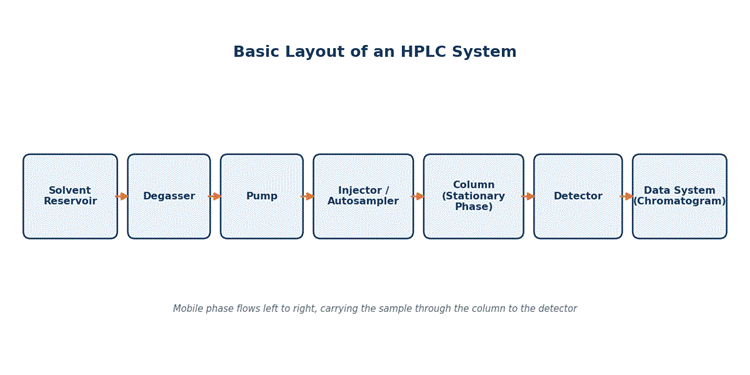
Figure 1: Basic layout of an HPLC system, from solvent reservoir to data output
1. Solvent Reservoir
This is simply the bottle or container that holds the mobile phase (the solvent). Most systems have more than one reservoir so different solvents can be mixed together in specific ratios.
2. Degasser
Dissolved air bubbles in the solvent can mess up the pump and detector readings. The degasser removes these trapped gases before the solvent enters the pump.
3. Pump
The pump is the heart of the system. It pushes the mobile phase through the column at a steady, controlled flow rate, often under very high pressure (sometimes several thousand psi). A stable flow rate is critical — even small fluctuations can distort the chromatogram.
Pumps can be single-solvent (isocratic) or multi-solvent (gradient capable), where two or more solvents are blended together in changing ratios during the run. Most modern HPLC systems use reciprocating piston pumps because they can deliver a consistent, pulse-free flow over long periods without needing to be refilled.
4. Injector / Autosampler
This part introduces a precise, small volume of the sample into the flowing mobile phase. Older systems used manual injection valves; modern systems use an autosampler that can run dozens of samples automatically without a person present.
5. HPLC Column
The column is where the actual separation happens. It is a narrow metal or PEEK tube tightly packed with tiny particles (the stationary phase). We will cover this in more detail in the HPLC column section below.
6. Detector
As compounds exit the column, the detector senses them and sends a signal to the data system. Common detector types include:
- UV-Visible (UV-Vis) detector — the most common, detects compounds that absorb UV light
- Photodiode Array (PDA) detector — records a full UV spectrum for every peak
- Fluorescence detector — used for compounds that glow under specific light
- Refractive Index (RI) detector — useful for compounds that don’t absorb UV light, like sugars
- Mass Spectrometer (MS) — gives molecular weight and structural information (LC-MS)
7. Data System
This is the software and computer that records the detector’s signal and turns it into the chromatogram you actually look at, along with peak areas, retention times, and calculated results.
HPLC Working: Step-by-Step
Now that we know the parts, let’s see how they work together during an actual run.
- The mobile phase is pulled from the reservoir and pushed through the system by the pump at a steady flow rate.
- The sample is injected into the flowing mobile phase through the injector or autosampler.
- The sample travels with the mobile phase into the column, where separation begins.
- Each compound moves through the packed column at its own speed, based on how strongly it interacts with the stationary phase.
- Compounds exit the column one at a time (ideally) and pass through the detector.
- The detector sends an electrical signal to the data system every time a compound passes through.
- The data system plots this signal against time, creating the chromatogram — a series of peaks, one for each compound.
- Software calculates the retention time and peak area for each compound, which is then used to identify and quantify it.
That is the entire HPLC working process in a nutshell. It sounds like a lot of steps, but a full run is often fully automated and takes anywhere from a few minutes to under an hour.
Before any of this happens, though, the sample itself needs to be prepared properly. It has to be dissolved in a solvent that is compatible with the mobile phase, filtered to remove any particles that could clog the column or tubing, and diluted to a concentration that falls within the method’s tested range. Skipping sample preparation is one of the most common reasons a run produces messy or unreliable results.
Advantages and Limitations of HPLC
Like any technique, HPLC has clear strengths and a few trade-offs worth knowing.
| Advantages | Limitations |
| Very high sensitivity and accuracy | Instruments and columns can be expensive |
| Works for a huge range of compounds | Requires trained operators for method development |
| Can be fully automated for high sample throughput | Mobile phase solvents add ongoing running costs |
| Results are highly reproducible when validated | Columns wear out and need periodic replacement |
| Can be combined with mass spectrometry (LC-MS) for extra detail | Not ideal for compounds that are highly volatile (GC may suit better) |
HPLC Mobile Phase
The mobile phase is the solvent (or mix of solvents) that carries your sample through the column. Choosing the right mobile phase is one of the most important parts of developing a good HPLC method, because it directly controls how well compounds separate.
Common mobile phase solvents include water, methanol, acetonitrile, and buffer solutions, often mixed in specific ratios depending on the sample being tested.
A good mobile phase needs to do a few things well: dissolve the sample completely, stay compatible with the detector you’re using, and give enough contrast in “polarity” against the stationary phase so that compounds actually separate instead of all rushing through together. Buffers are often added to control pH, since even small pH shifts can change how a compound behaves on the column, especially for acidic or basic compounds.
Isocratic vs Gradient Elution
There are two main ways to run the mobile phase during an analysis:
- Isocratic elution — the mobile phase composition stays the same throughout the whole run. Simple and stable, but not always ideal for complex mixtures.
- Gradient elution — the mobile phase composition changes gradually during the run (for example, starting weak and becoming stronger). This helps separate compounds with very different properties in one single run.
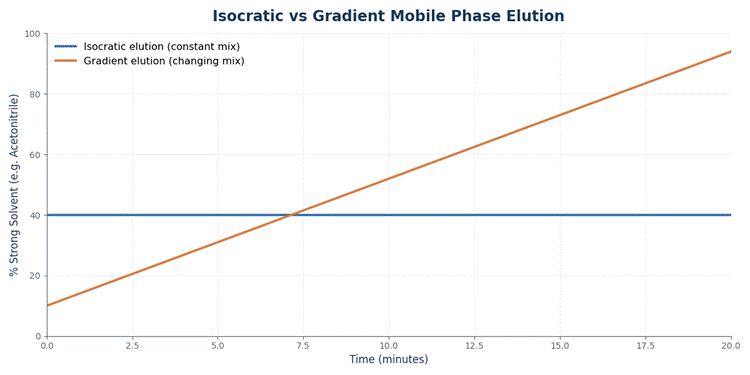
Figure 2: Isocratic elution keeps the solvent mix constant, gradient elution changes it over time
Picking between isocratic and gradient elution depends on your sample. Simple mixtures with similar compounds often work fine with isocratic elution, while complex samples with a wide range of compound types usually need gradient elution for a clean separation.
HPLC Column
If the pump is the heart of an HPLC system, the column is where the real work happens. It is a narrow tube tightly packed with tiny porous particles, and this packing material is called the stationary phase.
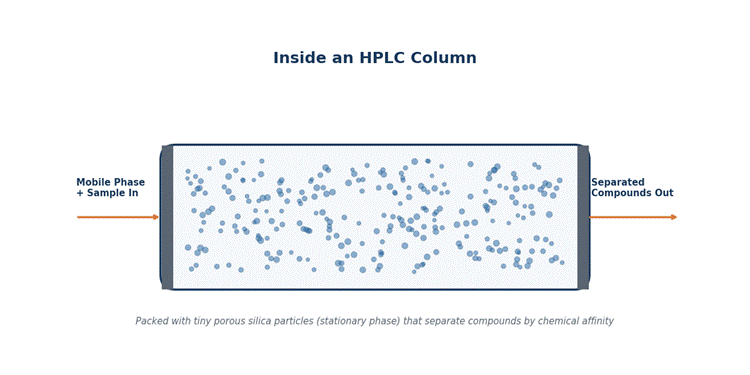
Figure 3: Cross-section view of a packed HPLC column
Common HPLC Column Types
| Column Type | How It Works | Typical Use |
| Reverse Phase (C18, C8) | Stationary phase is non-polar, mobile phase is polar | Most common; used for a wide range of compounds |
| Normal Phase | Stationary phase is polar, mobile phase is non-polar | Separating polar compounds, isomers |
| Ion Exchange | Separation based on charge | Proteins, amino acids, ions |
| Size Exclusion | Separation based on molecular size | Polymers, large proteins |
| Chiral Column | Separates mirror-image molecules (enantiomers) | Pharmaceutical purity testing |
Choosing the right column depends on your compound’s polarity, size, and charge. Sigma-Aldrich’s HPLC column selection guide is a handy reference when picking a column and stationary phase for a new method.
Most labs also place a small guard column right before the main analytical column. It is packed with the same type of stationary phase but is much shorter and cheaper. Its job is to catch dirt, particles, and strongly-retained junk from the sample before it ever reaches the expensive main column — think of it as a sacrificial filter that extends the life of your real column by months.
Column dimensions matter too. Length, internal diameter, and particle size all affect how sharp your peaks are and how much pressure the pump needs to generate. Smaller particles (sub-2-micron, used in UHPLC) give sharper peaks and faster runs, but need much higher pressure to push the solvent through.
Understanding an HPLC Chromatogram
The chromatogram is the final output of an HPLC run — a graph with time on the x-axis and detector response on the y-axis. Every bump, or peak, on this graph represents one compound in your sample.
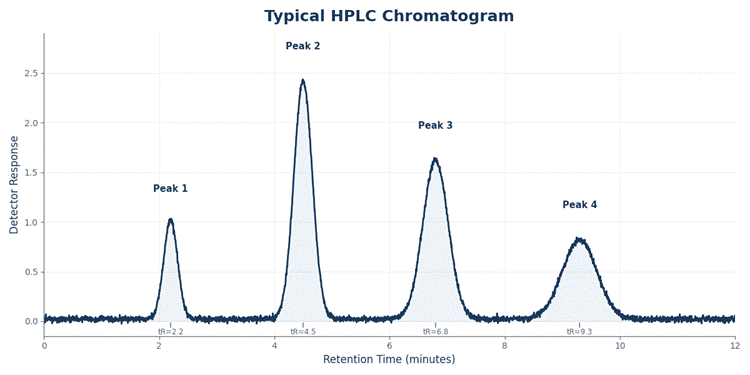
Figure 4: A typical HPLC chromatogram showing separated peaks
Here is how to read it in simple terms:
- The position of a peak (its retention time) tells you which compound it likely is, based on comparison with a known standard.
- The height and area of a peak tell you how much of that compound is present — bigger peak, more of that compound.
- Well-separated, sharp peaks mean good separation. Overlapping or broad peaks usually point to a method problem.
A clean chromatogram with sharp, well-spaced peaks and a flat baseline is the sign of a healthy, well-tuned HPLC method.
Types of HPLC
HPLC is not a single fixed method — it comes in several forms, each suited to a different kind of separation problem.
| Type | Best For |
| Reverse Phase HPLC (RP-HPLC) | The most widely used form; works for most organic compounds |
| Normal Phase HPLC (NP-HPLC) | Polar compounds and isomer separation |
| Ion Exchange Chromatography | Charged molecules like proteins and amino acids |
| Size Exclusion Chromatography (SEC) | Separating molecules by size, e.g. polymers |
| Affinity Chromatography | Highly specific separations, such as antibody purification |
| Chiral HPLC | Separating enantiomers (mirror-image molecules) |
HPLC vs GC: What’s the Difference?
People often mix up HPLC with Gas Chromatography (GC), but they suit different kinds of samples. HPLC uses a liquid mobile phase and works well for compounds that are not very volatile, are heat-sensitive, or are large molecules like proteins. GC uses a gas mobile phase and heats the sample, so it only works for compounds that can vaporize without breaking down. If a compound would decompose under heat, HPLC is almost always the safer choice.
HPLC Applications
HPLC is used across many different industries because almost any liquid-soluble sample can be tested with it. Some of the most common HPLC applications include:
- Pharmaceutical industry — testing drug purity, potency, and detecting impurities
- Food and beverage industry — checking for additives, preservatives, vitamins, and contaminants
- Environmental testing — detecting pesticides, pollutants, and heavy compounds in water and soil
- Clinical and forensic labs — drug testing, toxicology, and biomarker analysis
- Cosmetics industry — checking ingredient concentration and safety
- Research labs — studying new compounds, proteins, and chemical reactions
Because HPLC can detect compounds down to very tiny concentrations (parts per billion in some cases), it has become the go-to method wherever accuracy and reliability matter.
It also plays a big part behind the scenes in everyday life. The vitamin content listed on a supplement label, the caffeine level in a soft drink, the purity of an active ingredient in a tablet, and the pesticide residue limit on imported produce have all very likely been confirmed using HPLC at some stage.
HPLC Validation
Before an HPLC method can be trusted for real testing (especially in pharmaceutical or regulated labs), it has to be validated. Validation is simply the process of proving that a method gives accurate, reliable, and repeatable results.
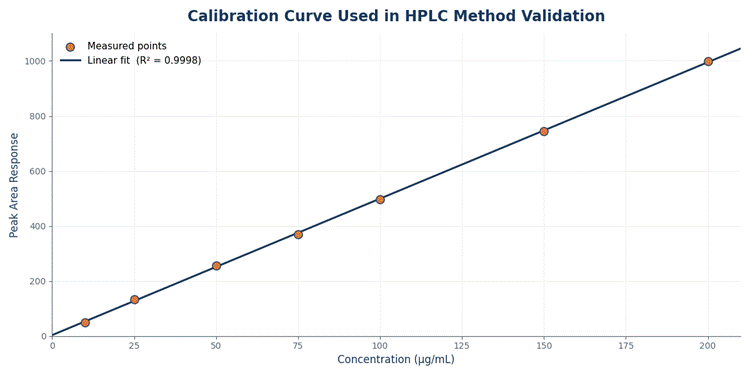
Figure 5: A calibration curve is used to check linearity during method validation
Most labs follow the internationally recognised ICH Q2(R2) guideline on validation of analytical procedures, which is also accepted by the U.S. FDA for regulatory submissions.
Key HPLC Validation Parameters
| Parameter | What It Checks |
| Accuracy | How close the result is to the true, known value |
| Precision | How repeatable the results are when the test is run again |
| Specificity | Whether the method can tell the target compound apart from other substances |
| Linearity | Whether the response increases proportionally with concentration |
| Range | The concentration span over which the method works reliably |
| LOD (Limit of Detection) | The smallest amount of a compound that can be detected |
| LOQ (Limit of Quantitation) | The smallest amount that can be measured accurately |
| Robustness | How stable the method is against small, deliberate changes |
| System Suitability | A quick daily check that the instrument is performing correctly before a run |
A method that passes all these checks can be trusted to give the same result, on the same sample, no matter which analyst or which day it is run.
HPLC Troubleshooting
Even a well-built HPLC method can run into problems. Here are some of the most common HPLC troubleshooting issues and what usually causes them. A good habit is to always run a system suitability check and a blank injection before the real samples — this catches many of these problems early, before they waste an entire batch of samples.
| Problem | Likely Cause | What to Check |
| Peak tailing | Column contamination or poor packing | Clean or replace column, check pH of mobile phase |
| Ghost peaks | Contaminated solvent or carryover from previous run | Use fresh solvent, run a blank injection |
| Noisy baseline | Air bubbles, lamp issues, or dirty detector cell | Degas mobile phase, check lamp and flow cell |
| High back pressure | Blocked frit or column, particles in mobile phase | Filter solvents, replace inline filter or guard column |
| Poor peak resolution | Wrong column choice or weak mobile phase strength | Adjust mobile phase ratio, try a different column |
| Retention time drift | Temperature changes or pump flow inconsistency | Use a column oven, check pump calibration |
| No peaks detected | Wrong wavelength, empty sample vial, blocked injector | Verify method settings and sample preparation |
Most HPLC problems trace back to one of three things: a dirty or worn-out column, contaminated mobile phase, or an instrument that needs maintenance. Keeping a simple maintenance log can save a lot of troubleshooting time later.
HPLC Interview Questions
Whether you’re preparing for a QC chemist role, an analytical lab job, or a viva exam, these HPLC interview questions cover the basics that almost always come up. Try answering each one out loud in your own words before checking a textbook — interviewers usually care more about whether you understand the concept than whether you recite a textbook definition word for word.
Basic Level
- What does HPLC stand for?
- What is the basic principle behind HPLC separation?
- What is the difference between the mobile phase and the stationary phase?
- What is retention time?
- Name the main parts of an HPLC system.
- What is the role of the pump in an HPLC system?
- What is a chromatogram?
Intermediate Level
- What is the difference between isocratic and gradient elution?
- What is the difference between normal phase and reverse phase HPLC?
- Why is degassing the mobile phase important?
- What causes peak tailing, and how would you fix it?
- What is the difference between HPLC and UPLC?
- What detectors are commonly used in HPLC, and when would you choose each one?
- What is a guard column, and why is it used?
Advanced Level
- Explain the validation parameters required for an HPLC method.
- What is the difference between LOD and LOQ?
- How do you calculate theoretical plates for a column?
- What is system suitability testing, and why is it done before every run?
- How would you troubleshoot a sudden increase in system back pressure?
- What is the difference between accuracy and precision in method validation?
- How does column temperature affect an HPLC separation?
Frequently Asked Questions
Is HPLC the same as UPLC?
Not exactly. UPLC (Ultra Performance Liquid Chromatography) is a newer, faster version of HPLC that uses smaller particle columns and higher pressures. It runs faster and gives sharper peaks, but the core separation principle is the same as HPLC.
How long does a typical HPLC run take?
It depends on the method, but most runs fall somewhere between 5 and 60 minutes. Simple methods with few compounds can finish in under 10 minutes, while complex gradient methods checking for many impurities can take much longer.
What is the most common HPLC column type?
Reverse phase columns, especially C18 columns, are by far the most widely used. They work for a very broad range of compounds, which is why most labs start method development with a C18 column.
Why is mobile phase filtration important?
Unfiltered solvent can carry tiny particles that clog the column frit or damage the pump seals over time. Filtering the mobile phase before use protects the whole system and helps keep back pressure stable.
Can HPLC be used for quality control in manufacturing?
Yes, and this is actually one of its biggest uses. Pharmaceutical, food, and chemical manufacturers routinely use validated HPLC methods to release batches, confirming that each batch meets its required purity and concentration specifications before it reaches the market.
Conclusion
HPLC might look complicated from the outside, with all its tubing, pumps, and technical settings, but the core idea is straightforward: push a liquid sample through a packed column and let each compound separate out based on its own chemistry. Once you understand the principle, the instrumentation, the mobile phase, and the column all start to make a lot more sense.
Whether you’re a student, a working analyst, or preparing for an interview, understanding these basics of HPLC principle, working, validation, and troubleshooting will take you a long way in any analytical chemistry lab.
Quick Recap
- HPLC separates compounds using a stationary phase (column) and a moving mobile phase (solvent)
- Key instrumentation includes the pump, injector, column, and detector
- Mobile phase can run isocratic (constant) or gradient (changing)
- Validation proves a method is accurate, precise, and reliable before real use
- Most troubleshooting issues trace back to the column, mobile phase, or instrument maintenance
People also interested in these articles
- Pharmaceutical Stability Testing Guide: How to Keep Medicines Safe and Effective
- Cold Chain in Pharmaceutical Industry: A Complete Guide
- Dissolution Testing in Pharmaceutical Industry
- UV Spectroscopy: Principle, Instrumentation, Working, Applications, Advantages & Limitations (Complete Guide)
- Gas Chromatography: Principles, Working, Components, Applications, Advantages & Limitations
- Pharma QA vs QC Difference