Principles, Methods, Apparatus, Applications, and USP Guidelines
If you work in pharma, you have probably heard the phrase “dissolution testing” more times than you can count. It sounds technical, but the idea behind it is simple. This test tells us how fast and how much of a drug dissolves once it enters the body. That single piece of information can decide whether a tablet works the way it should, or whether it fails a patient when they need it most.
In this guide, we will walk through what dissolution testing is, why it matters so much in pharmaceutical quality control, the different types of dissolution apparatus used around the world, and how USP dissolution test guidelines shape the way labs run this test every single day. We will also look at dissolution method validation, the factors affecting dissolution, the difference between dissolution vs disintegration, and how in vitro drug release testing connects to real patient outcomes.
By the end, you should have a clear, plain-language understanding of this topic, whether you are a student, a QC analyst, a formulation scientist, or just someone curious about how medicines are tested before they reach a pharmacy shelf.
What Is Dissolution Testing?
Dissolution testing is a lab method used to measure how a solid dosage form, such as a tablet or capsule, releases its active drug into a liquid over time. Think of it like watching a sugar cube dissolve in a cup of tea, except here scientists track the exact percentage of drug that dissolves at set time points, using controlled temperature, speed, and liquid volume.
This is not a one-time check. Every batch of tablets or capsules made in a pharmaceutical plant goes through dissolution testing before it is approved for sale. It is one of the most important tests in the entire drug manufacturing process because it gives a strong hint about how the medicine will behave once it is swallowed.
The liquid used in the test is called the dissolution medium, and it is chosen to represent conditions similar to the stomach or intestines. Common examples include water, diluted hydrochloric acid, or a buffer solution set to a specific pH.
Why Dissolution Testing Matters in Pharmaceutical Quality Control
Pharmaceutical quality control exists to make sure every tablet a patient takes works safely and consistently. Dissolution testing sits right at the center of this goal for a few clear reasons.
- It checks that the drug will actually be available for the body to absorb, not just sitting unused inside the tablet.
- It helps catch manufacturing problems early, such as a coating that is too thick or a tablet that was compressed too hard.
- It supports batch-to-batch consistency, so a tablet made this month behaves the same as one made last year.
- It is required by regulatory bodies like the FDA and EMA before a drug can be approved or sold.
- It plays a key role when a generic drug company wants to prove its product works the same as the original brand.
Without dissolution testing, a manufacturer would have almost no reliable way to confirm that a drug releases properly before it reaches a patient. This is why regulatory agencies treat it as a mandatory, non-negotiable step in quality control.
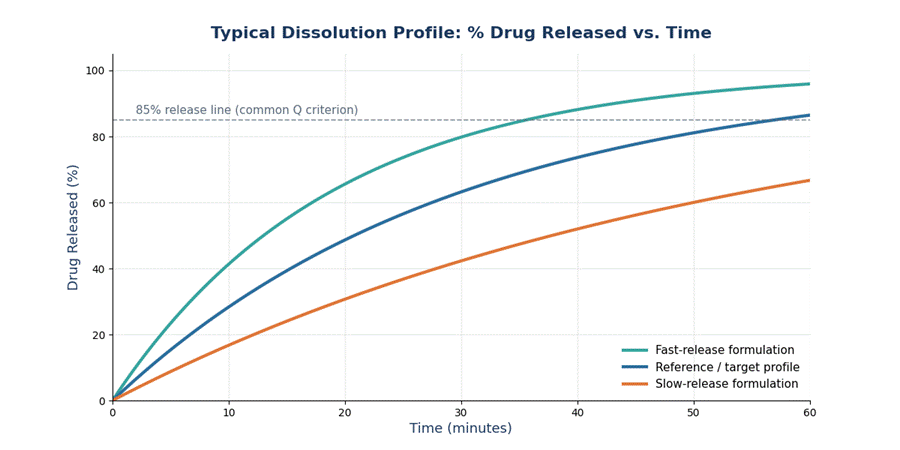
Figure 1: A typical dissolution profile showing percentage of drug released over time for different formulations.
Dissolution vs Disintegration: What Is the Difference?
People often mix up dissolution vs disintegration, but they are two different tests that measure two different things.
Disintegration testing simply checks how long it takes for a tablet to break apart into smaller pieces or granules once placed in a liquid. It does not tell you how much of the actual drug has been released, only that the tablet has physically fallen apart.
Dissolution testing goes a step further. It measures the actual amount of active drug that has dissolved into the solution at different time points. A tablet can disintegrate quickly but still release its drug slowly, which is why dissolution testing gives a much more complete picture of drug performance.
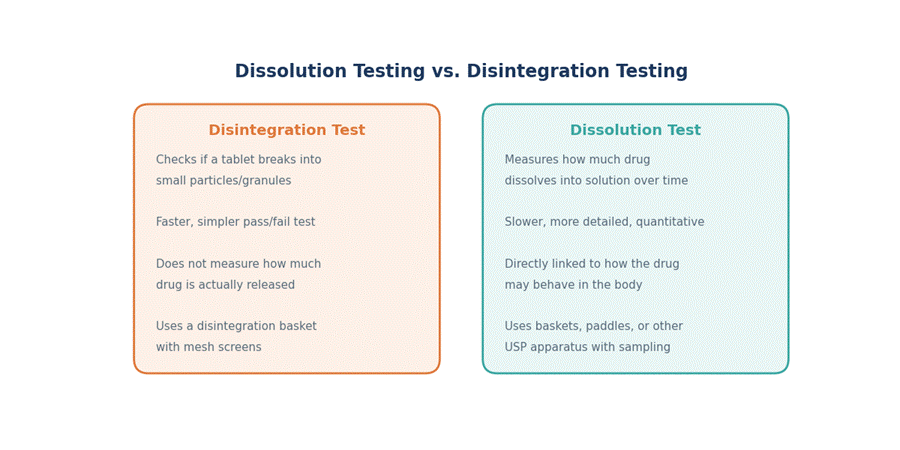
Figure 2: Key differences between disintegration testing and dissolution testing.
Quick Comparison Table
| Aspect | Disintegration Test | Dissolution Test |
| What it measures | Physical breakdown of tablet | Amount of drug released over time |
| Result type | Pass or fail, time-based | Percentage released at each time point |
| Regulatory weight | Basic quality check | Core requirement for approval |
| Equipment used | Disintegration basket-rack | USP dissolution apparatus (1 to 7) |
| Relation to absorption | Indirect indicator | Closer link to drug absorption |
The Basic Principles Behind Dissolution Testing
At its core, dissolution testing follows a simple scientific idea. A drug can only be absorbed by the body once it is dissolved in a liquid. A tablet sitting whole in the stomach cannot enter the bloodstream. So the speed at which a drug dissolves often controls the speed at which it starts working.
The Noyes-Whitney Concept
Back in 1897, two scientists named Noyes and Whitney described how the rate of dissolution depends on several things: the surface area of the drug particles, the difference between the drug’s concentration at the particle surface and in the bulk liquid, and the thickness of the liquid layer surrounding each particle. In simple words, smaller particles with more surface area tend to dissolve faster, and a well-mixed liquid helps too.
Sink Conditions
A good dissolution test usually tries to maintain what is called sink conditions. This means there is enough liquid in the vessel that the drug never gets close to fully saturating the medium. If the liquid becomes too saturated, dissolution slows down artificially, and the test would not reflect real-world behavior accurately.
Dissolution Apparatus: Types and How They Work
The United States Pharmacopeia (USP) lists several standard types of dissolution apparatus, and each one is built for a different kind of dosage form. Choosing the right apparatus is one of the first and most important decisions in setting up a dissolution method.
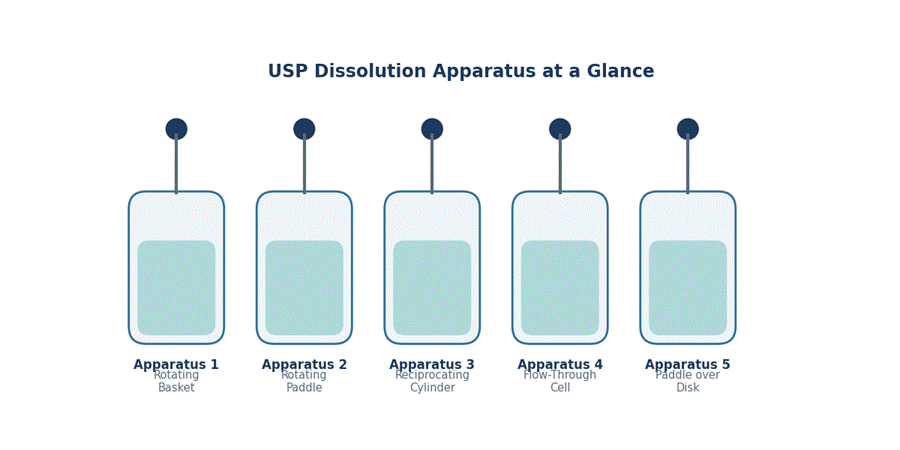
Figure 3: Overview of the main USP dissolution apparatus types.
Apparatus 1: Rotating Basket
This is one of the oldest and most widely used designs. A cylindrical mesh basket holds the tablet or capsule and rotates slowly inside a vessel filled with the dissolution medium. It works well for capsules and tablets that tend to float.
Apparatus 2: Rotating Paddle
Instead of a basket, this apparatus uses a paddle that stirs the liquid while the dosage form sits at the bottom of the vessel. It is probably the most commonly used apparatus across the industry because it suits a wide range of immediate-release tablets.
Apparatus 3: Reciprocating Cylinder
This design moves the dosage form up and down through different rows of liquid held in glass cylinders. It is often chosen for extended-release products and chewable tablets.
Apparatus 4: Flow-Through Cell
Fresh medium flows continuously through a small cell holding the sample. This apparatus works well for drugs with very low solubility or for products like implants and micro particles, since it keeps sink conditions easier to maintain.
Apparatus 5, 6, and 7
These less common designs (paddle over disk, rotating cylinder, and reciprocating holder) are typically reserved for special dosage forms such as transdermal patches or specific extended-release systems.
Apparatus Comparison Table
| Apparatus | Common Name | Best Suited For |
| Apparatus 1 | Rotating Basket | Capsules, floating tablets |
| Apparatus 2 | Rotating Paddle | Most immediate-release tablets |
| Apparatus 3 | Reciprocating Cylinder | Extended-release, chewables |
| Apparatus 4 | Flow-Through Cell | Low-solubility drugs, implants |
| Apparatus 5 | Paddle over Disk | Transdermal patches |
| Apparatus 6 | Rotating Cylinder | Transdermal patches (alternate) |
| Apparatus 7 | Reciprocating Holder | Special extended-release forms |
USP Dissolution Test Guidelines Explained
The USP dissolution test is described mainly in General Chapter <711> of the United States Pharmacopeia, along with related chapters that cover apparatus calibration and acceptance criteria. These guidelines exist so that labs around the world run the test the same way and get comparable, trustworthy results.
Choosing the Right Medium
The dissolution medium is chosen based on where the drug is expected to release in the body. Common choices include 0.1N hydrochloric acid to mimic stomach acid, phosphate buffer for intestinal pH, or plain purified water. Volume usually ranges from 500 mL to 1000 mL, and temperature is kept steady at 37°C to match normal body temperature.
Acceptance Criteria: The Three-Stage (S1, S2, S3) System
USP guidelines use a staged testing approach to decide if a batch passes.
| Stage | Number of Units | Acceptance Rule |
| S1 | 6 units | Each unit releases at or above the stated Q value plus 5% |
| S2 | 6 more units (12 total) | Average of 12 units meets Q, no unit falls too far below |
| S3 | 12 more units (24 total) | Average of 24 units meets Q, with tight limits on how many can fall below |
Here, “Q” refers to the target percentage of drug that should be released by a specific time, as stated in the individual drug monograph. If the batch fails at S1, the lab moves to S2, and if needed, to S3, giving manufacturers a fair, structured way to confirm quality without unnecessarily rejecting good batches.
For the full, current text of these requirements, the official USP-NF compendium is the most reliable source, since chapter numbers and limits can be updated over time.
How a Dissolution Test Is Actually Performed
It helps to walk through the test step by step, so the whole process feels less abstract. While exact details change depending on the product and the chosen apparatus, most dissolution tests follow a similar general path in the lab.
Step 1: Prepare the Dissolution Medium
The analyst prepares the correct volume and type of medium, whether that is water, acid, or buffer, and checks that its pH and temperature match the method requirements. The medium is usually deaerated first, since trapped air bubbles can stick to the tablet or apparatus and quietly change the results.
Step 2: Set Up and Calibrate the Apparatus
Before any sample is added, the vessel is filled with the medium and allowed to reach 37 degrees Celsius. The apparatus is checked for correct alignment, wobble, and rotation speed, since even a small mechanical issue can affect how the liquid moves around the tablet.
Step 3: Add the Dosage Form
The tablet or capsule is carefully dropped into the vessel, or placed in the basket, at time zero. Analysts try to add the sample the same way every time, because something as simple as the drop angle can slightly change early dissolution behavior.
Step 4: Collect Samples at Set Time Points
At fixed intervals, such as 10, 20, 30, and 45 minutes, a small volume of liquid is withdrawn from a fixed position in the vessel. Fresh medium is often added back to keep the total volume constant, unless the method says otherwise.
Step 5: Analyze the Samples
Each withdrawn sample is measured to find out exactly how much drug has dissolved. This step relies on a separate, validated analytical method, which we cover in more detail below.
Step 6: Calculate and Compare Results
The percentage of drug released at each time point is calculated and plotted to build the dissolution profile. These numbers are then compared against the acceptance criteria in the product specification, or against a reference profile if the goal is a similarity comparison.
Analytical Methods Used to Measure Dissolved Drug
Running the dissolution test itself only produces liquid samples. A separate analytical technique is needed to actually find out how much drug is present in each sample. A few methods are common across the industry.
UV-Visible Spectroscopy
This method shines light through the sample and measures how much light the dissolved drug absorbs. It is fast, simple, and works well when the formulation does not contain other ingredients that absorb light at the same wavelength as the drug.
High-Performance Liquid Chromatography (HPLC)
HPLC separates the drug from other substances in the sample before measuring it, which makes it far more specific than UV spectroscopy. It is often the preferred choice when excipients, degradation products, or multiple active ingredients could otherwise interfere with a simple absorbance reading.
Other Techniques
In some cases, methods like fiber-optic UV probes are used to measure drug concentration directly inside the vessel, without manually removing a sample. This can reduce human handling error and is becoming more common in modern, automated dissolution labs.
Dissolution Method Validation: Making Sure the Test Is Trustworthy
Before a dissolution method can be used for routine testing, it must go through dissolution method validation. This is basically a set of experiments that prove the method gives accurate, repeatable, and reliable results every time it is used.
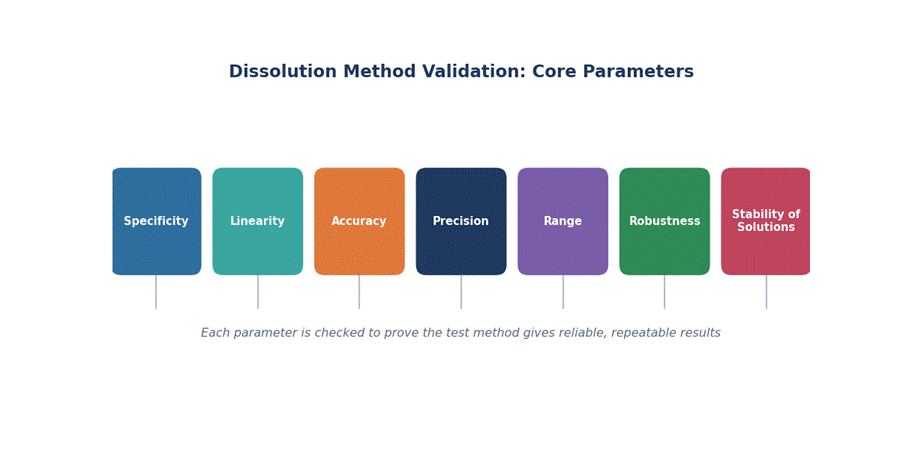
Figure 4: Core parameters checked during dissolution method validation.
Specificity
This confirms that the method measures only the drug of interest, without interference from excipients, coatings, or degradation products.
Linearity and Range
The method should give a straight-line response across the range of concentrations expected during testing, so results stay accurate whether release is low or nearly complete.
Accuracy and Precision
Accuracy checks how close the measured value is to the true value, usually through spike-recovery experiments. Precision checks how consistent results are when the test is repeated, both on the same day and across different days or analysts.
Robustness
Small, deliberate changes are made to conditions like stirring speed, medium pH, or temperature, to see if the method still gives similar results. A robust method should not be overly sensitive to minor variations.
Solution Stability
Since samples are not always tested immediately, the method should confirm that the dissolved drug remains stable in the medium for a reasonable amount of time before analysis.
Factors Affecting Dissolution
Many small details can change how fast or how completely a drug dissolves. Understanding these factors affecting dissolution helps both formulation scientists and quality teams troubleshoot problems quickly.
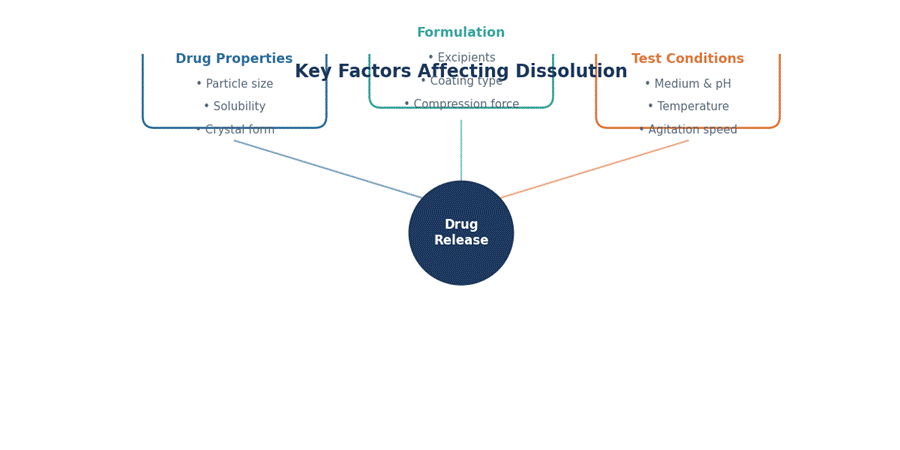
Figure 5: Major categories of factors that influence drug dissolution.
Drug-Related Factors
- Particle size: smaller particles have more surface area, which speeds up dissolution.
- Solubility: drugs with poor water solubility naturally dissolve slower.
- Crystal form: the same drug can dissolve at different speeds depending on its crystalline or amorphous structure.
- Salt form: some salt forms of a drug dissolve faster than the free acid or base form.
Formulation-Related Factors
- Excipients: binders, fillers, and disintegrants can speed up or slow down release.
- Coating type: enteric or sustained-release coatings are designed to control when and where release happens.
- Compression force: tablets pressed too hard can become dense and dissolve more slowly.
- Granulation method: how ingredients are mixed and processed affects the final tablet structure.
Test-Related Factors
- Medium pH and composition: different pH levels can dramatically change solubility.
- Agitation speed: faster stirring generally increases the dissolution rate.
- Temperature: even small shifts away from 37°C can affect results.
- Apparatus alignment and vibration: poor equipment setup can introduce unwanted variability.
Understanding a Dissolution Profile
A dissolution profile is simply a plot of the percentage of drug released against time. Instead of looking at just one time point, scientists often study the entire curve to understand the full release pattern of a product.
Comparing Profiles with f1 and f2 Values
When comparing a generic product to a reference product, two mathematical tools are commonly used.
- f1 (difference factor): measures the percentage difference between two curves at each time point. Lower values mean the curves are closer.
- f2 (similarity factor): a value between 50 and 100 is generally considered to show the two dissolution profiles are similar enough.
These calculations are especially important for generic drug manufacturers, since regulatory agencies often expect dissolution profile similarity as part of proving that a generic product performs like the original brand.
In Vitro Drug Release Testing: Real-World Applications
In vitro drug release testing is not just a routine lab exercise. It connects to several important stages across the life of a medicine.
Research and Development
During early formulation work, dissolution testing helps scientists choose the best combination of ingredients and manufacturing process before moving into larger clinical trials.
Batch Release and Quality Control
Every commercial batch is tested to confirm it meets the approved specification, protecting patients from receiving a substandard product.
Generic Drug Approval
Generic manufacturers use dissolution testing, often alongside bioequivalence studies, to show their product behaves similarly to the original brand-name drug.
In Vitro-In Vivo Correlation (IVIVC)
In some cases, a strong relationship can be built between in vitro dissolution data and actual in vivo (in-body) drug performance. When this correlation is strong, dissolution testing can sometimes reduce the need for additional human studies during certain formulation changes.
Stability Studies
Dissolution testing is repeated at different points during a product’s shelf-life study, to make sure release behavior does not drift over time as the product ages.
Regulatory Bodies That Oversee Dissolution Standards
Dissolution testing is not something each company defines on its own. It is guided by international standards, and several major regulatory bodies play a role in shaping how the test is run and interpreted.
United States Pharmacopeia (USP)
The USP dissolution test chapters are widely followed not just in the United States but around the world, since many other countries reference or align with USP methods and apparatus specifications.
U.S. Food and Drug Administration (FDA)
The FDA reviews dissolution data as part of new drug applications and generic drug submissions, and publishes specific guidance documents for many individual drug products, recommending exact test conditions.
European Medicines Agency (EMA)
In Europe, the EMA works alongside the European Pharmacopoeia to set expectations for dissolution testing, particularly for demonstrating that generic products are equivalent to reference products sold in the EU.
International Council for Harmonisation (ICH)
ICH guidelines help align quality expectations, including aspects of dissolution and drug release testing, across different regulatory regions, making it easier for companies to develop one global dossier instead of many separate regional ones.
Staying current with these standards matters, since requirements can shift over time. The FDA’s official guidance library is a useful place to check for the latest product-specific dissolution recommendations.
Common Challenges in Dissolution Testing
- Poor solubility drugs can be difficult to test using standard aqueous media, sometimes requiring surfactants or modified conditions.
- Vessel-to-vessel variability can occur if equipment is not properly calibrated or aligned.
- Sampling errors, such as air bubbles or filter clogging, can quietly affect result accuracy.
- Deaeration of the medium is sometimes overlooked, even though trapped air can change results.
- Method transfer between laboratories can introduce small but meaningful differences if procedures are not followed exactly.
- Sink condition failures can happen when a drug is too concentrated for the chosen medium volume, which slows dissolution in a way that does not reflect true drug behavior.
- Analyst-to-analyst variation, such as differences in sample withdrawal timing or technique, can introduce small inconsistencies unless training is standardized.
Most of these challenges can be managed with careful method development, proper training, and routine equipment maintenance. Labs that invest time upfront in solid method design tend to face far fewer problems once the test moves into daily routine use.
Best Practices for Reliable Dissolution Testing
- Calibrate dissolution apparatus regularly using both mechanical checks and performance verification tests.
- Deaerate the dissolution medium properly before use, especially for water-based media.
- Maintain temperature tightly at 37°C ± 0.5°C throughout the run.
- Train analysts consistently, since technique can subtly influence sampling accuracy.
- Document every deviation, no matter how small, to support strong quality control records.
- Use validated analytical methods, such as HPLC or UV spectroscopy, to measure dissolved drug concentration accurately.
Frequently Asked Questions (FAQ)
What is the main purpose of dissolution testing?
The main purpose is to measure how much of a drug releases from a tablet or capsule into a liquid over a set time, which helps predict how well the drug may work once taken by a patient.
What is the difference between dissolution and disintegration testing?
Disintegration testing checks how quickly a tablet breaks apart, while dissolution testing measures the actual amount of drug released into the liquid over time. Dissolution gives a more complete picture of drug performance.
Which dissolution apparatus is most commonly used?
Apparatus 2 (rotating paddle) is one of the most widely used designs, mainly because it suits a large range of immediate-release tablets.
What does the USP dissolution test S1, S2, S3 stages mean?
These are staged acceptance criteria. If a batch does not pass at the S1 stage with 6 units, more units are tested at S2 and, if needed, S3, using progressively stricter average-based rules.
Why is dissolution method validation important?
It confirms that a test method gives accurate, consistent, and reliable results, so quality decisions based on that method can be trusted.
What factors can slow down dissolution?
Large particle size, poor drug solubility, dense tablet compression, certain coatings, and low agitation speed can all slow down the dissolution rate.
What is a dissolution profile used for?
It shows the full pattern of drug release over time and is often used to compare a generic product against a reference product using tools like the f2 similarity factor.
What temperature is used for dissolution testing?
Most dissolution tests are run at 37°C, since this matches normal human body temperature and helps the results reflect real conditions inside the body.
Can dissolution testing predict how a drug works in the body?
It cannot fully predict human results on its own, but it often correlates closely with how a drug behaves in the body, especially when a strong in vitro-in vivo correlation has been established for that product.
How often is dissolution testing performed during manufacturing?
It is performed on every commercial batch as part of routine quality control, and also during development, stability studies, and whenever a significant formulation or process change is made.
What analytical method is used to measure dissolved drug?
UV-Visible spectroscopy and HPLC are the two most common methods, chosen based on how specific the measurement needs to be and whether other ingredients might interfere with the result.
Final Thoughts
Dissolution testing might seem like just another lab procedure, but it plays a real role in protecting patient safety and confirming that a medicine will work as intended. From choosing the correct dissolution apparatus, to following USP dissolution test guidelines, to running proper dissolution method validation, every step matters.
It is worth remembering that this test connects several different worlds at once. It touches formulation science, since the way a tablet is built directly shapes its release pattern. It touches quality control, since every commercial batch must prove itself before reaching a pharmacy shelf. And it touches regulatory science, since agencies rely on this data to decide whether a product is fit for approval or whether a generic can stand in for a brand-name drug.
Whether you are studying for a pharmacy exam, working in a QC lab, or developing new formulations, understanding the principles behind dissolution testing gives you a much clearer picture of how solid dosage forms are checked before they ever reach a patient. A small, careful test happening quietly inside a lab vessel ends up playing a real part in making sure medicines work safely, consistently, and as intended, every single time.
Further Reading
For more official and detailed information, these resources are a good starting point:
- U.S. Pharmacopeia (USP)
- FDA Guidance on Dissolution Testing
- ICH Quality Guidelines
- European Medicines Agency (EMA)
- PubMed / NCBI Research Database
Similar Post
- Pharma QA vs QC Difference
- Top 100 Pharma QA Interview Questions and Answers
- How to Introduce Yourself in Job Interviews
- M Pharm Career Options: A Complete Guide to Jobs After Master of Pharmacy
- Gas Chromatography: Principles, Working, Components, Applications, Advantages & Limitations
- UV Spectroscopy: Principle, Instrumentation, Working, Applications, Advantages & Limitations (Complete Guide)