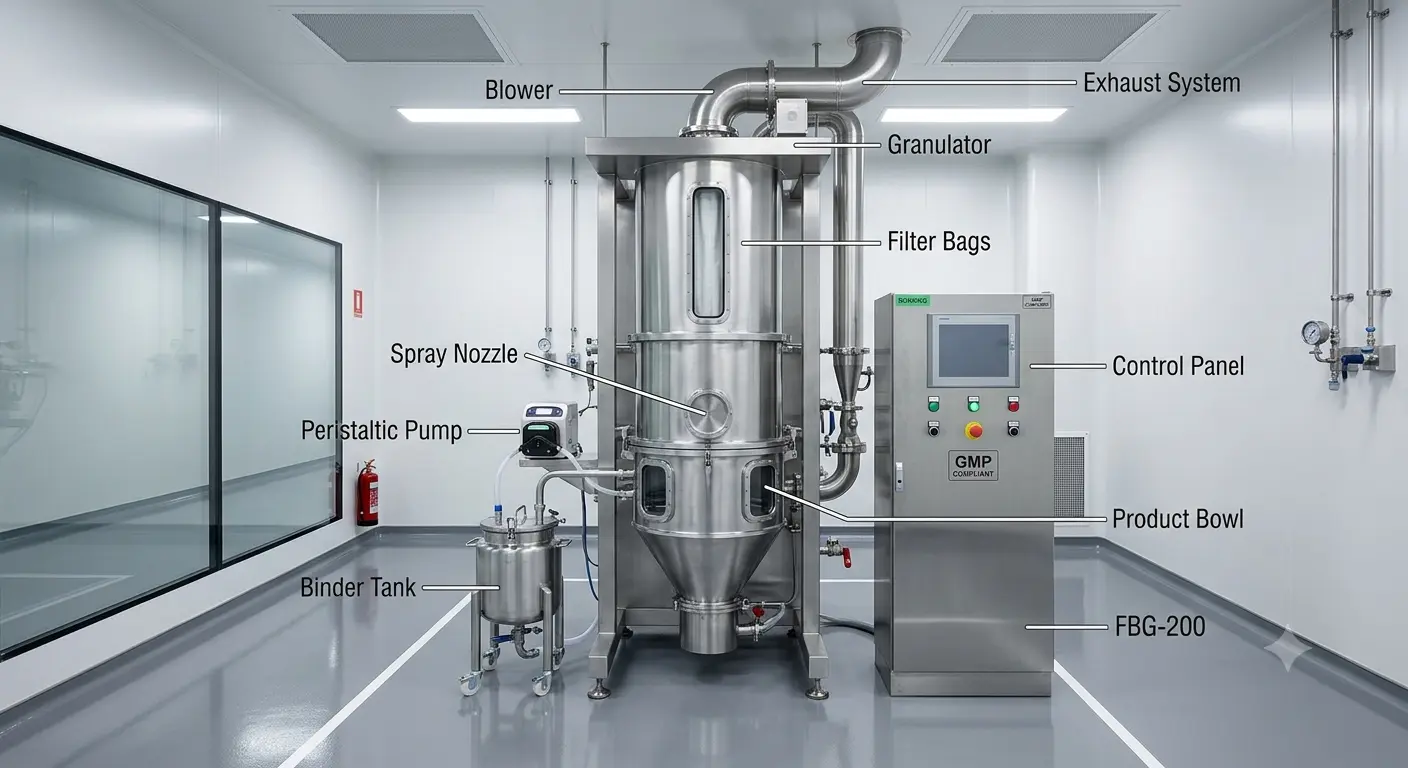
A practical, in-depth reference for QA, QC, Production, R&D, Technology Transfer, Validation, and Regulatory Affairs professionals.
Fluid bed granulation is one of the most widely used processes in solid oral dosage manufacturing. It combines mixing, granulation, and drying inside a single, enclosed piece of equipment, which is why so many pharmaceutical companies rely on it for tablets, capsules, and pellets. Instead of moving a wet powder mass between separate machines, the entire granule formation and drying cycle happens inside one product bowl, under carefully controlled airflow.
For QA, QC, Production, R&D, Technology Transfer, and Regulatory Affairs teams, understanding fluid bed granulation in pharmaceutical manufacturing is essential. The technique directly affects granule size, flow, compressibility, and ultimately the quality of the final tablet or capsule. A poorly controlled fluid bed granulation process can lead to over-wetted granules, poor content uniformity, or batch rejection, so getting the fundamentals right matters at every stage of a product’s life cycle.
This guide walks through the working principle, equipment parts, process stages, critical process parameters, quality attributes, troubleshooting, GMP requirements, and safety practices associated with fluid bed granulation. Whether you are a fresher learning the basics, a production officer running daily batches, or a validation professional preparing a protocol, this guide is written to give you a practical, real-world understanding of the fluid bed granulator and the fluid bed granulation process.
What is Fluid Bed Granulation?
Definition: Fluid bed granulation is a wet granulation technique in which fine powder particles are suspended in a stream of upward-moving air while a binder solution is sprayed onto them, causing the particles to stick together and grow into granules. Once granule formation is complete, the same equipment dries the granules using heated air, without moving the product to a separate dryer.
Basic principle: The process relies on fluidization, which means passing air through a bed of powder at a velocity high enough to lift and suspend the particles so they behave almost like a boiling liquid. While suspended, a binder solution sprayed through a nozzle wets the particle surfaces, and the particles collide and bond into porous, uniform granules.
Purpose: Fluid bed granulation is performed to improve the flow property, compressibility, and content uniformity of a powder blend that would otherwise be difficult to compress directly into tablets.
Importance: Because a single unit performs mixing, granulation, and drying, batch cycle time is shorter, cross-contamination risk is lower, and the granules produced are generally more porous and free-flowing than those from high shear or conventional wet granulation.
Working Principle of Fluid Bed Granulation
Every fluid bed granulator, regardless of manufacturer, works on the same basic sequence of airflow, fluidization, spraying, and drying. Here is how it happens step by step.
- Airflow generation – A blower pulls or pushes filtered, temperature-controlled air through the product bowl, creating the upward air current needed for fluidization.
- Fluidization – As airflow increases past a critical velocity, the static powder bed expands and the particles begin to move freely, suspended in the air stream, similar to a fluid. This is where the process gets its name.
- Binder spraying – A binder solution or suspension is pumped through a spray nozzle (top, bottom, or tangential, depending on the granulator type) and atomized onto the fluidized particles.
- Granule formation – Wetted particles collide and stick to each other, forming small agglomerates. As spraying continues in controlled pulses, these agglomerates grow into granules of the desired size.
- Drying – Once spraying stops, heated air continues to flow through the bed, evaporating moisture from the granules while they remain fluidized, so drying is fast and even.
- Cooling – Before discharge, cooler air is passed through the bed to bring the granules down to room temperature, reducing the risk of caking or moisture re-absorption during unloading.
Main Parts of a Fluid Bed Granulator
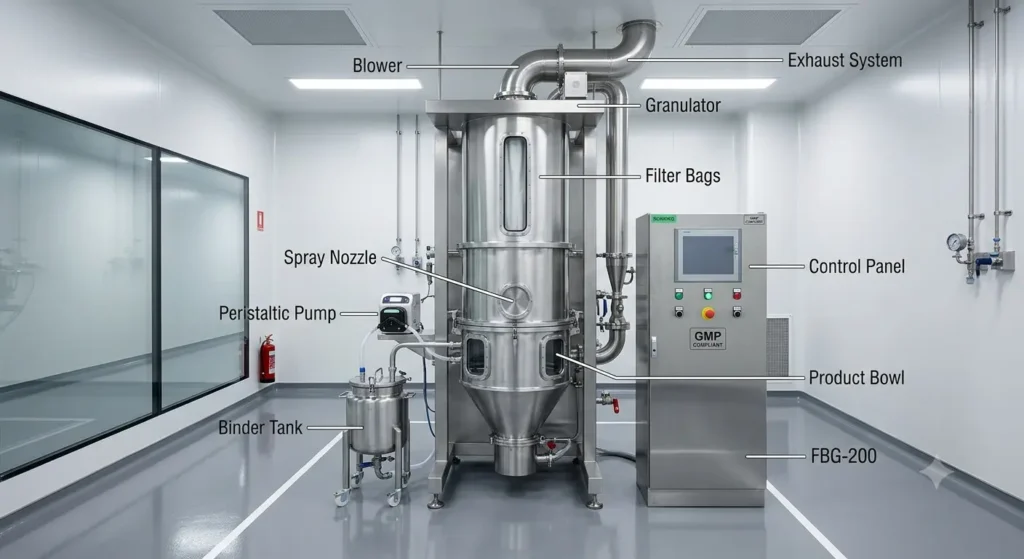
A fluid bed granulator is a self-contained system built around one central chamber, the product bowl, supported by several linked components that control airflow, spraying, and filtration. Knowing what each part does makes it much easier to troubleshoot problems on the shop floor.
| Component | Function |
| Product Bowl | Holds the powder bed where fluidization, spraying, granulation, and drying take place. |
| Air Handling Unit (AHU) | Filters, heats, and controls the humidity of the process air before it enters the bowl. |
| Blower | Generates the airflow needed to fluidize the powder bed and drive drying. |
| Filter Bags | Retain fine particles inside the bowl and prevent product loss into the exhaust air, while allowing air to pass through. |
| Spray Nozzle | Atomizes the binder solution into fine droplets and directs it onto the fluidized bed. |
| Binder Tank | Holds the binder solution or suspension ready for spraying, usually under gentle stirring. |
| Peristaltic Pump | Delivers the binder solution from the tank to the spray nozzle at a controlled, adjustable rate. |
| Exhaust System | Removes moist air from the bowl and carries it out of the machine after passing through the filter bags. |
| Control Panel | Lets operators set and monitor inlet air temperature, airflow, spray rate, and other process parameters. |
| Heating System | Warms the incoming process air to the temperature needed for effective drying. |
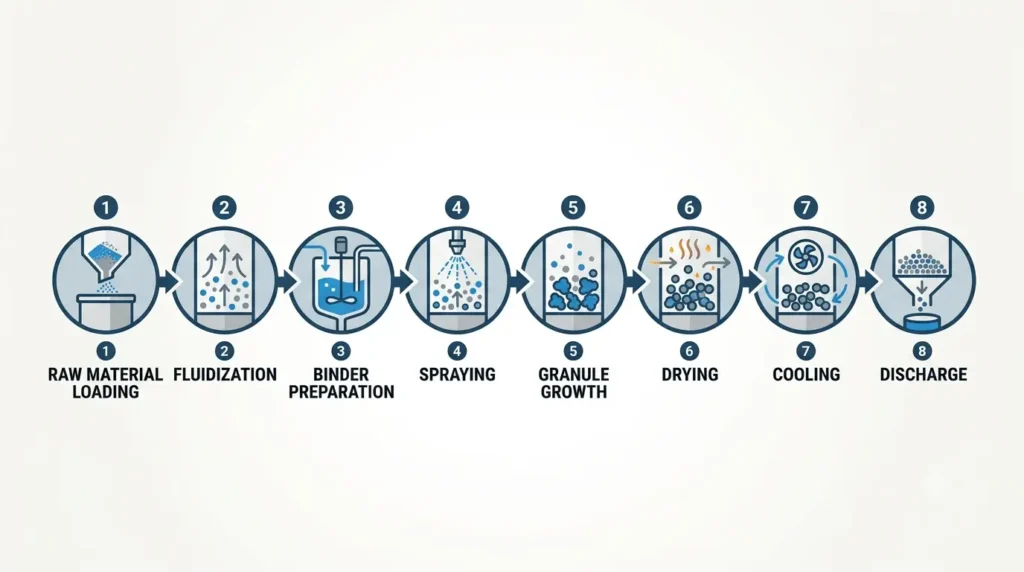
Fluid Bed Granulation Process
Once the equipment is qualified and the batch record is in hand, a typical fluid bed granulation run moves through eight linked stages.
- Raw Material Loading – Pre-sifted active ingredient and excipients are charged into the product bowl, either manually or through a vacuum transfer system, to form the starting powder bed.
- Fluidization – The blower is switched on and airflow is gradually increased until the powder bed fluidizes evenly across the bowl.
- Binder Preparation – The binder solution is prepared separately in the binder tank, filtered if needed, and kept under gentle stirring so it stays homogeneous during spraying.
- Spraying – The peristaltic pump delivers binder solution to the nozzle, which atomizes it onto the fluidized powder at a pre-set spray rate and atomization air pressure.
- Granule Growth – Wetted particles agglomerate and grow layer by layer as spraying continues, with periodic in-process checks confirming that granule size is progressing toward target.
- Drying – Once the target granule size and moisture addition are reached, spraying stops and heated air continues to flow, reducing loss on drying (LOD) to the required endpoint.
- Cooling – Ambient or cooled air is passed through the dried granules to bring the product temperature down before discharge.
- Discharge – The dried, cooled granules are discharged into containers or fed directly into the next processing step, such as blending or compression.
Types of Fluid Bed Granulation
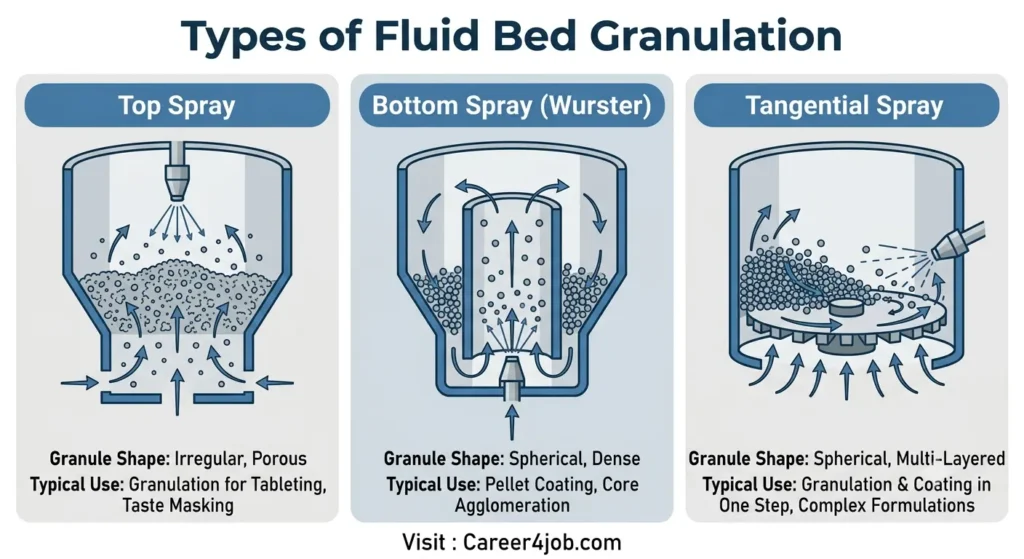
Fluid bed granulators are built with different spray-nozzle positions, and each configuration suits a different kind of product.
Top Spray Granulation: The nozzle sits above the fluidized bed and sprays binder downward onto the rising powder. This is the most common configuration for standard tablet and capsule granulation because it is simple to operate and works well across a wide particle size range.
Bottom Spray Granulation (Wurster process): The nozzle is mounted at the base of the bowl, inside a cylindrical partition, and sprays binder or coating solution upward as particles rise through the column. It is mainly used for pellet coating and modified-release layering because it gives a very uniform film.
Tangential Spray Granulation (Rotor granulation): The nozzle sprays horizontally while a rotating disc at the base of the bowl moves the powder in a spiral path. This configuration produces dense, spherical pellets and is often used to build pellet cores that will later be coated.
| Parameter | Top Spray | Bottom Spray | Tangential Spray |
| Granule shape | Irregular, porous | Uniform, layered | Dense, spherical |
| Typical use | Tablet/capsule granulation | Pellet coating, modified release | Pellet core building |
| Nozzle position | Above the bed | Base, inside partition column | Side, horizontal |
| Process speed | Fast | Slower | Moderate |
| Equipment complexity | Simple | Complex (Wurster insert) | Moderate (rotor disc) |
Critical Process Parameters (CPP)
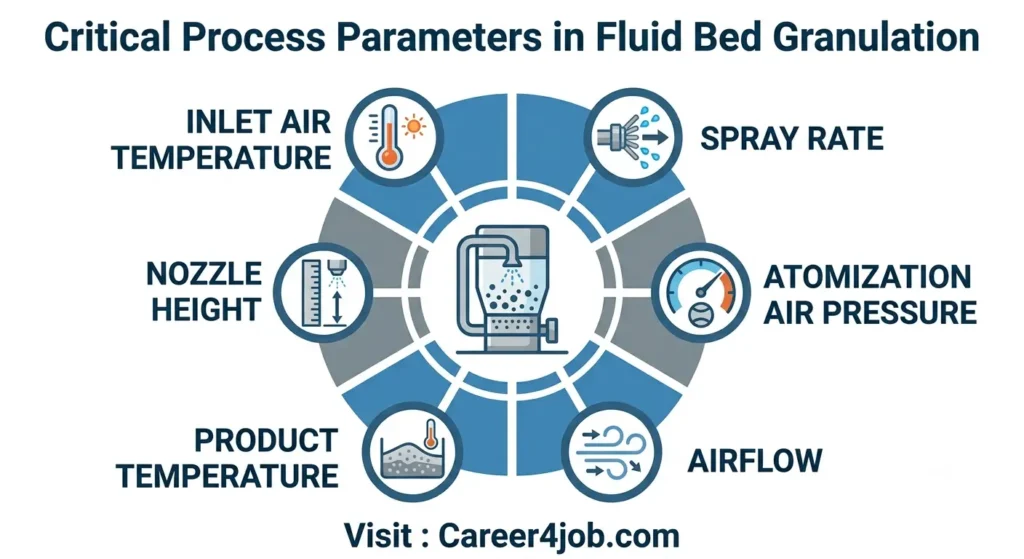
The following parameters are routinely monitored and controlled during a fluid bed granulation batch because they directly determine granule quality.
| Parameter | Effect | Recommended Control |
| Inlet Air Temperature | Controls the rate of moisture evaporation and granule drying. | Set and monitor within a validated range for the specific formulation. |
| Outlet Temperature | Reflects how much drying has actually occurred inside the bed. | Monitor continuously as a process endpoint indicator. |
| Product Temperature | Directly affects binder activation and moisture-sensitive actives. | Track using a calibrated probe placed inside the bed. |
| Spray Rate | Too fast causes over-wetting; too slow slows granule growth. | Set based on batch size and confirm during process development. |
| Atomization Air Pressure | Determines binder droplet size, which affects granule structure. | Keep within the qualified range for the nozzle in use. |
| Airflow | Maintains fluidization and affects drying speed. | Adjust to keep the bed uniformly fluidized without excessive fines. |
| Air Velocity | Too low causes poor fluidization; too high causes product loss to filters. | Balance against batch size and bowl geometry. |
| Fluidization | Uneven fluidization leads to inconsistent granule size. | Visually and instrumentally confirm a stable, expanded bed. |
| Drying Time | Insufficient drying leaves high residual moisture. | Set an LOD-based endpoint rather than a fixed time alone. |
| Binder Concentration | Higher concentration increases granule strength and size. | Standardize per the approved formula and verify viscosity. |
| Batch Size | Affects fluidization behavior and spray coverage. | Scale airflow and spray rate proportionally during scale-up. |
| Nozzle Height | Incorrect height causes spray drying or wall build-up. | Set and lock at the validated distance from the bed surface. |
Critical Quality Attributes (CQA)
Critical quality attributes are the measurable properties of the granules that must stay within an acceptable range for the final dosage form to perform as intended.
- Particle Size – Determines the flow, compressibility, and content uniformity of the final blend.
- Moisture Content – Affects granule stability, flow, and downstream compression performance.
- Flowability – Impacts the consistency of die filling during tableting.
- Bulk Density – Influences tablet weight variation and capsule fill weight.
- Compressibility – Determines how well the granules form a coherent tablet under compression force.
- Uniformity – Ensures each portion of the granule batch contains a consistent ratio of active ingredient to excipients.
- Assay – Confirms the correct amount of active ingredient is present after granulation and drying.
- Dissolution – Reflects how quickly the active ingredient will be released from the final dosage form.
In-Process Quality Checks
During a fluid bed granulation batch, operators and QA perform routine in-process checks to confirm the process is on track before the batch moves to the next stage:
- LOD (Loss on Drying) – Sampled at intervals to track moisture reduction against the target endpoint.
- Granule Size – Checked by sieve analysis to confirm growth is progressing as expected.
- Appearance – Visually inspected for color, uniformity, and the absence of lumps.
- Temperature – Inlet, outlet, and product temperatures are logged at set intervals.
- Moisture – Confirmed with a calibrated moisture analyzer at the drying endpoint.
- Flow Property – Assessed before discharge, often using angle of repose or bulk/tapped density testing.
Advantages of Fluid Bed Granulation
- Combines granulation and drying in a single closed unit, reducing material handling.
- Shorter overall processing time compared to conventional wet granulation.
- Produces porous, free-flowing granules with good compressibility.
- Reduces manual intervention and operator exposure to powder.
- Lower risk of cross-contamination since the product stays in one bowl.
- Uniform heat and mass transfer due to constant fluidization.
- Better control over granule size distribution through adjustable spray parameters.
- Suitable for heat-sensitive materials when operated at controlled, lower temperatures.
- Enables in-line moisture monitoring for real-time process control.
- Scales well from lab-scale to commercial production with proportional parameter adjustment.
- Reduces the number of equipment transfers, lowering yield loss.
- Can be adapted for coating and pellet layering using bottom or tangential spray.
- Improves content uniformity by evenly distributing binder across the powder bed.
- Lower risk of over-massing compared to high shear granulation.
- Supports continuous manufacturing platforms when integrated with automated controls.
Limitations of Fluid Bed Granulation
- High capital and maintenance cost compared to simple wet granulation equipment.
- Requires skilled operators to manage multiple interacting parameters.
- Risk of over-wetting or spray drying if spray rate and airflow are not balanced.
- Not suitable for very fine, cohesive, or poorly flowing powders without pre-treatment.
- Filter bag blockage can interrupt airflow and reduce batch efficiency.
- Higher fines generation if fluidization air velocity is too aggressive.
- Longer cycle times for thick or highly viscous binder solutions.
- Cross-contamination risk still exists between batches if cleaning validation is inadequate.
- Sensitive to changes in ambient humidity, which can alter drying behavior.
- Scale-up is not always linear and can require re-optimization of spray parameters.
Applications of Fluid Bed Granulation
Fluid bed granulation is used well beyond conventional tablets, across several related industries.
- Tablets – Granulating powder blends before compression to improve flow and compressibility.
- Capsules – Producing free-flowing granules that fill capsule shells consistently.
- Nutraceuticals – Granulating vitamin, mineral, and herbal powder blends for tablets and capsules.
- Herbal Products – Agglomerating plant extracts and powders that are otherwise difficult to compress.
- Modified Release Products – Building and coating pellets using bottom spray for controlled drug release.
- Pellet Manufacturing – Forming dense, spherical pellet cores using tangential spray granulation.
- Food Industry – Granulating instant beverage mixes, seasonings, and nutritional powders.
- Chemical Industry – Agglomerating detergents, fertilizers, and other fine powders for dust-free handling.
Common Problems and Troubleshooting
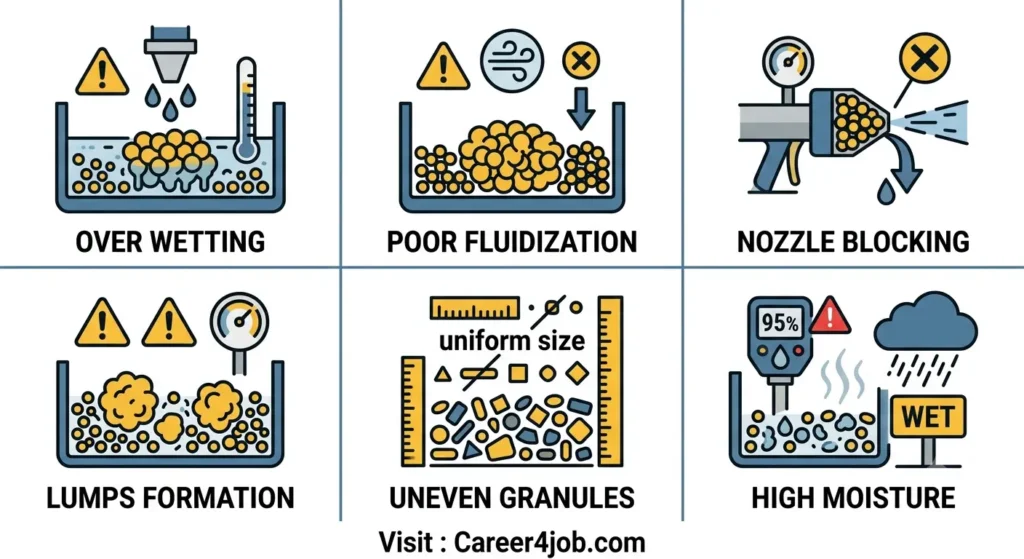
Most fluid bed granulation problems trace back to an imbalance between spray rate, airflow, and drying capacity. The table below summarizes the most frequent issues.
| Problem | Possible Cause | Solution |
| Over Wetting | Spray rate too high or drying airflow too low. | Reduce spray rate, or increase inlet air temperature and airflow. |
| Poor Fluidization | Excess fines, incorrect airflow, or an overloaded bowl. | Adjust airflow and check batch size against bowl capacity. |
| Nozzle Blocking | Dried binder residue or particulate contamination in the nozzle. | Clean the nozzle regularly and filter the binder solution before spraying. |
| Lumps | Localized over-wetting or inadequate atomization. | Check atomization air pressure and spray rate uniformity. |
| Fine Generation | Excessive airflow or attrition during fluidization. | Lower air velocity and review binder concentration. |
| Spray Drying | Nozzle positioned too high or spray rate too low. | Adjust nozzle height and increase spray rate within the validated range. |
| Uneven Granules | Inconsistent fluidization across the bed. | Check for filter bag blockage and uneven airflow distribution. |
| High Moisture | Insufficient drying time or low inlet temperature. | Extend the drying phase and confirm the inlet temperature setting. |
| Attrition | Excessive air velocity or prolonged fluidization. | Reduce airflow once the target granule size is achieved. |
| Sticking | Product build-up on bowl walls due to over-wetting. | Reduce spray rate and check the nozzle spray pattern. |
Fluid Bed Granulation vs High Shear Granulation
Both techniques produce wet granules, but the mechanism, equipment, and resulting granule properties are quite different.
| Parameter | Fluid Bed Granulation | High Shear Granulation |
| Mechanism | Air fluidization and spraying | Mechanical mixing with impeller and chopper |
| Granule density | Low, porous | High, dense |
| Drying | Built into the same unit | Requires a separate dryer |
| Process time | Shorter overall (combined granulation and drying) | Granulation is faster but needs added drying time |
| Equipment cost | Higher | Moderate |
| Granule strength | Softer, more friable | Stronger, more compact |
| Compressibility | Very good | Good, but may need more compression force |
| Scale-up sensitivity | Sensitive to airflow and spray parameters | Sensitive to impeller speed and shear |
| Heat sensitivity handling | Better suited to heat-sensitive actives | Higher shear can generate localized heat |
| Cross-contamination risk | Lower (single unit) | Higher (transfer between granulator and dryer) |
| Batch uniformity | High, due to constant fluidization | Can vary with mixing efficiency |
| Suitable powder type | Free-flowing to moderately cohesive | Cohesive, dense powders |
| Fines generation | Can be higher if airflow is excessive | Generally lower |
| Footprint | Larger, due to air handling components | More compact |
| Energy consumption | Higher (continuous heated airflow) | Lower |
Fluid Bed Granulation vs Conventional Wet Granulation
| Parameter | Fluid Bed Granulation | Conventional Wet Granulation |
| Process steps | Combined granulation and drying in one unit | Separate mixing, wet massing, and tray or oven drying steps |
| Drying time | Fast, even drying through the fluidized bed | Slower, less even drying, especially in tray dryers |
| Granule uniformity | High | Variable, dependent on manual mixing |
| Labor requirement | Lower | Higher, more manual handling |
| Contamination risk | Lower | Higher, due to multiple product transfers |
| Equipment footprint | Compact single unit | Multiple separate machines required |
| Cost | Higher initial investment | Lower initial investment |
| Suitability for heat-sensitive materials | Good, with controlled temperature | Depends heavily on the drying method used |
Cleaning and Maintenance
Cleaning Procedure
- Remove and disassemble the spray nozzle, filter bags, and product bowl after each batch or product change.
- Rinse or wash all product-contact parts according to the approved cleaning SOP.
- Wipe down non-product-contact surfaces and the exterior of the machine.
- Verify visual cleanliness before proceeding to swab or rinse sampling.
- Dry all parts fully before reassembly to prevent microbial growth.
Preventive Maintenance
- Inspect filter bags periodically for wear or blockage and replace them as scheduled.
- Lubricate moving parts such as the blower and peristaltic pump per the maintenance calendar.
- Calibrate temperature probes, airflow sensors, and the control panel at defined intervals.
- Check gaskets and seals for wear to prevent air or product leaks.
- Review the air handling unit filters for pressure drop and replace them as needed.
Inspection Checklist
- Product bowl and internal surfaces free of residue.
- Filter bags intact, correctly seated, and free of holes.
- Spray nozzle clean and unblocked.
- Gaskets and seals in good condition.
- Calibration status of all sensors current.
GMP Requirements
Regulatory bodies expect a documented, qualified, and controlled approach to fluid bed granulation at every stage of the product life cycle.
- Documentation – SOPs, batch manufacturing records, and process specifications must be current, approved, and readily available at the point of use.
- Validation – Process validation confirms that the fluid bed granulation process consistently produces granules meeting predefined quality attributes across multiple validation batches.
- Qualification – Equipment must undergo Design, Installation, Operational, and Performance Qualification (DQ/IQ/OQ/PQ) before routine use.
- Calibration – Instruments such as temperature probes, airflow sensors, and the control panel need periodic calibration traceable to a recognized standard.
- Cleaning Validation – Demonstrates that cleaning procedures reliably remove residues and prevent cross-contamination between products.
- Operator Training – Personnel must be trained on the specific granulator model, the batch record, and relevant SOPs before operating the equipment independently.
- Batch Records – Every batch must be documented in real time, including all critical process parameters, in-process check results, and any deviations.
International guidance from bodies such as the US FDA, the European Medicines Agency, and the World Health Organization underpins most of these expectations, and forms the basis for site-level SOPs and validation master plans.
Safety Precautions
- Wear appropriate personal protective equipment, including masks, gloves, and safety goggles.
- Ensure the exhaust and dust collection system is functioning before starting the batch.
- Never open the product bowl while the blower is running.
- Confirm earthing and static discharge measures are in place before processing flammable solvents.
- Keep fire extinguishing equipment accessible near the granulation area.
- Follow lockout-tagout procedures during maintenance or cleaning.
- Check that all safety interlocks and emergency stop buttons are functional.
- Avoid overloading the product bowl beyond its rated capacity.
- Handle binder solutions and solvents according to their material safety data sheets.
- Ensure adequate room ventilation, especially when using organic solvent-based binders.
- Do not bypass filter bags, as this increases dust exposure and explosion risk.
- Label and store cleaning agents and solvents separately from raw materials.
- Report unusual noise, vibration, or temperature fluctuations immediately to maintenance.
- Ensure operators are trained in dust explosion prevention when handling combustible powders.
- Keep the surrounding floor dry and free of spilled powder to prevent slips.
Frequently Asked Questions (FAQ)
Q: What is fluid bed granulation in pharmaceutical manufacturing?
A: It is a wet granulation method where powder particles are suspended in upward-flowing air and bound together using a sprayed binder solution, with drying taking place in the same equipment right after granule formation.
Q: How is fluid bed granulation different from wet granulation?
A: Fluid bed granulation is a specific type of wet granulation. What sets it apart is that the granulator fluidizes, sprays, and dries the product in one machine, rather than needing separate mixing, wet massing, and drying steps.
Q: What are the main types of fluid bed granulation?
A: The three main types are top spray, bottom spray (Wurster process), and tangential spray granulation, each named for the position of the spray nozzle relative to the fluidized bed.
Q: Which parameters are considered critical process parameters in fluid bed granulation?
A: Inlet air temperature, spray rate, atomization air pressure, airflow, product temperature, and nozzle height are commonly treated as critical process parameters because they directly influence granule size, moisture, and quality.
Q: Why does over-wetting happen in fluid bed granulation?
A: Over-wetting typically happens when the spray rate is too high relative to the drying airflow, or when atomization air pressure is too low, causing binder droplets to accumulate on the powder bed faster than they can be dried.
Q: What is the ideal loss on drying (LOD) for granules?
A: The target LOD depends on the specific formulation and is defined during process development and validation. It is usually confirmed with a calibrated moisture analyzer at the drying endpoint rather than a single universal number.
Q: Can fluid bed granulation be used for heat-sensitive drugs?
A: Yes, as long as inlet air temperature and product temperature are controlled within a validated, lower range, fluid bed granulation can be suitable for actives that are sensitive to heat.
Q: What causes poor fluidization in a fluid bed granulator?
A: Poor fluidization is usually caused by an overloaded product bowl, insufficient airflow, excessive fines, or a blocked filter bag restricting air movement through the bed.
Q: How is granule size controlled during the process?
A: Granule size is controlled through spray rate, binder concentration, atomization air pressure, and spraying duration, with periodic in-process sieve analysis used to confirm growth is on track.
Q: What is the Wurster process?
A: The Wurster process is the bottom spray configuration of fluid bed granulation, commonly used for pellet coating and modified release layering because it produces a very even, uniform coat.
Q: Why is fluid bed granulation preferred for tablet manufacturing?
A: It produces porous, free-flowing granules with good compressibility and uniform drug distribution, while also reducing processing time and material handling compared to conventional wet granulation.
Q: What GMP documents are required for fluid bed granulation?
A: Typical documents include the batch manufacturing record, equipment qualification protocols, process validation reports, cleaning validation records, calibration certificates, and approved standard operating procedures.
Q: How often should filter bags be inspected?
A: Filter bags should be inspected after every batch for visible damage and checked against a scheduled preventive maintenance program, since a blocked or torn bag directly affects fluidization and product loss.
Q: What is the difference between top spray and tangential spray granulation?
A: Top spray sprays binder downward from above the bed and is mainly used for standard granulation, while tangential spray uses a rotating disc and horizontal spray to build denser, more spherical pellet cores.
Q: Is fluid bed granulation suitable for continuous manufacturing?
A: Yes, when integrated with automated process controls and real-time monitoring, fluid bed granulation can be adapted into continuous manufacturing lines, particularly for oral solid dosage forms.
Conclusion
Fluid bed granulation remains one of the most reliable and widely adopted granulation techniques in pharmaceutical manufacturing because it brings mixing, granulation, and drying together in a single, well-controlled process. When critical process parameters such as inlet air temperature, spray rate, and airflow are properly understood and controlled, the result is consistently porous, free-flowing granules that compress well and meet quality requirements batch after batch.
Whether you are new to pharmaceutical production or already managing validation and technology transfer projects, a solid grasp of fluid bed granulation, its working principle, equipment, process parameters, and troubleshooting approach, will help you run more consistent batches and resolve problems faster when they arise.
If you found this guide useful, explore our other articles on pharmaceutical manufacturing processes, from high shear granulation and tablet compression to coating technology and process validation, to keep building your knowledge of solid dosage manufacturing.
References
For further reading and official regulatory guidance related to pharmaceutical granulation and manufacturing, the following authoritative sources are useful starting points:
- US FDA – ICH Q8(R2) Pharmaceutical Development guidance
- European Medicines Agency (EMA) – ICH Q8(R2) Pharmaceutical Development scientific guideline
- World Health Organization (WHO) – Good Manufacturing Practices (GMP) standards
- ISPE – Guidance Documents and Good Practice Guides
- ICH – International Council for Harmonisation, official site and Quality guidelines
Similar Post
- High Shear Granulation in Pharmaceutical Manufacturing
- Tablet Compression Process and Machine Types
- Pharmaceutical Process Validation: A Complete Overview
- Tablet Coating Techniques and Equipment
- Blending and Mixing in Pharmaceutical Manufacturing
- Capsule Filling Machines and Process
- Pellet Coating and Modified Release Technology
- Cleaning Validation in Pharmaceutical Manufacturing
- Equipment Qualification: DQ, IQ, OQ, PQ Explained
- GMP Documentation and Batch Manufacturing Records