Learn how granulation scale-up works in pharmaceutical manufacturing, from lab to pilot to commercial batches, with practical tips and common problems.
Introduction to Granulation Scale-Up
Every pharmaceutical product starts small. A formulator mixes a few hundred grams of powder in a lab, runs a trial batch, and checks if the tablets come out right. But a product can’t stay at lab size forever. At some point, it has to move to pilot batches, and eventually to full commercial production, where batch sizes can be hundreds of kilograms.
This jump from small to large is called scale-up. And when it comes to granulation, scale-up is one of the trickiest steps in the whole manufacturing journey. A process that works beautifully in a one-litre bowl doesn’t always behave the same way in a 500-litre one.
In this article, we’ll walk through what granulation scale-up really means, why it’s so important, what can go wrong, and how manufacturers manage the transition smoothly. We’ve kept the language simple, so this guide works whether you’re a student, a new production officer, or someone brushing up before a plant audit.
Think of it a bit like cooking. A recipe that tastes perfect when you cook for two people doesn’t always taste the same when you try to cook the same dish for two hundred. The ratios might be identical on paper, but heat distribution, mixing time, and even timing can behave differently at a bigger scale. Granulation scale-up deals with exactly this kind of challenge, just in a tightly controlled, regulated manufacturing environment.
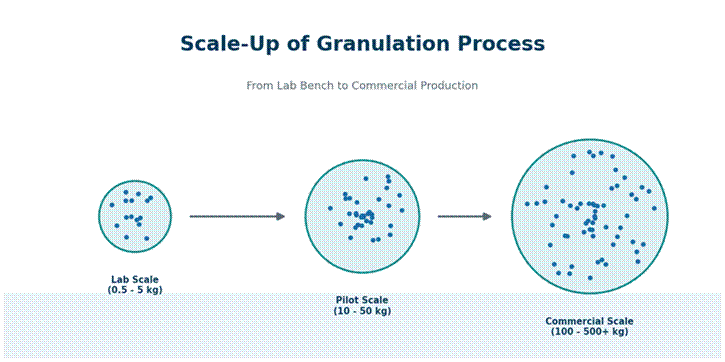
Figure 1: Granulation scale-up moves a process from small lab batches to large commercial batches.
Why Scale-Up Matters in Pharmaceutical Manufacturing
Scale-up isn’t just about making more product. It’s about making sure the bigger batch behaves exactly like the smaller one that was tested and approved. If granule size, moisture content, or flow properties change during scale-up, the final tablets can end up different from what was originally validated.
That difference matters a lot in a regulated industry. Regulatory bodies expect consistent quality, batch after batch, regardless of size. So getting scale-up right isn’t just good practice — it’s often a regulatory requirement too.
- Keeps granule and tablet quality consistent across batch sizes.
- Reduces the risk of failed batches during commercial production.
- Saves time and material by avoiding repeated trial-and-error at large scale.
- Supports a smoother path through regulatory approval and audits.
Common Challenges in Granulation Scale-Up
Scaling up sounds simple on paper — just make more of the same thing. In reality, several things change when batch size grows, even if the formula stays exactly the same. Below are the challenges that come up again and again across the industry.
Equipment Behaves Differently at Larger Sizes
A small mixing bowl and a large one don’t always mix powder the same way, even if their shapes look similar. The distance powder travels, the mixing pattern, and the shear force it experiences can all shift with size.
Heat and Moisture Distribute Unevenly
In a large fluid bed dryer, hot air may not reach every particle as evenly as it does in a small unit, which can lead to some granules drying faster than others.
Process Timing Doesn’t Always Scale in a Straight Line
Massing time, spray time, and drying time that work at lab scale often need adjustment at larger scale — they rarely just multiply in the same proportion as the batch size.
Material Behavior Can Shift with Batch Size
Powder flow, bulk density, and how a blend settles can behave slightly differently once you’re working with much larger quantities, especially with cohesive or poorly flowing powders. A blend that seemed fine in a small container can segregate or clump differently once it’s sitting in a much larger hopper or bowl.
Factors That Affect Granulation Scale-Up
Before scaling up a granulation process, manufacturers study several factors closely. Getting these right early on saves a lot of trouble later.
Equipment Geometry
The shape and proportions of the bowl, impeller, and chopper matter. Many manufacturers try to keep the same shape ratio between small and large equipment, a concept known as geometric similarity.
Impeller Speed and Tip Speed
In high shear granulation, the speed at which the impeller tip moves through the powder is often more important than the rotations per minute (RPM) alone. Matching tip speed between scales is a common scale-up strategy.
Batch Size and Fill Volume
The percentage of the bowl or vessel that is filled with powder can affect mixing efficiency. Keeping a similar fill ratio across scales helps maintain consistent mixing behavior.
Binder Addition Method
How and where the binder is added — spray versus pour, fast versus slow — can behave differently as batch size grows, especially in terms of how evenly it spreads through the powder bed.
Material Properties
Powder flow, particle size, density, and moisture sensitivity of the drug and excipients all influence how the batch responds to scale-up, regardless of equipment settings.
Environmental Conditions
Room humidity and temperature can have a bigger impact on large batches simply because they are exposed to the environment for longer processing times.
Common Approaches to Granulation Scale-Up
There isn’t one single formula that works for every product. Manufacturers usually rely on one or a mix of the following approaches.
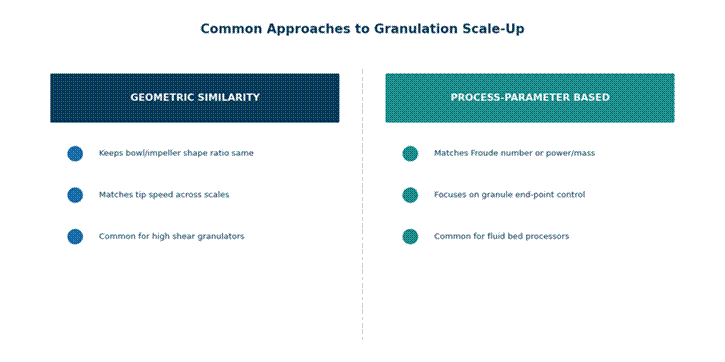
Figure 2: Two common strategies used to scale up a granulation process.
Geometric Similarity
This approach keeps the shape and proportions of the equipment the same across scales, so a larger bowl is essentially a bigger version of the smaller one, with matched impeller and chopper positioning.
Process Parameter Matching
Instead of just matching shapes, this approach tries to match key numbers, such as impeller tip speed, Froude number, or power consumption per unit mass, between the small and large batch.
Quality by Design (QbD) Approach
A more modern approach studies how each process parameter affects granule quality through structured experiments, then builds a ‘design space’ that stays valid across different batch sizes.
A Quick Note on the Froude Number
The Froude number is a simple ratio that compares the centrifugal force from the impeller to gravity. Many formulators use it to help match mixing intensity between a small and large high shear granulator, since it accounts for both speed and impeller size together.
Scale-Up Considerations for Different Granulation Methods
Wet Granulation (High Shear)
For high shear granulators, tip speed and Froude number matching are common strategies. Binder addition rate and massing time are usually adjusted and re-verified through trial batches at each new scale.
Fluid Bed Granulation
Airflow, inlet air temperature, and spray rate all need careful re-balancing as vessel size increases, since air distribution and drying behavior change with bed size and depth.
Roller Compaction
Roller compaction tends to scale up more predictably than wet methods because it’s a continuous, pressure-driven process. Roller speed, roller pressure, and feed screw speed are the main parameters adjusted.
Dry Granulation (Slugging)
Since slugging relies on a tablet press, scale-up mainly involves adjusting compression force and slug thickness, along with confirming the mill settings used to break slugs into granules.
Lab, Pilot, and Commercial Scale: A Quick Comparison
Here’s a simple side-by-side look at how granulation batches typically differ across the three stages of development.
| Stage | Typical Batch Size | Main Purpose | Key Focus |
| Lab Scale | 0.5 – 5 kg | Formula development and early trials | Feasibility and formula screening |
| Pilot Scale | 10 – 50 kg | Process refinement before commercial batch | Process parameter optimization |
| Commercial Scale | 100 – 500+ kg | Routine, ongoing production | Consistency, robustness, validation |
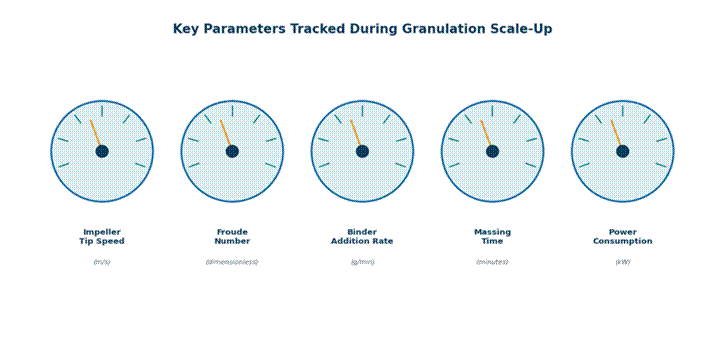
Figure 3: Key process parameters tracked as a granulation batch moves through scale-up.
Common Problems During Scale-Up and How to Fix Them
Scale-up rarely goes perfectly on the first attempt. Here are common issues manufacturers run into, along with practical fixes.
| Problem | Likely Cause | Suggested Fix |
| Granules softer than lab batch | Lower shear or shorter effective massing time at large scale | Re-optimize massing time or impeller speed for the new scale |
| Uneven drying in large batch | Poor air distribution in bigger dryer bed | Adjust airflow rate and check bed depth |
| Granule size larger than expected | Higher local shear near impeller at large scale | Fine-tune chopper speed and binder addition rate |
| Batch-to-batch variation at commercial scale | Process parameters not fully re-verified after scale-up | Run additional confirmation batches before full validation |
| Longer processing time than predicted | Mixing or drying doesn’t scale in a straight line with batch size | Use trial batches at intermediate (pilot) scale to adjust timing |
Best Practices for Smooth Granulation Scale-Up
- Always run a pilot-scale batch before jumping straight to commercial scale.
- Track the same critical process parameters at every scale, not just at the final one.
- Use statistical tools like Design of Experiments (DoE) to understand parameter effects early.
- Keep detailed records of settings and results at each scale for future reference.
- Involve production, QA, and engineering teams early in the scale-up planning process.
- Re-validate granule flow, density, and moisture specs at every new scale, don’t assume they’ll match.
Regulatory Considerations During Scale-Up
Scale-up isn’t only a technical exercise — it’s closely tied to regulatory expectations. Once a manufacturing process is filed with a regulatory authority, any major scale-up change may need supporting data or formal review.
Process validation is a key part of this. Manufacturers are expected to demonstrate, with real batch data, that the scaled-up process consistently produces a product that meets its quality specifications.
For official guidance on scale-up and process validation, these resources are useful starting points: the U.S. Food and Drug Administration (FDA) process validation guidance, the International Council for Harmonisation (ICH) Q8 guideline on pharmaceutical development, and the World Health Organization (WHO) guidance on technology transfer.
A Simple Real-World Example
Imagine a paracetamol tablet formulation developed at 2 kg lab scale using a high shear granulator. The lab batch showed good granule strength and flow. When scaled up to a 25 kg pilot batch, the granules came out noticeably harder, causing slower tablet disintegration.
After review, the team found that impeller tip speed had increased more than expected at the larger scale, creating higher shear on the wet mass. By adjusting impeller speed to better match the original tip speed and slightly reducing massing time, the pilot batch granules matched the lab batch much more closely.
This kind of small, targeted adjustment is typical of real scale-up work — it’s rarely about redesigning the whole process, but fine-tuning specific parameters based on what the data shows.
Future Trends in Granulation Scale-Up
Continuous manufacturing is changing how companies think about scale-up altogether. Instead of scaling a batch process up in size, continuous lines simply run for a longer time at a fixed, already-validated rate, which can reduce classic scale-up risk.
Process Analytical Technology (PAT) tools, like near-infrared sensors, are increasingly used to monitor granule properties in real time during scale-up trials, helping teams catch problems faster than traditional offline testing.
Predictive modeling and simulation tools are also being used more often to estimate how a process will behave at a larger scale before it’s even tested physically, which can shorten development timelines.
Conclusion
Scale-up is one of those steps that looks straightforward from the outside but demands real technical care behind the scenes. Moving a granulation process from a small lab batch to a large commercial one involves far more than simply multiplying quantities.
By understanding the key factors, choosing the right scale-up approach, and testing carefully at each stage, manufacturers can move from lab to commercial production with far fewer surprises — and with a product that stays consistent, batch after batch.
Frequently Asked Questions
Q: What is scale-up in granulation?
A: Scale-up is the process of increasing a granulation batch size, from a small lab batch to a larger pilot or commercial batch, while keeping product quality consistent.
Q: Why does granule quality sometimes change during scale-up?
A: Because equipment behavior, mixing patterns, and heat or air distribution can all shift when batch size increases, even if the formula itself stays the same.
Q: What is geometric similarity in scale-up?
A: It means keeping the shape and proportions of equipment, like the bowl and impeller, consistent between small and large scale versions.
Q: What is tip speed, and why is it important?
A: Tip speed is how fast the outer edge of the impeller moves. It’s often matched across scales because it closely relates to the shear force applied to the wet mass.
Q: Is a pilot batch always necessary before commercial production?
A: In most cases, yes. A pilot batch helps confirm the process works at an intermediate scale before committing to a full commercial batch.
Q: Does roller compaction scale up more easily than wet granulation?
A: Generally yes, since it’s a continuous, pressure-based process that tends to behave more predictably across different scales.
Q: What is Quality by Design (QbD) in relation to scale-up?
A: QbD is an approach where formulators study how process parameters affect product quality upfront, building a ‘design space’ that stays valid even as batch size changes.
Q: How many trial batches are typically needed before commercial scale-up?
A: This varies by product, but most companies run at least one pilot batch, and often more, until process parameters are confirmed to give consistent, reproducible results.
Similar Post
- Fluid Bed Dryer (FBD): Working Principle, Diagram, Operation, Advantages, and Disadvantages
- Table Compression Machine: Complete Guide to Working Principle, Types, Parts, Applications, and Maintenance
- Tablet Coating Machine Explained: Benefits, Working Principle & Applications
- Cleaning Validation: Complete Guide to Process, Protocol, Acceptance Criteria, and FDA Guidelines
- Tablet Manufacturing: Complete Guide to Process, Equipment, Quality Control, and Best Practices