Explore the main types of gas chromatography detectors, how FID, TCD, ECD, and other GC detectors work, and how to pick the right one for your lab.
If you have worked with a gas chromatograph before, you know that the column is very critical component of system. It’s used for separating the different compounds in a sample. But separation is only one part of the process. The column does not identify those compounds or measure how much of each compound is present. That is where the detector comes in—it provides the information needed to understand which are drug or material present in sample.
Gas chromatography detectors sit at the end of the column and convert each separated compound into an electrical signal the software can turn into a peak. The detector you choose decides what you can see, how sensitive your method is, and how selective it is toward the compounds you actually care about. Pick the wrong detector, and even a perfect separation will not give you a usable result.
This guide walks through every major GC detector type — FID, TCD, ECD, FPD, NPD, and GC-MS — in plain English. You will learn how each one works, where it shines, where it struggles, and how to match a detector to your sample, budget, and regulatory requirements. Whether you are a student, a QC analyst, or a lab manager choosing instrumentation, this article is built to answer the practical questions people actually search for when they type “gas chromatography detectors” into Google.
What Are Gas Chromatography Detectors?
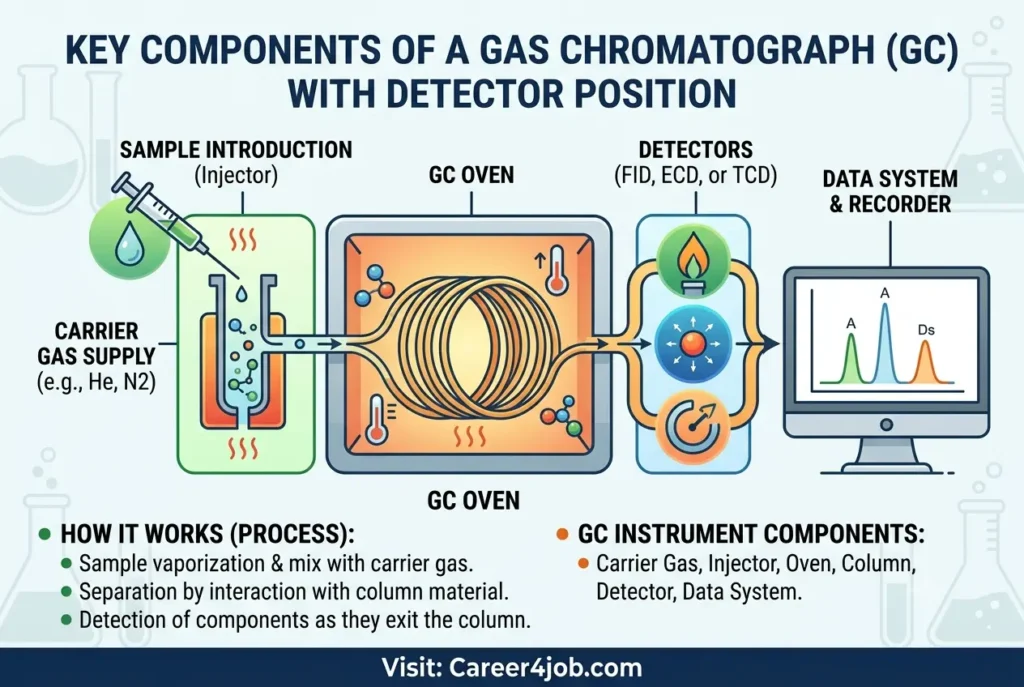
A gas chromatography detector is the component that sits right after the column outlet and measures the compounds as they elute, one after another, in the carrier gas stream. It does not separate anything. Separation already happened inside the column. The detector’s only job is to sense that a compound is present and turn that presence into a measurable signal — usually a tiny electrical current.
Think of the column as a race track and the detector as the finish-line camera. Every runner (compound) crosses the line at a different time. The camera does not care how they got there — it just records who crossed, when, and how big a splash they made. That “splash size” becomes the peak height or area you see in your chromatogram.
Most detectors work by generating a small baseline signal when only carrier gas is flowing, then measuring a change in that signal when a compound passes through. The size of the change is proportional (within a working range) to the amount of compound present. This is what makes GC detectors useful for both identification (retention time) and quantification (peak area).
Why Are GC Detectors Important?
The detector controls four things that decide whether your method actually works in the real world: sensitivity, selectivity, accuracy, and the type of analysis you can run.
Sensitivity
Sensitivity determines the smallest amount of a compound you can reliably detect. A residue testing lab looking for pesticides at parts-per-billion levels needs a detector far more sensitive than a QC lab checking solvent purity at percent levels.
Selectivity
Selectivity determines which compounds the detector responds to. A universal detector like FID responds to almost anything containing carbon. A selective detector like ECD responds strongly to halogenated compounds and barely reacts to everything else. Selectivity is what lets you find a needle in a haystack without seeing the whole haystack.
Accuracy and quantitative analysis
A detector with a wide, linear response range gives you reliable numbers whether the compound is present in trace amounts or in large concentrations. This linearity is what quantitative methods — like calibration curves in pharmaceutical assays — depend on.
Qualitative analysis
Retention time alone can suggest what a compound is, but a detector like GC-MS adds a mass spectrum, giving you a fingerprint that confirms identity with far more confidence than retention time alone.
Example: a food testing lab screening olive oil for pesticide residues will typically pair a non-selective column separation with ECD or GC-MS, because the compounds of interest are present at trace levels and must be positively identified, not just detected.
Types of Gas Chromatography Detectors
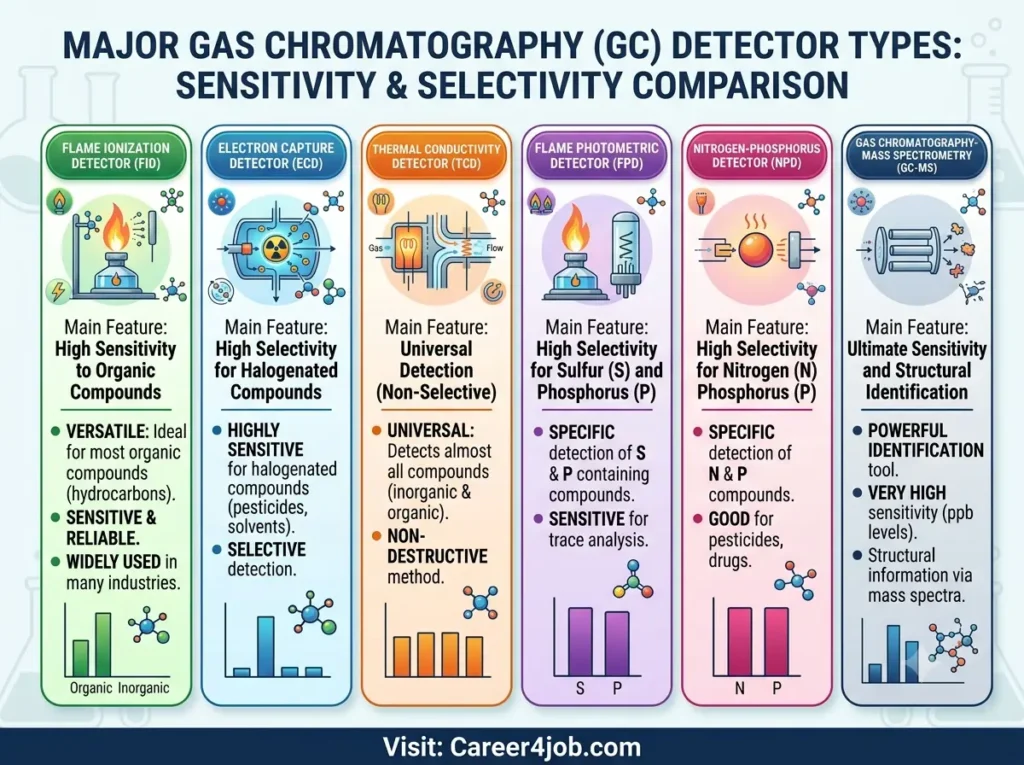
There is no single “best” GC detector. Each type trades sensitivity, selectivity, cost, and complexity differently. Below is a quick overview before we go into each detector in detail.
- FID (Flame Ionization Detector) — the workhorse universal detector for organic compounds
- TCD (Thermal Conductivity Detector) — universal and non-destructive, good for gases
- ECD (Electron Capture Detector) — highly selective for halogenated compounds
- FPD (Flame Photometric Detector) — selective for sulfur and phosphorus compounds
- NPD (Nitrogen Phosphorus Detector) — selective for nitrogen- and phosphorus-containing compounds
- GC-MS (Mass Spectrometry Detector) — near-universal, with full compound identification
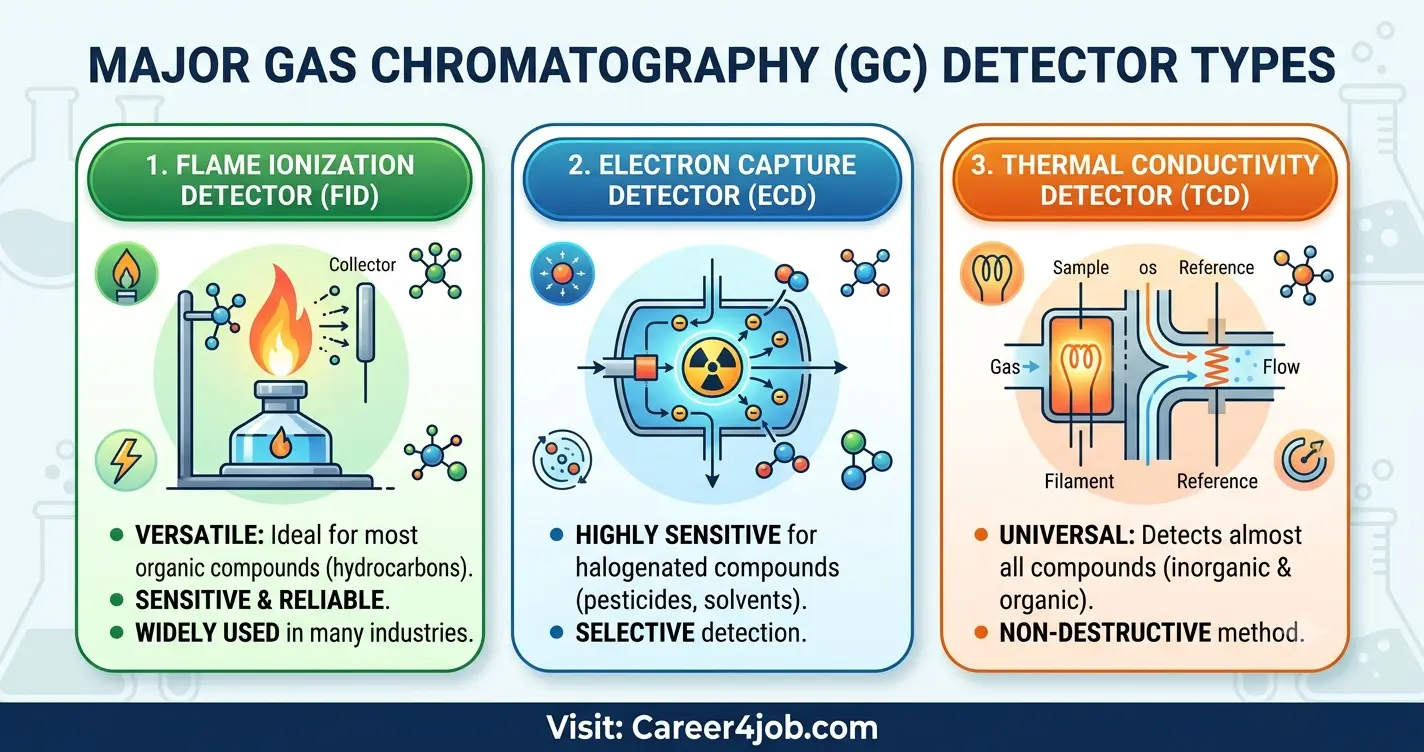
Flame Ionization Detector (FID)
What Is FID?
The flame ionization detector is the most widely used GC detector in the world. It is the default choice for laboratories analyzing organic compounds, and most GC instruments ship with one installed.
Working Principle
As compounds elute from the column, they are mixed with hydrogen and burned in a small flame fed by air. Burning organic compounds in the flame produces ions and electrons. These charged particles are collected by an electrode, and the resulting current is proportional to the number of carbon atoms being burned.
Construction
An FID has a jet where the column effluent mixes with hydrogen, a surrounding air supply to sustain combustion, and a collector electrode positioned above the flame. A polarizing voltage is applied to drive ions toward the collector.
How It Works — Step by Step
- Column effluent enters the FID jet and mixes with hydrogen gas
- The mixture is ignited and burns continuously in air
- Organic compounds burning in the flame produce ions
- The collector electrode captures these ions as a tiny current
- The current is amplified and converted into a chromatographic peak
Advantages
- Excellent sensitivity for almost all organic compounds
- Wide linear dynamic range, good for both trace and major components
- Rugged, reliable, and relatively low maintenance
- Not affected much by moisture or minor column bleed
Limitations
- Destructive — the sample is burned and cannot be recovered or sent to another detector afterward
- Poor or no response to fully inorganic gases such as water, CO2, and noble gases
- Requires hydrogen and air supply, adding a safety and gas-cost consideration
Applications and Best Compounds Detected
FID is the go-to detector for hydrocarbons, solvents, fatty acids, alcohols, and most volatile organic compounds. It is standard in petrochemical labs analyzing fuel composition, in food labs measuring fatty acid profiles, and in environmental labs screening volatile organics.
Maintenance Tips
- Keep the jet clean; residue buildup causes flame instability and signal drift
- Use high-purity hydrogen and air to avoid contaminating the baseline
- Check the flame regularly — a properly lit FID should show a stable, low baseline noise
Thermal Conductivity Detector (TCD)
What Is TCD?
The thermal conductivity detector is the oldest and simplest GC detector still in common use. It is prized for being universal and non-destructive, meaning the sample survives the detector intact.
Working Principle
TCD measures changes in the thermal conductivity of the gas stream. A heated filament sits in the gas flow. Pure carrier gas (usually helium or hydrogen, which conduct heat very well) keeps the filament at a stable temperature. When an analyte with lower thermal conductivity elutes, it insulates the filament, changing its temperature and electrical resistance. That resistance change is the signal.
Construction
A typical TCD has two filaments in a Wheatstone bridge arrangement — one exposed to column effluent, one exposed to a reference flow of pure carrier gas — so temperature drift and pressure fluctuations cancel out.
Advantages
- Truly universal — responds to virtually any compound with different thermal conductivity than the carrier gas
- Non-destructive, so the effluent can be sent to another detector or collected
- Simple, robust, and inexpensive to operate
- Ideal for permanent gases like O2, N2, CO2, and CO, which FID cannot see
Limitations
- Much less sensitive than FID — not suitable for trace analysis
- Requires a carrier gas with very different thermal conductivity than the analytes (helium or hydrogen work best)
- Slower response and lower resolution for closely eluting peaks
Applications and Best Compounds Detected
TCD is the standard choice for permanent gas analysis: natural gas composition, biogas monitoring, and fixed-gas analysis in petrochemical and environmental labs. It is also used in teaching labs because it is simple to understand and maintain.
Maintenance Tips
- Never run a TCD filament with the carrier gas off — it can burn out instantly
- Keep flow rates stable, since the bridge circuit is sensitive to pressure changes
- Allow adequate warm-up and stabilization time before starting a run
Electron Capture Detector (ECD)
What Is ECD?
The electron capture detector is a highly selective detector built around a radioactive source, typically nickel-63. It is famous for its extreme sensitivity to halogenated compounds.
Working Principle
The radioactive source emits beta particles that ionize the carrier gas (usually nitrogen or an argon-methane mix), creating a steady stream of free electrons and a constant baseline current. When an electron-capturing compound — typically one containing chlorine, bromine, fluorine, or a nitro group — elutes, it absorbs some of these free electrons. This reduces the baseline current, and that drop is measured as the signal.
Radioactive Source and Safety Considerations
Because ECD relies on a sealed radioactive source, labs using it must follow specific licensing, handling, and disposal regulations set by national radiation-safety authorities. The source itself is sealed and low-risk under normal use, but instruments must be leak-tested periodically, and disposal at end of life requires a licensed process. Always check local regulatory requirements before installing an ECD.
Advantages
- Extremely sensitive to halogenated and nitro compounds, often into the parts-per-trillion range
- Ideal for trace-level residue analysis where FID would show nothing
- Relatively simple electronics once installed correctly
Limitations
- Regulatory burden due to the radioactive source
- Narrow linear range compared to FID
- Very selective — essentially blind to non-halogenated compounds
- Sensitive to oxygen and moisture contamination, which raises baseline noise
Environmental and Applications
ECD is the classic detector for pesticide residue analysis, PCB testing, and halogenated solvent monitoring in environmental and food-safety labs. It is a common choice for regulatory methods that specifically target organochlorine pesticides.
Maintenance Tips
- Use ultra-high-purity carrier gas; trace oxygen or moisture will quench sensitivity
- Follow your radiation safety officer’s wipe-test schedule
- Avoid injecting samples that could contaminate the cell with non-volatile residues
Flame Photometric Detector (FPD)
The flame photometric detector is a selective detector built for sulfur- and phosphorus-containing compounds. It burns the column effluent in a hydrogen-rich flame, similar to FID, but instead of measuring ions, it measures the light emitted by excited sulfur or phosphorus species as they cool.
Sulfur Analysis
Sulfur compounds burning in the flame form excited S2 molecules that emit a characteristic blue-green light around 394 nm. A narrow-bandpass optical filter isolates this wavelength, and a photomultiplier tube measures the intensity.
Phosphorus Analysis
Phosphorus compounds emit light near 526 nm through an HPO species formed in the flame. A separate filter setting targets this emission for phosphorus-selective analysis.
Industries Using FPD
- Petroleum and natural gas — measuring total sulfur content for fuel-quality specifications
- Agriculture — detecting organophosphate pesticide residues
- Environmental monitoring — sulfur compounds linked to air quality and odor complaints
FPD’s main limitation is a non-linear response for sulfur (the signal is roughly proportional to the square of concentration), which means calibration needs extra care compared to a linear detector like FID.
Nitrogen Phosphorus Detector (NPD)
The nitrogen phosphorus detector, sometimes called a thermionic detector, is built specifically to find nitrogen- and phosphorus-containing compounds while suppressing the response to ordinary hydrocarbons.
Working Principle
NPD uses a heated alkali-metal bead (usually a rubidium or cesium salt) positioned near a small hydrogen flame. Nitrogen- and phosphorus-containing compounds interact with the bead surface in a way that dramatically enhances ion formation compared to hydrocarbons, which barely register.
Selectivity
This design gives NPD selectivity ratios of roughly 10,000:1 for nitrogen or phosphorus compounds over carbon-only compounds, making it possible to spot trace nitrogen- or phosphorus-based analytes in a complex hydrocarbon background without the background overwhelming the signal.
Applications
- Pesticide residue screening, particularly organophosphate and carbamate classes
- Pharmaceutical analysis of nitrogen-containing drug compounds
- Forensic toxicology screening for drugs and their nitrogen-based metabolites
Mass Spectrometry Detector (GC-MS)
GC-MS pairs a gas chromatograph with a mass spectrometer acting as the detector. Instead of producing a single signal per compound, it produces a full mass spectrum — a fingerprint that can be matched against reference libraries for confident identification.
Ionization
Most GC-MS systems use electron ionization (EI), where compounds are bombarded with high-energy electrons as they enter the source. This knocks electrons out of the molecules, creating ions that fragment in predictable, reproducible patterns. Some methods use the gentler chemical ionization (CI) when an intact molecular ion is needed.
Mass Analyzer
The ions are separated by their mass-to-charge ratio, most commonly using a quadrupole mass analyzer, though time-of-flight and ion trap analyzers are also used for specific applications requiring higher resolution or faster scanning.
Identification
Each compound’s fragmentation pattern is compared against a mass spectral database or library to identify unknowns, or the system can be set to monitor only specific ions (SIM mode) for targeted, highly sensitive quantification.
Advantages
- Near-universal response combined with true structural identification
- Can confirm compound identity, not just estimate it from retention time
- Selected ion monitoring gives excellent sensitivity for targeted compounds
- A single run can screen for hundreds of compounds simultaneously
Limitations
- Higher purchase and running cost than single-purpose detectors
- Requires vacuum systems and more specialized training
- Generally destructive to the sample
- Can be less rugged with dirty or high-matrix samples than a simple FID
Pharmaceutical, Forensic, and Food Testing Applications
GC-MS is the reference method for confirming drug identity in pharmaceutical impurity profiling, for forensic toxicology and drug-screening casework where legal defensibility matters, and for food-safety labs confirming pesticide or contaminant identity beyond a simple retention-time match.
Comparison of GC Detectors
The table below summarizes how the major detector types compare across the factors that matter most when choosing one.
| Detector | Sensitivity | Selectivity | Destructive? | Best For | Relative Cost |
| FID | High | Universal (organics) | Yes | Hydrocarbons, solvents, general organics | Low |
| TCD | Moderate | Universal (all compounds) | No | Permanent gases, non-destructive checks | Low |
| ECD | Very High | Halogenated / nitro compounds | No | Pesticides, PCBs, halogenated solvents | Medium |
| FPD | High (S/P only) | Sulfur / phosphorus | Yes | Fuel sulfur, organophosphate pesticides | Medium |
| NPD | High (N/P only) | Nitrogen / phosphorus | Yes | Pesticides, nitrogen-containing drugs | Medium |
| GC-MS | High | Near-universal + identification | Yes | Compound confirmation, screening, forensics | High |
Advantages vs. Disadvantages at a Glance
| Detector | Key Advantage | Key Disadvantage |
| FID | Sensitive and reliable for organics | Blind to inorganic gases; destructive |
| TCD | Universal and non-destructive | Low sensitivity |
| ECD | Extremely sensitive to halogens | Radioactive source; narrow linear range |
| FPD | Selective for S and P | Non-linear response for sulfur |
| NPD | High selectivity for N and P | Bead degrades over time, needs replacement |
| GC-MS | Confirms compound identity | High cost and complexity |
How to Choose the Right GC Detector
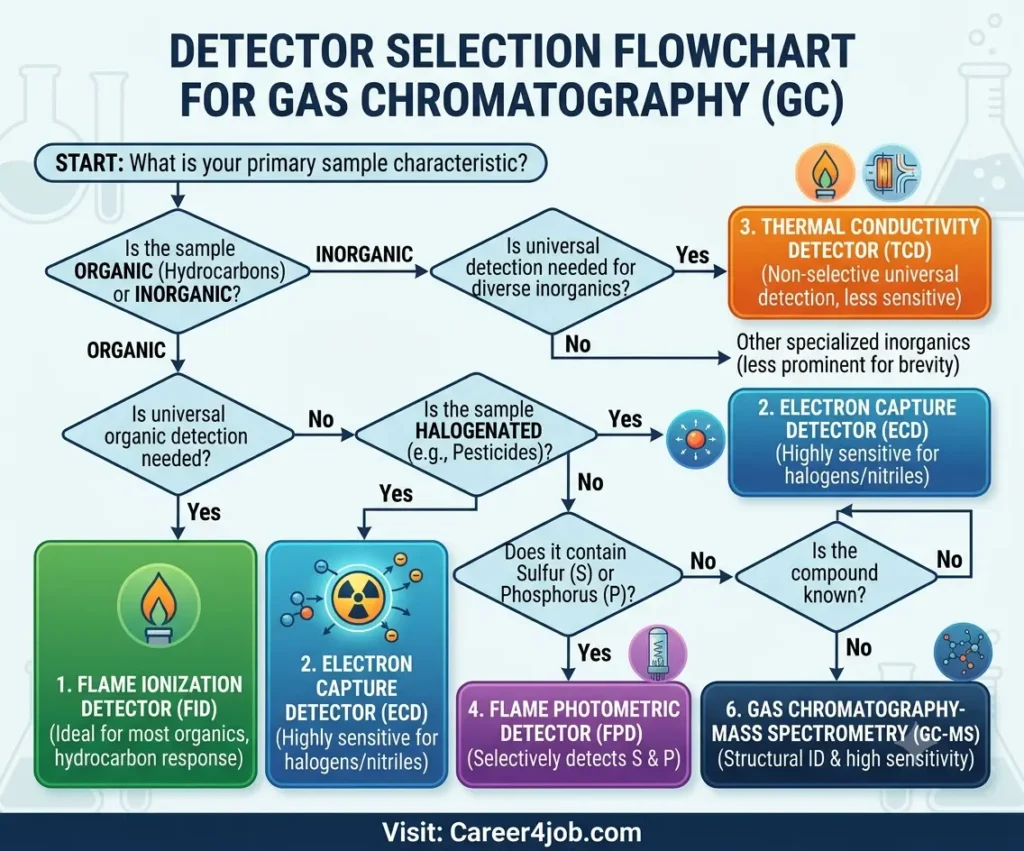
Choosing a detector is really a matter of matching its strengths to your sample type, required sensitivity, and lab constraints. Work through these factors in order.
Sample Type
Are you analyzing hydrocarbons, permanent gases, halogenated compounds, or nitrogen/phosphorus pesticides? The compound class narrows your choice immediately — FID for general organics, TCD for gases, ECD for halogens, FPD or NPD for sulfur/nitrogen/phosphorus targets.
Concentration Level
Trace-level work (ppb or lower) usually rules out TCD and points toward ECD, NPD, or GC-MS in SIM mode. Major-component analysis, such as solvent purity, works fine with FID or TCD.
Budget
FID and TCD are the most budget-friendly to purchase and run. ECD, FPD, and NPD sit in the middle. GC-MS carries the highest upfront and maintenance cost but often replaces the need for multiple selective detectors.
Maintenance Capacity
Consider what your team can realistically maintain. GC-MS needs vacuum-system upkeep and more specialized troubleshooting skills. NPD beads need periodic replacement. TCD and FID are comparatively low-maintenance.
Required Sensitivity
Match the detector’s typical detection limit to your method’s requirement. Regulatory residue limits, for instance, often dictate ECD or GC-MS rather than FID.
Regulatory Needs
Some regulatory methods specify the detector by name (for example, many pesticide residue methods specify ECD or GC-MS). Check the applicable method or standard before assuming a substitute detector is acceptable.
Laboratory Workload
High-throughput QC labs often prefer simpler, faster detectors like FID for routine screening, reserving GC-MS for confirmatory testing on flagged samples only.
Detector Selection Checklist
- What compound class am I targeting?
- What is the required detection limit?
- Does a regulatory method specify a detector?
- Can my budget support the purchase and running cost?
- Does my team have the skills to maintain this detector?
- Do I need compound identification, or just detection?
- Will this detector be used for routine screening or confirmatory testing?
- Compare instrument and detector pricing across major vendors such as Shimadzu, Thermo Fisher Scientific, and PerkinElmer before committing to a configuration.
Real-Life Applications
| Industry | Typical Detector(s) | Example Use Case |
| Pharmaceuticals | FID, GC-MS | Residual solvent testing, impurity profiling |
| Food testing | ECD, FPD, GC-MS | Pesticide residues, fatty acid profiling |
| Environmental monitoring | ECD, FID, GC-MS | Soil and water contaminant screening |
| Petrochemical | FID, TCD, FPD | Fuel composition, sulfur content |
| Forensic science | GC-MS | Drug identification, toxicology casework |
| Clinical laboratories | GC-MS, NPD | Blood alcohol testing, drug screening |
| Research laboratories | GC-MS, FID | Novel compound characterization |
| Agriculture | NPD, FPD, ECD | Organophosphate and organochlorine residues |
Common Mistakes When Selecting GC Detectors
Mistake 1: Choosing a detector based on cost alone
A cheaper detector that cannot reach the required sensitivity ends up costing more in repeated testing and failed method validations. Solution: match sensitivity requirements first, then compare cost among detectors that qualify.
Mistake 2: Ignoring regulatory method requirements
Some standard methods name a specific detector. Substituting another detector, even a more sensitive one, can invalidate results for compliance purposes. Solution: always check the referenced method before finalizing detector choice.
Mistake 3: Overlooking maintenance burden
A highly capable detector that your team cannot properly maintain will produce inconsistent results. Solution: be honest about in-house expertise and factor training time into the decision.
Mistake 4: Assuming one detector fits every sample type
Labs running diverse sample types often try to force everything through a single universal detector. Solution: consider a dual-detector setup or detector switching for labs with varied testing needs.
Mistake 5: Underestimating gas purity requirements
Detectors like ECD and FID are sensitive to gas purity. Using lower-grade carrier or fuel gas introduces baseline noise and drift that mimics real peaks. Solution: use the gas purity grade specified by the instrument manufacturer.
Expert Tips
- Run a system suitability test before every batch — a stable baseline tells you more about detector health than any single peak.
- Log detector maintenance (jet cleaning, bead replacement, source leak tests) so drift issues can be traced to a cause instead of guessed at.
- When switching from FID to a selective detector like ECD or NPD, re-verify your calibration curve rather than assuming linearity carries over.
- For trace analysis, always run a solvent blank between samples to rule out carryover, especially with sensitive detectors like ECD.
- If two detectors could technically do the job, choose the one your team can maintain consistently — consistency beats theoretical sensitivity in daily practice.
Frequently Asked Questions
What is the most common GC detector?
The flame ionization detector (FID) is the most widely used GC detector because it offers strong sensitivity for organic compounds, a wide linear range, and relatively simple operation and maintenance.
Which detector is best for hydrocarbons?
FID is generally the best choice for hydrocarbons. It responds strongly to carbon-containing compounds and is the standard detector for petrochemical and solvent analysis.
What is the difference between FID and TCD?
FID is destructive, more sensitive, and responds only to organic (carbon-containing) compounds. TCD is non-destructive, less sensitive, and responds to virtually any compound, including permanent gases that FID cannot detect.
Which detector is non-destructive?
TCD is the most commonly used non-destructive GC detector, which is why it is often chosen when the sample needs to be preserved or sent to another detector afterward.
Why is ECD used for pesticides?
Many pesticides, especially organochlorine compounds, contain halogen atoms that strongly capture electrons. ECD is extremely sensitive to these compounds, making it well suited for detecting pesticide residues at trace levels.
Can one GC use multiple detectors?
Yes. Many gas chromatographs are configured with dual detectors, such as FID and ECD in parallel, using a column effluent splitter. This lets a single injection generate two complementary sets of data.
What is the most sensitive GC detector?
ECD and GC-MS in selected ion monitoring (SIM) mode are generally the most sensitive, though ECD’s sensitivity applies specifically to halogenated and electron-capturing compounds.
How do I select the right detector?
Start with your target compound class, then confirm the sensitivity level you need, check whether a regulatory method specifies a detector, and finally weigh cost and maintenance capacity before deciding.
Conclusion
Gas chromatography detectors are what turn a good separation into a usable result. FID remains the reliable, general-purpose workhorse for organic compounds. TCD offers a simple, non-destructive option for gases. ECD delivers exceptional sensitivity for halogenated residues. FPD and NPD bring targeted selectivity for sulfur, phosphorus, and nitrogen compounds. GC-MS adds true compound identification on top of near-universal detection.
There is no universally “best” gas chromatography detector — only the detector that best matches your sample type, required sensitivity, budget, and regulatory needs. Use the comparison table and selection checklist in this guide as a starting point and revisit your choice whenever your sample matrix or detection limits change.
If you are setting up or troubleshooting a GC method, take the time to match the detector to the job before you touch the column chemistry — it will save you far more time than optimizing an oven ramp on the wrong detector. For a deeper look at the separation side of the process, explore our companion guides below.
People also interested in these articles
- Pharmaceutical Stability Testing Guide: How to Keep Medicines Safe and Effective
- Cold Chain in Pharmaceutical Industry: A Complete Guide
- HPLC Explained: Principle, Instrumentation, Working, Types, Applications, Validation & Interview Questions
- Dissolution Testing in Pharmaceutical Industry
- UV Spectroscopy: Principle, Instrumentation, Working, Applications, Advantages & Limitations (Complete Guide)
- Gas Chromatography: Principles, Working, Components, Applications, Advantages & Limitations
- Pharma QA vs QC Difference