A simple, honest breakdown of what a B.Pharm graduate actually earns as a government hospital pharmacist — pay levels, in-hand salary, allowances, and how to get there.
Introduction
If you have finished your B.Pharm degree, or you are close to finishing it, there is a good chance one question keeps popping into your head: how much does a B Pharmacy graduate actually earn in a government hospital? It is a fair question. A government job means job security, a pension, medical benefits, and a steady paycheck that does not depend on how busy the hospital was that month.
This guide breaks down the real numbers. No vague promises, no exaggerated figures. Just the pay scale, the allowances, and what you can expect at every stage of your career as a government hospital pharmacist in India.
Quick Answer: How Much Does a Government Hospital Pharmacist Earn?
Most B.Pharm graduates who join a government hospital as a pharmacist start under Pay Level 5 of the 7th Central Pay Commission (7th CPC). The basic pay begins at ₹29,200 per month. Once you add Dearness Allowance (DA), House Rent Allowance (HRA), and Transport Allowance (TA), the gross monthly salary usually falls between ₹45,000 and ₹55,000, and the in-hand salary after deductions is roughly ₹40,000 to ₹51,000 per month.
Some state government hospitals pay less than central government bodies, especially at the start. A state-run hospital pharmacist may begin around ₹18,000 to ₹27,000 per month, while central institutions like AIIMS, ESIC, and Indian Railways usually pay closer to the higher end.

B Pharmacy Government Hospital Salary: Pay Scale Table
Here is a simple table showing how the pay looks at different stages of a government pharmacist’s career.
| Career Stage | Pay Level (7th CPC) | Basic Pay (₹/month) | Approx. In-Hand Salary (₹/month) |
| Fresher / Entry-level | Level 5 | ₹29,200 | ₹40,000 – ₹51,000 |
| After 5–6 years (1st increment cycle) | Level 5/6 | ₹35,000 – ₹42,000 | ₹48,000 – ₹58,000 |
| Senior Pharmacist (10+ years) | Level 6 | ₹44,900 onward | ₹58,000 – ₹70,000 |
| Chief Pharmacist / Pharmacy Officer | Level 7 | ₹44,900 – ₹1,42,400 | ₹75,000 – ₹95,000 |
These figures change slightly with every Dearness Allowance revision, which usually happens twice a year. The numbers above are a realistic 2026 estimate, not a fixed guarantee, since exact pay depends on your posting location and the specific recruiting body.
Salary by Government Hospital or Department
Not every government job pays the same. Central government institutions generally offer a slightly better starting package than state-run hospitals, mainly because of higher DA rates and better HRA slabs in bigger cities. Here is how the major recruiters compare.
| Employer | Starting Basic Pay | Approx. Monthly In-Hand |
| State Government Hospital | ₹19,900 – ₹29,200 | ₹18,000 – ₹35,000 |
| Indian Railways (RRB) | ₹29,200 | ₹24,000 – ₹50,000 |
| ESIC Hospitals | ₹29,200 | ₹43,000 – ₹51,000 |
| AIIMS | ₹29,200 | ₹30,000 – ₹92,300 (with growth) |
| Army / Defence Medical Services | ₹19,900 | ₹35,000 – ₹63,200 |
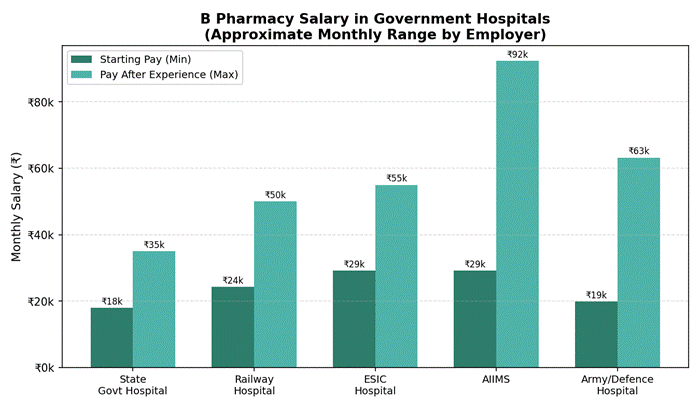
Chart: Approximate monthly salary range across different government hospital employers.
What Decides Your Pay Level?
Government pay is not random. It follows a fixed structure called the Pay Matrix, introduced under the 7th Pay Commission. A few things decide where you land on it:
- Your post: Pharmacist Grade II, Grade I, or Chief Pharmacist all sit at different pay levels.
- Your years of service: every year adds an increment, usually around 3% of basic pay.
- Your posting city: HRA is higher in metro cities like Delhi, Mumbai, and Bengaluru compared to smaller towns.
- Departmental promotions: moving up through seniority or a promotion exam raises your pay level entirely.
- Special postings: work in trauma wards, infectious disease units, or remote areas can bring extra allowances.
Allowances and Benefits Beyond Basic Pay
The basic pay is only part of the story. Government jobs are attractive mainly because of what comes on top of it.
- Dearness Allowance (DA) — revised twice a year to offset inflation, currently around 55–60% of basic pay.
- House Rent Allowance (HRA) — 8% to 24% of basic pay depending on the city category.
- Transport Allowance (TA) — a fixed monthly amount for commuting.
- Medical benefits — free or subsidised treatment for the employee and dependents.
- Leave Travel Concession (LTC) — travel reimbursement once every two years.
- Pension and gratuity — under the National Pension System (NPS), plus gratuity after retirement.
- Paid leave — casual leave, earned leave, and medical leave as per government service rules.
Government vs Private Hospital: Which Pays Better?
This is the question every fresher eventually asks. The honest answer is: it depends on your priorities.
In the first two to three years, private hospitals can sometimes pay a similar or even slightly better starting salary in big cities. But government pay grows in a fixed, predictable way, and it comes with a pension and job security that private jobs rarely match. Over a 15 to 20 year career, most government pharmacists end up ahead once you count total benefits, not just the basic number on the payslip.
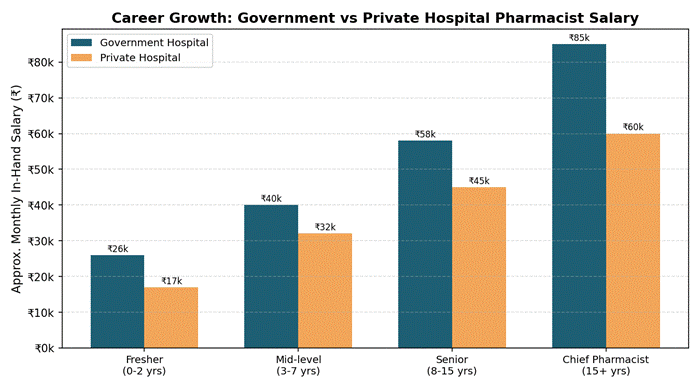
Chart: How government and private hospital pharmacist salaries typically grow over a career.
How to Get a Government Pharmacist Job
Government pharmacist posts are filled through competitive exams, not direct applications. Here is the usual path:
- Complete your B.Pharm (or D.Pharm) from a college recognised by the Pharmacy Council of India.
- Register with your State Pharmacy Council — this is mandatory to legally practise as a pharmacist.
- Watch for notifications from AIIMS, ESIC, RRB (Railways), SSC, State Health Departments, and Defence services.
- Prepare for the written exam, which usually tests pharmacy subjects along with general awareness and reasoning.
- Clear document verification and, in some cases, a short interview or skill test.
- Complete a probation period — often one to three years — before you get confirmed on full pay.
Career Growth After Joining
A government pharmacist career is slow but steady. Promotions usually happen through a Departmental Promotion Committee (DPC) based on seniority and performance. Even without a direct promotion, most departments offer financial upgradation under the MACP scheme after 10 years of service, so your pay keeps rising even if your post title does not change right away.
With experience, a government hospital pharmacist can move into roles such as Senior Pharmacist, Pharmacy Officer, Chief Pharmacist, or even administrative and teaching positions in government medical colleges and training institutes.
Tips to Increase Your Salary as a Pharmacist
- Add a postgraduate qualification like M.Pharm or Pharm.D — this helps in promotions and specialised postings.
- Apply to central government bodies (AIIMS, ESIC, Railways) rather than only state boards, since central pay is often higher.
- Prepare seriously for departmental promotion exams instead of waiting only for seniority-based upgrades.
- Take up postings that carry special duty allowances, such as trauma or infectious disease wards.
- Keep your PCI registration and continuing education credits updated — some states link this to eligibility for promotion.
Frequently Asked Questions
Q1. What is the starting salary of a B.Pharm graduate in a government hospital?
Most freshers start around ₹29,200 basic pay under Pay Level 5, which works out to roughly ₹40,000–₹51,000 in-hand after allowances, though state hospitals may start lower.
Q2. Is D.Pharm enough, or do I need B.Pharm for a government hospital job?
Both D.Pharm and B.Pharm holders can apply for most Pharmacist Grade II posts. A B.Pharm degree opens up a few additional and senior-level opportunities.
Q3. Which exam should I prepare for to get a government pharmacist job?
Watch for AIIMS CRE, ESIC recruitment, RRB Pharmacist notifications, SSC exams, and your State Health Department or PSC recruitment drives.
Q4. Does government pharmacist salary include a pension?
Yes. Most government pharmacists are covered under the National Pension System (NPS), along with gratuity and leave encashment benefits after retirement.
Q5. How long does it take to reach a senior pharmacist post?
With regular promotions or MACP upgradation, most pharmacists reach a senior pay level within 10 to 15 years of service.
Final Thoughts
A government hospital pharmacist job will not make you rich overnight. What it offers instead is something a lot of freshers underestimate at 22 years old: stability. A fixed pay scale that only goes up, a pension waiting at the end, medical cover for your family, and a job nobody can suddenly take away. If you are the kind of person who values that kind of security over a slightly higher private-sector number, preparing for a government pharmacist exam is one of the smartest moves you can make after B.Pharm.
References and Further Reading
- Pharmacy Council of India — official regulatory body for pharmacy education and registration.
- 7th Central Pay Commission Pay Matrix — Department of Expenditure, Ministry of Finance.
- Employees’ State Insurance Corporation — recruitment and pay details for ESIC pharmacists.
- Railway Recruitment Board — notifications for RRB Pharmacist posts.