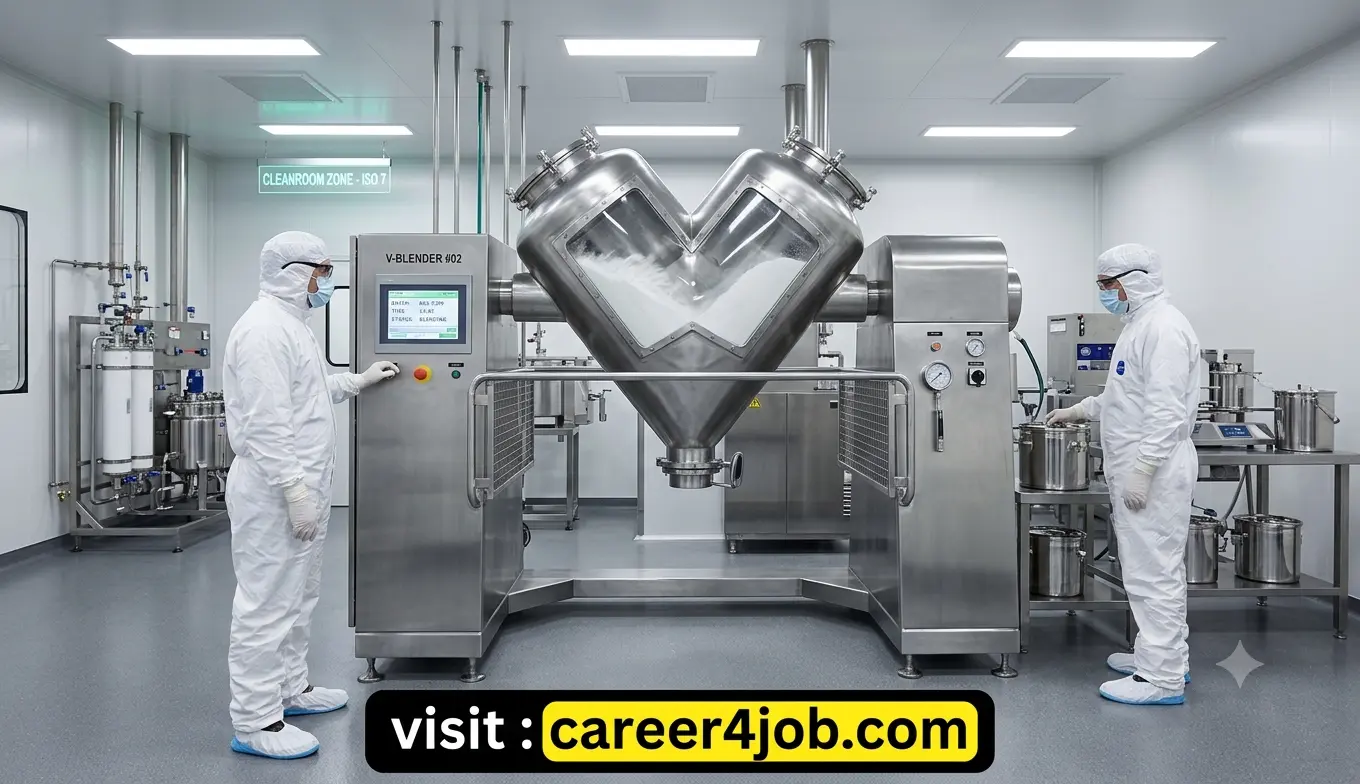
Learn how blending and mixing in pharmaceutical manufacturing ensure product quality, safety, and GMP compliance in every batch.
Every tablet you swallow started as loose powder. Before it became a solid dose, that powder went through one of the most important steps in the entire production line. That step is blending and mixing in pharmaceutical manufacturing.
Without proper blending and mixing, medicines would not work the way they should. Some tablets would have too much active ingredient. Others would have too little. That is why pharmaceutical companies spend so much time and money getting this step right.
In this guide, you will learn what blending and mixing really mean, how they differ, which equipment is used, and why regulators care so much about this process. We will also cover common problems, quality checks, and where the industry is heading next.
What is Blending in Pharmaceutical Manufacturing?
Blending is the process of combining two or more dry powders until they form one uniform mixture. In pharmaceutical manufacturing, this usually means combining the active pharmaceutical ingredient (API) with excipients like fillers, binders, and lubricants.
The goal is simple. Every scoop of the blended powder should contain the same ratio of ingredients as every other scoop. This is called blend uniformity, and it is one of the most watched numbers in the entire production process.
Purpose of blending:
- Distribute the active ingredient evenly through the powder mass
- Prepare powder for the next step, such as granulation or compression
- Improve flow properties before tableting or capsule filling
Advantages of blending:
- Ensures every dose has the correct amount of medicine
- Reduces waste from failed batches
- Supports consistent tablet weight and hardness
- Makes the manufacturing process repeatable
Applications:
Blending is used to prepare powders for tablets, capsules, sachets, and dry powder inhalers. It is also used in the early stages of making creams and ointments, where dry ingredients need to be combined before liquids are added.
What is Mixing in Pharmaceutical Manufacturing?
Mixing is a broader term. It refers to combining materials of different physical states, such as solids with liquids, or liquids with liquids, to form a uniform product. Pharmaceutical mixing covers everything from wet granulation to the making of syrups and creams.
Definition: Mixing is the mechanical process of bringing different components together so they lose their individual identity and form one consistent product, whether that is a paste, a liquid, or a semi-solid cream.
Importance: Mixing affects the texture, stability, and performance of the final product. Poor mixing can cause a cream to separate or a suspension to settle unevenly, which affects how well the medicine works.
Working principle: Most mixers work by applying mechanical energy through blades, paddles, or high-speed impellers. This energy breaks up clumps, disperses particles, and blends liquids together until the mixture is uniform throughout.
Examples:
- Mixing water with a binder solution for wet granulation
- Combining active ingredients into a cream base
- Blending liquid excipients for an oral suspension
Difference Between Blending and Mixing
People often use these two words interchangeably, but in pharmaceutical manufacturing, they mean different things. Blending usually refers to dry powder combination, while mixing includes wet, semi-solid, and liquid processes.
| Feature | Blending | Mixing |
| Materials involved | Dry powders only | Solids, liquids, or both |
| Physical state | Solid to solid | Solid-liquid, liquid-liquid |
| Common equipment | V blender, ribbon blender, bin blender | High shear mixer, planetary mixer, static mixer |
| Typical products | Tablets, capsules, sachets | Creams, ointments, suspensions, syrups |
| Energy input | Gentle tumbling or convective motion | Higher shear and mechanical force |
| Main goal | Even distribution of dry ingredients | Uniform dispersion across phases |
Why Blending and Mixing Are Important
Blending and mixing are not just routine steps. They directly affect whether a drug is safe, effective, and legal to sell.
Product quality: A well-blended powder produces tablets with consistent strength. A poorly blended one can lead to weak or overly strong doses in the same batch.
Uniformity: Regulators require that every tablet from a batch contains nearly the same amount of active ingredient. This is only possible with proper blend uniformity.
Safety: Uneven mixing can cause dangerous dosing errors, especially with potent drugs where a small difference in concentration matters a lot.
Regulatory compliance: Health authorities like the FDA inspect blending and mixing records closely during audits. Poor documentation or inconsistent results can delay or block product approval.
Batch consistency: Manufacturers need every batch to behave the same way, from flow during compression to dissolution in the body. Consistent blending and mixing make this possible.
Types of Blending Equipment
Different products need different blending equipment. The choice depends on batch size, powder properties, and how gentle or intense the mixing needs to be.
Ribbon Blender
Working principle: A ribbon blender uses a helical ribbon-shaped agitator that rotates inside a horizontal trough. The ribbon moves powder both forward and backward, creating a folding action.
Advantages: Handles large batch sizes well and works fast for many powder types.
Limitations: Not ideal for fragile or easily damaged particles, since the mixing action can be somewhat aggressive.
Applications: Common in bulk powder blending for tablets and dry mix formulations.
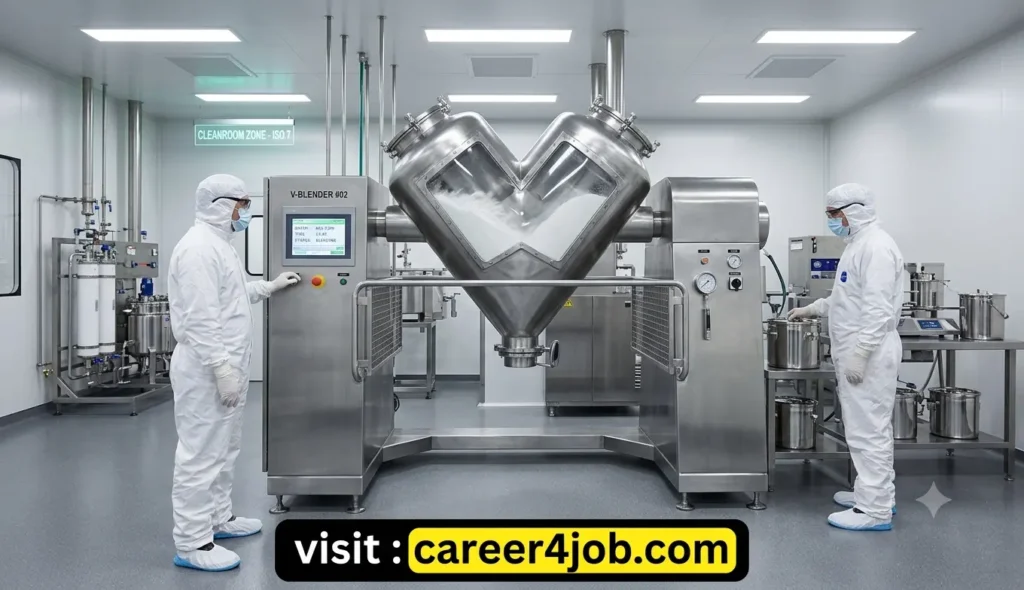
V Blender
Working principle: Two cylindrical shells are joined at an angle, forming a V shape. As the unit rotates, powder splits and rejoins repeatedly, creating a gentle tumbling blend.
Advantages: Produces very uniform blends with minimal particle damage.
Limitations: Not suited for cohesive or sticky powders that resist tumbling.
Applications: Widely used for tablet and capsule powder blends, including low-dose active ingredients.
Double Cone Blender
Working principle: Two cone-shaped sections are joined at their wide ends. As the vessel rotates, powder moves through the cones, creating a tumbling and diffusive blending action.
Advantages: Easy to clean and load, with gentle handling of powders.
Limitations: Less effective for breaking up clumps or lumps in the powder.
Applications: Suitable for free-flowing powders and granules in tablet manufacturing.
Bin Blender
Working principle: The bin itself, which is also used for storage and transport, becomes the blending vessel. It rotates on a frame to blend the powder inside.
Advantages: Reduces product handling, since the same container is used for blending, storage, and transfer to the next step.
Limitations: Requires investment in bin-handling systems and docking stations.
Applications: Common in modern facilities that want to minimize powder exposure and cross-contamination risk.
Drum Blender
Working principle: A drum blender rotates a cylindrical drum, often on rollers, to tumble powder inside using gravity and rotational motion.
Advantages: Simple design and lower cost compared to specialized blenders.
Limitations: Blending efficiency can be lower than purpose-built pharmaceutical blenders.
Applications: Used for smaller batches or less critical blending steps.
Types of Mixing Equipment
Mixing equipment tends to apply more mechanical energy than blending equipment, since it often has to combine ingredients that do not naturally combine on their own.
High Shear Mixer
Working: A high shear mixer uses a fast-rotating impeller to force material through a narrow gap, generating intense shear force that breaks up particles and disperses liquids quickly.
Benefits: Produces very fine, uniform mixtures in a short amount of time.
Uses: Common in wet granulation and in preparing creams that need a smooth, even texture.
Planetary Mixer
Working: The mixing blade rotates on its own axis while also moving around the bowl, similar to how planets orbit the sun. This dual motion covers the entire mixing vessel.
Benefits: Excellent for thick, viscous materials that need thorough, even mixing.
Uses: Frequently used for ointments, pastes, and semi-solid formulations.
Paddle Mixer
Working: Flat paddles rotate slowly through the material, gently folding and turning it without applying too much shear.
Benefits: Gentle on delicate ingredients and good for materials sensitive to heat buildup.
Uses: Suitable for granulation processes where particle integrity matters.
Static Mixer
Working: Static mixers have no moving parts. Instead, fixed internal elements split and redirect fluid flow as it passes through a pipe, creating mixing through flow patterns alone.
Benefits: Low maintenance, continuous operation, and no energy loss from moving mechanical parts.
Uses: Often used in continuous manufacturing lines for liquid formulations.
Rapid Mixer Granulator
Working: Combines a high-speed impeller for mixing with a separate chopper blade that breaks up wet clumps, all within one closed vessel.
Benefits: Combines mixing and granulation in a single step, saving time and reducing product transfer.
Uses: A standard piece of equipment for wet granulation in tablet manufacturing.
Factors Affecting Blending and Mixing
Getting a uniform blend is not automatic. Several variables influence how well ingredients combine, and manufacturers must control each one carefully.
- Particle size: Ingredients with very different particle sizes tend to separate rather than blend evenly.
- Density: Heavier particles can settle to the bottom during and after mixing, causing segregation.
- Moisture: Too much moisture can cause powder to clump, while too little can create static and poor flow.
- Mixing speed: Speed that is too low may under-mix, while speed that is too high can damage particles or cause overheating.
- Mixing time: Under-mixing leaves the blend uneven, while over-mixing can cause segregation to reappear.
- Equipment selection: The wrong blender or mixer type for a given powder can lead to poor results no matter how the process is run.
- Batch size: Equipment that works well for small batches may not scale properly to larger production volumes.
- Environmental conditions: Humidity and temperature in the manufacturing area can affect powder flow and mixing behavior.
Step-by-Step Blending Process
- Weigh raw materials according to the approved formula, checking each ingredient against the batch record.
- Screen the powders through a sieve to break up lumps and remove foreign particles.
- Load materials into the blender in the correct sequence, often starting with the major excipients.
- Set blending parameters, including speed and time, based on the validated process.
- Run the blending cycle and monitor the equipment during operation.
- Collect samples from multiple points in the blender to test for uniformity.
- Test blend uniformity in the quality control lab before releasing the batch for the next step.
- Discharge the blended powder into a clean, labeled container for the next manufacturing stage.
- Clean and document the equipment and process according to standard operating procedures.
Step-by-Step Mixing Process
- Prepare the formulation plan, identifying which materials need mixing and in what order.
- Weigh and measure all solid and liquid components accurately.
- Add the base material to the mixing vessel first, such as water or a solvent.
- Introduce other ingredients gradually while the mixer is running, to avoid clumping.
- Apply the required mixing speed and shear based on the product’s needs.
- Monitor consistency visually and with in-process checks like viscosity testing.
- Adjust mixing time if the product has not reached the desired uniformity.
- Sample and test the mixed product for quality parameters.
- Transfer the mixture to the next processing step, such as filling or packaging.
- Clean the mixer thoroughly and record all process details in the batch documentation.
Common Challenges
Even experienced manufacturing teams run into problems during blending and mixing. Knowing the common issues helps teams fix them faster.
Challenge: Segregation after blending — Solution: Reduce particle size differences between ingredients, and transfer blended powder carefully to avoid vibration that causes separation.
Challenge: Poor flow properties — Solution: Add a glidant or adjust moisture content to improve how the powder moves through equipment.
Challenge: Inconsistent blend uniformity results — Solution: Review sampling technique, since poor sampling often causes more variability than the blending process itself.
Challenge: Overheating during high shear mixing — Solution: Use jacketed vessels with temperature control, and monitor mixing time closely.
Challenge: Cross-contamination between products — Solution: Follow strict cleaning validation protocols and consider dedicated equipment for high-risk products.
GMP Guidelines
Good Manufacturing Practices, commonly known as GMP, set the rules for how blending and mixing must be controlled, documented, and verified.
Under GMP in pharmaceutical manufacturing, every blending and mixing step must follow a written, approved procedure. Deviations from that procedure must be recorded and investigated.
Validation: Equipment and processes must be validated to prove they consistently produce a uniform, quality product. This includes qualifying the equipment itself and validating the specific blending or mixing process for each formulation.
Cleaning: Cleaning procedures must be validated to show that no residue from a previous batch remains in the equipment. This protects against cross-contamination.
Documentation: Every batch must have complete records showing weights, times, speeds, operator names, and test results. These records are what regulators review during inspections.
Quality assurance: A quality assurance team reviews all documentation before a batch is released, confirming that the process stayed within approved limits at every stage.
According to the World Health Organization, GMP systems exist to minimize risks in pharmaceutical production that cannot be eliminated through testing the final product alone. This is exactly why blending and mixing controls matter so much before a batch ever reaches finished goods testing.
Quality Control in Blending and Mixing
Quality control confirms that blending and mixing actually achieved their goal before the product moves forward.
Blend uniformity testing: Samples are taken from multiple locations within the blender to measure how evenly the active ingredient is distributed.
Sampling: Sampling must be done carefully, using tools that do not disturb the powder bed or introduce bias into the results.
Process validation: Manufacturers run the process multiple times under controlled conditions to prove it reliably meets specifications.
Documentation: Every quality check, from sample collection to lab results, must be recorded and traceable back to the specific batch.
The U.S. Food and Drug Administration provides detailed guidance on process validation, emphasizing that manufacturers must demonstrate consistent quality across the entire product lifecycle, not just at the final testing stage.

Applications
Blending and mixing support nearly every dosage form produced in pharmaceutical manufacturing.
Tablets:
- Direct compression blends
- Wet granulation powder mixes
- Coating suspensions
Capsules:
- Powder fill blends
- Pellet coating mixtures
Powder formulations:
- Oral rehydration powders
- Dry powder inhaler formulations
Creams:
- Emulsion base mixing
- Active ingredient dispersion
Ointments:
- Base and active ingredient blending
- Homogenization of semi-solid mixtures
Suspensions:
- Solid particle dispersion in liquid
- Viscosity-building agent mixing
Injectable medicines:
- Sterile solution mixing
- Lyophilization pre-mix preparation
Advantages
Investing in proper blending and mixing pays off across the entire production process.
- Ensures accurate and consistent dosing in every unit
- Reduces batch failures and rework costs
- Improves powder flow for smoother tableting and capsule filling
- Supports compliance with GMP and regulatory requirements
- Enhances product stability and shelf life
- Builds trust with regulators and customers through consistent quality
Future Trends
Pharmaceutical blending and mixing are evolving with new technology that improves speed, accuracy, and control.
Automation: Automated systems reduce human error and improve repeatability across batches, especially for weighing, loading, and cycle control.
AI: Artificial intelligence is being used to predict optimal blending times and detect early signs of segregation or process drift.
PAT (Process Analytical Technology): PAT tools measure blend uniformity in real time during the process, rather than only after the fact through lab sampling.
Continuous manufacturing: Instead of batch-by-batch blending, continuous lines blend and process powder in an ongoing flow, improving efficiency and reducing downtime.
Smart manufacturing: Connected equipment shares data across the facility, giving managers a real-time view of every blending and mixing step.
Digital monitoring: Sensors and software track temperature, speed, and time continuously, flagging deviations before they become bigger problems.
The International Council for Harmonisation continues to publish guidance encouraging manufacturers to adopt these advanced monitoring and control approaches as part of modern quality systems.

Frequently Asked Questions (FAQ)
1. What is the difference between blending and mixing in pharmaceutical manufacturing?
Blending combines dry powders into a uniform mix, while mixing can combine solids, liquids, or both into a uniform product.
2. Why is blend uniformity important?
Blend uniformity ensures every dose of medicine contains the correct amount of active ingredient, which is essential for patient safety.
3. What equipment is used for pharmaceutical blending?
Common equipment includes ribbon blenders, V blenders, double cone blenders, bin blenders, and drum blenders.
4. What is a high shear mixer used for?
A high shear mixer is used to quickly break up particles and disperse liquids, often during wet granulation or cream manufacturing.
5. How is blend uniformity tested?
Samples are taken from multiple points in the blender and tested in a lab to confirm even distribution of the active ingredient.
6. What causes segregation in a powder blend?
Segregation usually happens due to differences in particle size or density, or from vibration during transfer after blending.
7. What is GMP in pharmaceutical manufacturing?
GMP stands for Good Manufacturing Practices, a set of regulations that ensure products are consistently produced and controlled to quality standards.
8. How long should powder blending take?
Blending time depends on the formulation and equipment, and is determined through process validation studies for each product.
9. Can blending and mixing equipment be used interchangeably?
No. Blending equipment is designed for dry powders, while mixing equipment is built to handle liquids or combinations of solids and liquids.
10. What is a rapid mixer granulator used for?
It combines mixing and granulation in one step, commonly used to prepare wet granules for tablet manufacturing.
11. Why is cleaning validation important after blending?
Cleaning validation confirms no residue remains in the equipment, preventing cross-contamination between different products.
12. What role does particle size play in blending?
Particles that are too different in size can separate instead of blending evenly, which is why particle size control matters.
13. What is Process Analytical Technology (PAT)?
PAT refers to tools and systems that measure critical process parameters, like blend uniformity, in real time during manufacturing.
14. Is mixing used in liquid medicine production?
Yes, mixing is essential for producing syrups, suspensions, and injectable solutions with consistent quality.
15. How does continuous manufacturing change blending and mixing?
It shifts the process from separate batches to an ongoing flow, often improving efficiency and reducing variability between batches.
Conclusion
Blending and mixing in pharmaceutical manufacturing form the foundation of safe, effective, and consistent medicines. From selecting the right equipment to following strict GMP guidelines, every step matters in delivering a product patients can trust.
Whether it is a V blender preparing tablet powder or a high shear mixer creating a smooth cream base, the goal remains the same: uniform, reliable quality in every single dose.
If you work in pharmaceutical production or quality assurance, now is a great time to review your blending and mixing processes and see where modern technology, like PAT and automation, could improve your results. Explore our other guides on tablet manufacturing and GMP guidelines to keep building your pharmaceutical process knowledge.
Related articles
- Wet granulation process
- Fluid bed drying in pharma manufacturing
- Tablet compression machine
- GMP guidelines for pharmaceutical manufacturing
- Pharmaceutical equipment validation: IQ, OQ, and PQ validation.