Learn what Kaizen is, how continuous improvement works, its key principles, benefits, real-world examples, and practical steps to implement Kaizen in your workplace or business.
Have you ever wished your team could get a little better every single day, without turning work upside down? That is the whole idea behind Kaizen. It is a simple word with a big impact, and it has helped factories, offices, hospitals, and small shops all over the world work smarter.
In this guide, we will explain what Kaizen means, why it matters, and how you can start using it today. We will keep the language simple and the steps easy to follow, so you can put continuous improvement to work right away, no matter what kind of team you run.
What Is Kaizen?
Kaizen is a Japanese word made from two parts: “kai” means change, and “zen” means good. Put together, Kaizen means “change for the better.” In business, it stands for continuous improvement, which means making small, steady changes over time instead of one big change all at once.
The idea is simple. Instead of waiting for a huge project to fix everything, teams look for small problems every day and fix them right away. Over months and years, these small fixes add up to big results.
Where Kaizen Came From
Kaizen became famous through the Toyota Production System in Japan after World War II. Toyota trained workers at every level to look for waste and suggest small fixes. You can read more about this history on Toyota’s own company site, which explains how the idea grew from factory floors into a full business philosophy.
Today, Kaizen is used far beyond car factories. Hospitals use it to cut patient wait times. Software teams use it to improve their code reviews. Even schools use it to improve how classes run.
Why Continuous Improvement Matters
You might ask, why not just make one big change and be done with it? The truth is, big changes are risky, expensive, and hard for people to accept. Small, steady changes are easier to test, easier to fix if they go wrong, and easier for your team to support.
Here are some of the main benefits of using Kaizen in your team or business:
- Lower costs, because small fixes rarely need a big budget
- Less waste of time, materials, and effort
- Higher quality, since problems get caught and fixed early
- Happier workers, because their ideas are heard and used
- Safer workplaces, since small hazards get fixed before they cause harm
- Steady growth, since improvement never really stops
The Core Principles of Kaizen
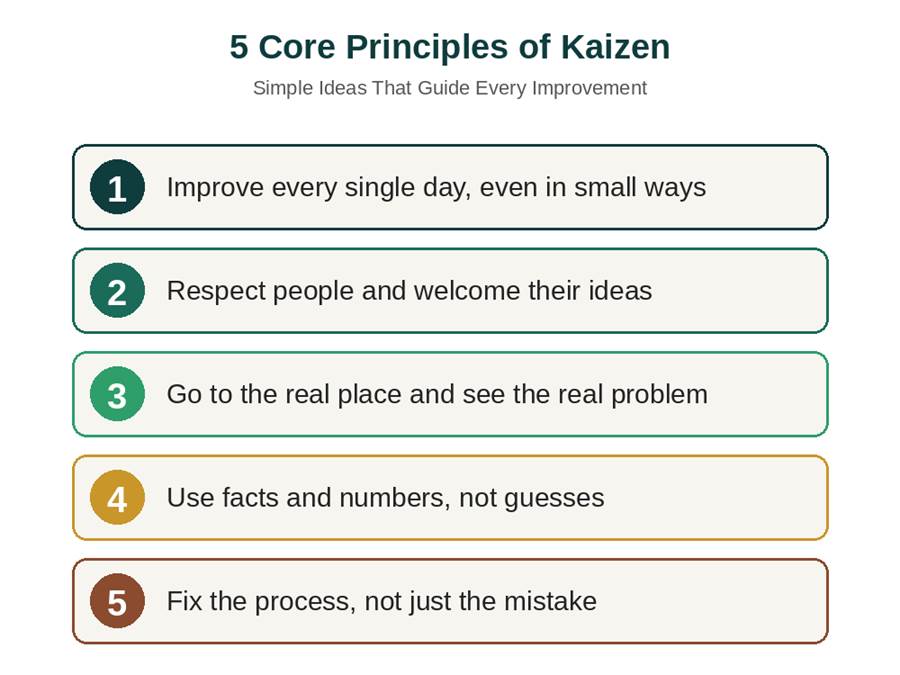
Kaizen is guided by a few simple ideas. Keep these in mind whenever you plan an improvement, and you will stay on the right track.
| Principle | What It Means |
| Improve daily | Look for at least one small thing to improve every day, not just once a year. |
| Respect people | Everyone’s ideas matter, from new staff to senior managers. |
| Go and see (Gemba) | Visit the real place where work happens instead of guessing from a desk. |
| Use facts | Base decisions on real numbers and observations, not opinions alone. |
| Fix the process | Look at why a mistake happened, not just who made it. |
How Kaizen Works in Practice: The PDCA Cycle
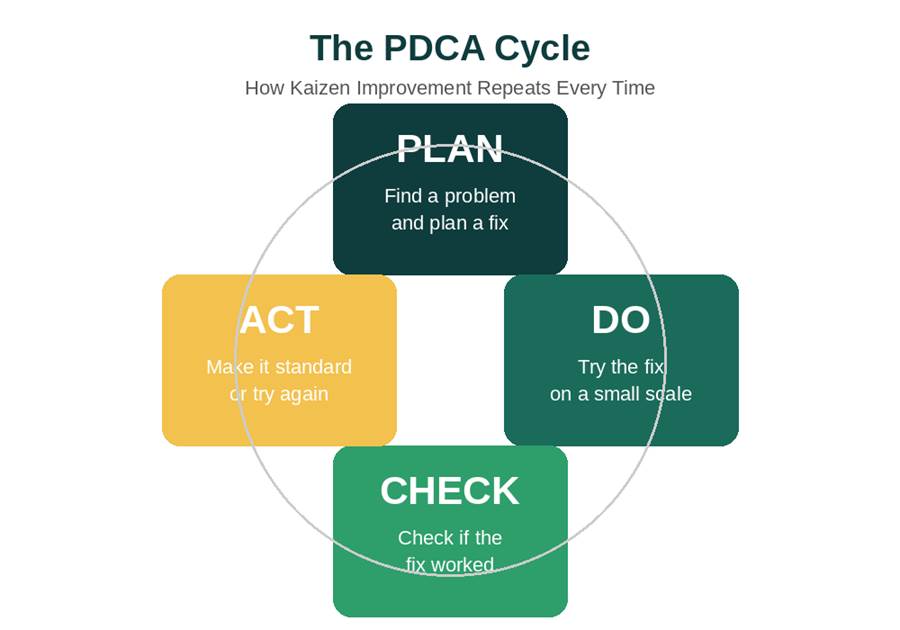
Most Kaizen improvements follow a simple four-step cycle called PDCA. This stands for Plan, Do, Check, Act. It gives teams a clear, repeatable way to test new ideas safely.
Plan
Find a problem, look at the facts, and plan a small fix. Keep the plan simple enough to try in a short time.
Do
Try the fix on a small scale first. This could mean testing it with one team, one shift, or one machine.
Check
Look at the results. Did the fix work? Use real numbers to check, not just a feeling.
Act
If the fix worked, make it the new standard way of working. If it did not work, learn from it and start the cycle again with a new idea.
Types of Kaizen
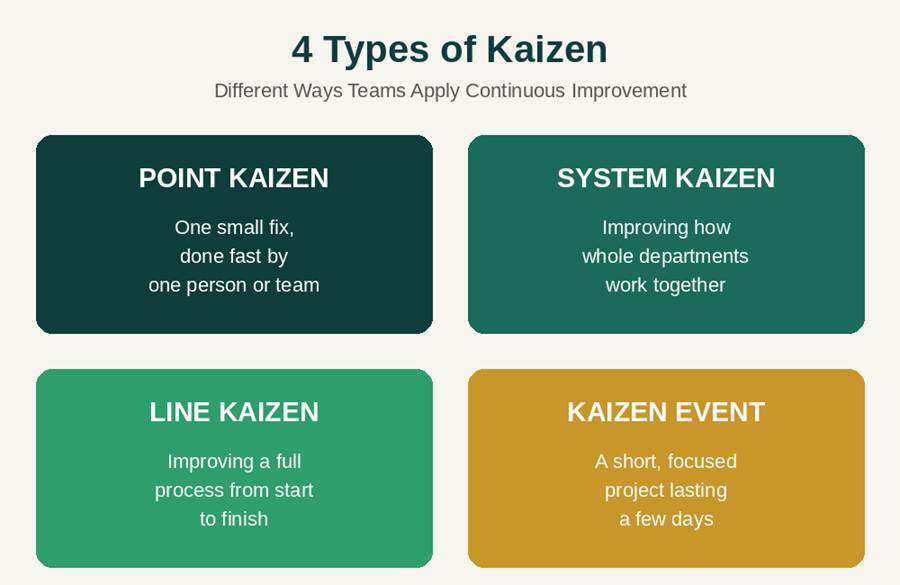
Not every improvement looks the same. Kaizen can be applied in a few different ways, depending on the size of the problem and how many people are involved.
Point Kaizen
A small, quick fix made by one person or a small team, such as moving a tool closer to a work area to save time.
System Kaizen
A bigger improvement that changes how a whole department or system works, such as redesigning how orders move through a warehouse.
Line Kaizen
An improvement that looks at a full process from start to finish, connecting several steps or teams together.
Kaizen Event (Kaizen Blitz)
A short, focused project, often lasting just a few days, where a team drops other work to solve one clear problem fast.
Kaizen Tools You Should Know
Kaizen often uses simple tools to help teams see problems clearly and track improvement. Here are some of the most common ones.
| Tool | Purpose |
| 5S | Sort, Set in order, Shine, Standardize, Sustain — keeps work areas clean and organized. |
| PDCA Cycle | A four-step loop for planning, testing, checking, and locking in improvements. |
| Gemba Walk | Managers walk the real work area to see problems firsthand. |
| Fishbone Diagram | A visual map used to find the root cause of a problem. |
| Kanban Board | A visual board that shows work in progress and helps spot bottlenecks. |
| Suggestion System | A simple way for any worker to submit improvement ideas. |
Steps to Start a Kaizen Program in Your Team
You do not need a big budget or a special title to start using Kaizen. Here is a simple way to begin.
- Pick one small area to improve, such as a single task or work station.
- Watch how the work is really done, not how you think it is done.
- Ask the people doing the work what slows them down.
- Pick one small change to test, using the PDCA cycle.
- Try the change for a short trial period.
- Check the results with real numbers or feedback.
- If it works, make it the new standard and share it with other teams.
- Repeat the process with a new problem.
Common Mistakes to Avoid
Kaizen is simple, but a few common mistakes can slow it down. Watch out for these:
- Trying to fix too many things at once instead of one small step at a time
- Skipping the “Check” step and assuming a change worked
- Ignoring ideas from front-line workers
- Treating Kaizen as a one-time event instead of an ongoing habit
- Blaming people instead of looking at the process
Real Examples of Kaizen
Toyota is the most well-known example, where workers can stop the whole production line to fix a problem right away. This idea is explained in detail by the Lean Enterprise Institute, a nonprofit group that studies and teaches Lean and Kaizen methods.
Outside of factories, many hospitals now use Kaizen to reduce patient waiting times and medical errors. The American Society for Quality (ASQ) shares case studies showing how small, steady changes in healthcare settings have led to safer, faster patient care.
Even small businesses use Kaizen. A local bakery might notice that staff spend too much time walking between the oven and the packing table. A quick Kaizen fix, like moving the packing table closer, can save hours of walking every week.
Frequently Asked Questions
What does Kaizen mean in simple words?
Kaizen means “change for the better.” It is about making small, steady improvements over time instead of one big change.
Is Kaizen only used in factories?
No. Kaizen started in factories but is now used in offices, hospitals, schools, and even at home. Any team that wants to improve step by step can use it.
How is Kaizen different from a big company change?
A big change usually happens once and affects everything at the same time. Kaizen focuses on small, low-risk changes that happen often and build up over time.
Do I need special training to start Kaizen?
No special training is required to begin. Many teams start with simple tools like PDCA and 5S, then learn more advanced tools as they go.
How long does a Kaizen event usually last?
A Kaizen event, sometimes called a Kaizen Blitz, usually lasts between two and five days and focuses on solving one clear problem.
Can Kaizen work for a small business or a single team?
Yes. Kaizen works well for teams of any size. Even a team of two or three people can use it to improve how they work together.
What is the difference between Kaizen and Lean?
Lean is a wider business approach focused on removing waste. Kaizen is one of the main tools used inside Lean to make continuous, small improvements.
Conclusion
Kaizen is not about making one huge change and hoping it fixes everything. It is about building a habit of noticing small problems and fixing them, one step at a time. Start small, involve your whole team, use the PDCA cycle to test your ideas, and keep going. Over time, these small steps can lead to safer, faster, and better work for everyone.
The next time you notice something that slows your team down, do not wait for a big project to fix it. Try a small Kaizen step today, check the results, and keep improving.