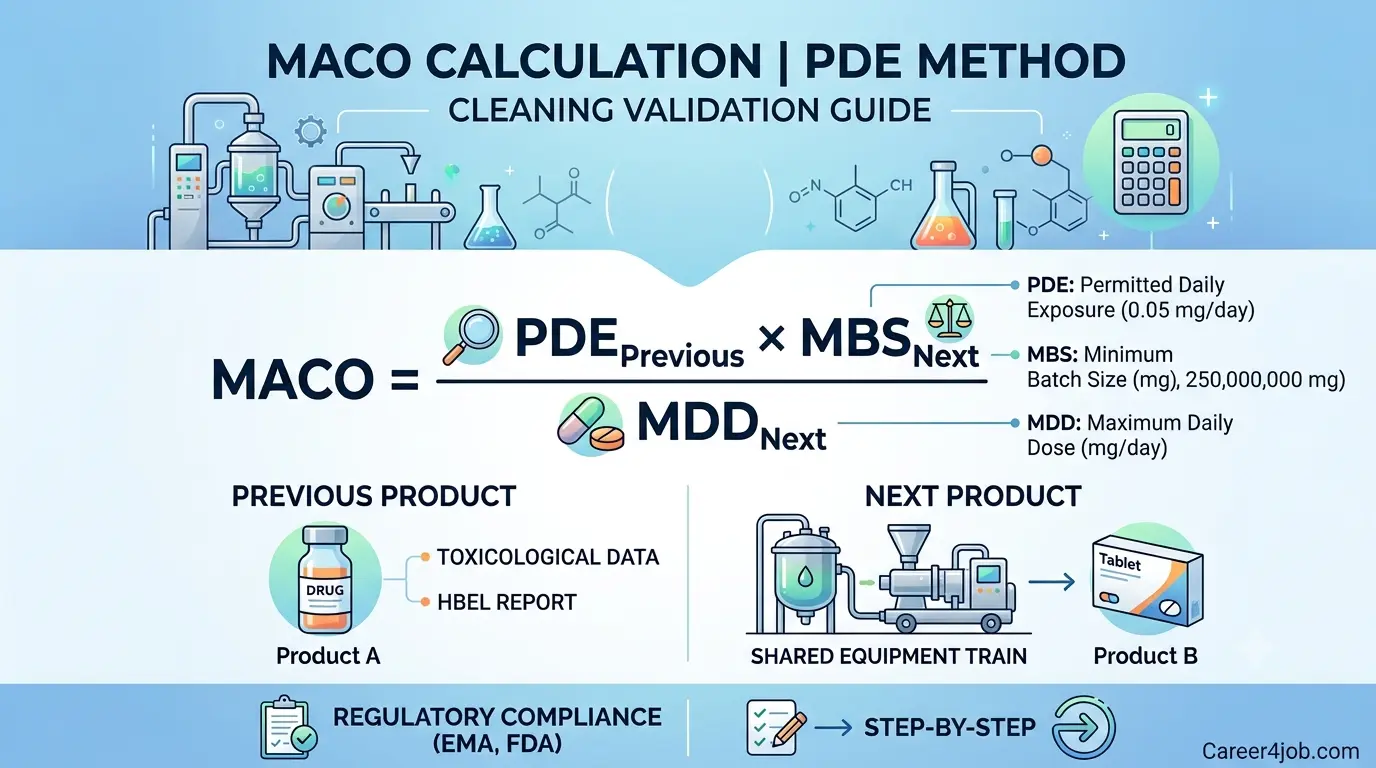
Learn how to calculate MACO using the PDE method in cleaning validation. Simple formula, worked example, tables, and FAQs included. A simple, step-by-step guide for pharma quality teams
If you work in a pharmaceutical or biotech plant, you have heard the word “MACO.” It sounds technical, but the idea behind it is simple. MACO tells you how much leftover product residue is safe to leave behind on equipment before you make the next batch. In this guide, we will explain MACO in plain words, show you the PDE method step by step, and give you a real worked example. No hard jargon. No confusion. Just a clear guide you can actually use.
Quick Summary (Key Takeaways)
- MACO stands for Maximum Allowable Carryover. It is the highest amount of leftover residue that is safe on shared equipment.
- PDE stands for Permitted Daily Exposure. It is a science-based, health-based safety limit for a drug substance.
- The PDE method is now the preferred way to set cleaning limits, replacing older methods like the 10 ppm rule and the dose-based rule.
- The formula is simple once you know the four numbers you need: PDE, batch size, daily dose, and shared surface area.
1. What Is Cleaning Validation?
Cleaning validation is proof that your cleaning process actually works. After you manufacture one drug product in a piece of equipment, small traces of that product can stay behind. Before you use the same equipment for a different product, you must clean it and prove, with real data, that the leftover residue is below a safe limit. This protects patients from cross-contamination, and it is a basic requirement under Good Manufacturing Practice (GMP) rules around the world.
The whole process depends on one key number: the safe limit of residue that can be left behind. This safe limit is called MACO, and today, most regulators want it calculated using the PDE method.
2. What Is MACO?
MACO stands for Maximum Allowable Carryover. Think of it as a safety line. If the leftover residue on your equipment stays under this line, the next product made in that equipment is safe for patients. If the residue goes above this line, there is a risk of contamination that could harm someone.
MACO is not a fixed number. It changes based on the product made before, the product made next, the equipment involved, and the shared surface area between the two products. That is why every cleaning validation study needs its own MACO calculation.
3. What Is PDE?
PDE stands for Permitted Daily Exposure. It is the highest amount of a substance, in milligrams per day, that a person can be exposed to over a lifetime without any noticeable health risk. Toxicology experts calculate PDE by studying the drug’s pharmacology, toxicology data, and clinical information.
The PDE value is set by trained safety experts, not by a simple formula or a guess. This is what makes the PDE method more scientific and more accurate than older, simpler methods.
4. Why the PDE Method Is the Preferred Choice Today
For many years, companies used simple rules to set cleaning limits, such as the 10 ppm rule or a dose-based formula. These rules were easy to use, but they were not based on real health data. The European Medicines Agency (EMA) changed this in 2014 with a guideline that asked companies to use health-based limits, like PDE, instead. Since then, the PDE method has become the global standard.
Comparison: PDE Method vs. Older Methods
| Method | Based On | Accuracy | Current Status |
| PDE Method | Toxicology and health data | High – scientific and product-specific | Preferred by regulators (EMA, PIC/S, WHO) |
| 10 ppm Rule | A fixed general ratio | Low – not health-based | Older method, rarely accepted alone today |
| Dose-Based Rule | 1/1000th of the smallest dose | Medium – simple but not toxicology-based | Used mainly as a backup check |
5. The MACO Formula Using the PDE Method
Here is the formula in plain words. It looks technical at first, but it only needs four numbers.
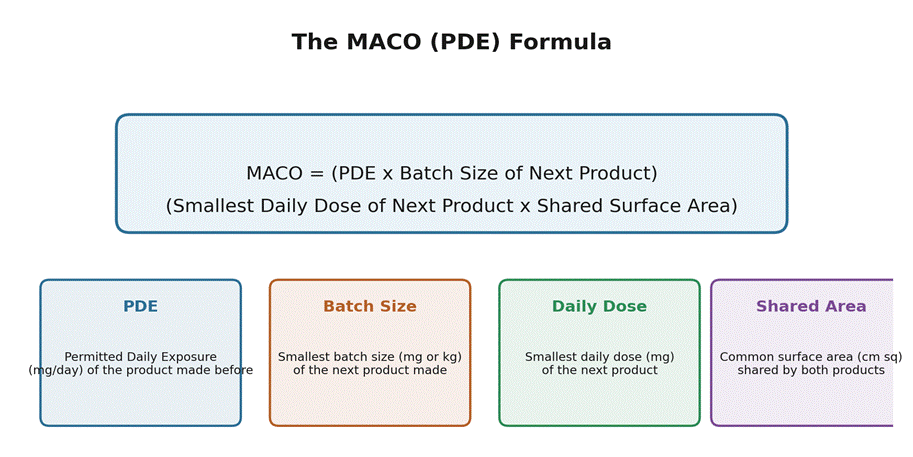
Figure 1: The MACO formula and what each part means
What Each Term Means
| Term | Meaning | Typical Unit |
| PDE | Permitted Daily Exposure of the product made earlier | mg/day |
| Batch Size | Smallest batch size of the next product made | mg or kg |
| Daily Dose | Smallest daily dose of the next product | mg |
| Shared Surface Area | Common equipment surface area used by both products | cm² |
6. Step-by-Step: How to Calculate MACO
Let’s walk through the process in order. This is the same order a quality or validation officer would follow on the job.
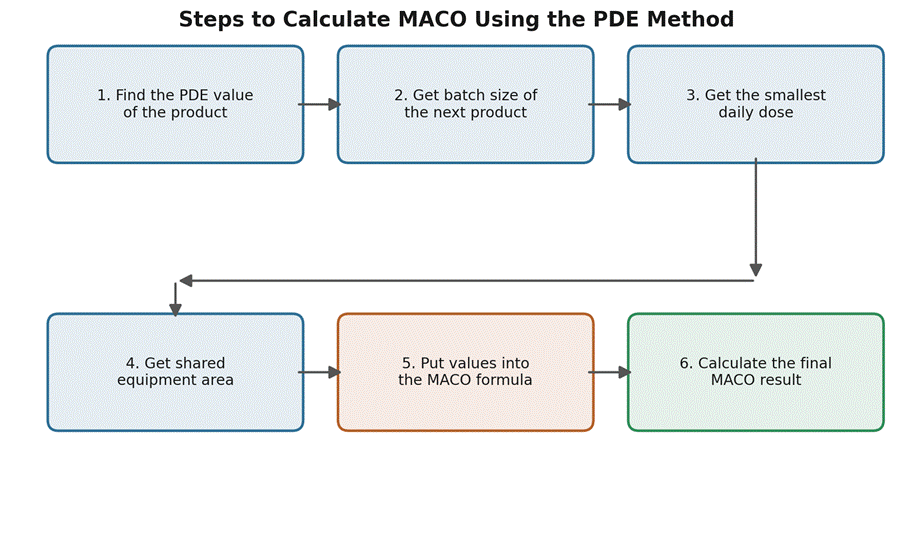
Figure 2: The six steps to calculate MACO using PDE
- Find the PDE value of the product made earlier. This value usually comes from a toxicology report or a safety data sheet.
- Note the smallest batch size of the next product that will be made in the same equipment.
- Note the smallest daily dose of the next product.
- Measure the shared surface area between the equipment used for both products.
- Place all four numbers into the MACO formula.
- Calculate the result. This is your safe carryover limit in milligrams.
Worked Example
Let’s use simple, made-up numbers to see the formula in action.
| Input | Value |
| PDE of Product A | 0.5 mg/day |
| Batch size of Product B | 200,000 mg (200 kg) |
| Smallest daily dose of Product B | 10 mg |
| Shared surface area | 2,000 cm² |
MACO = (0.5 x 200,000) ÷ (10 x 2,000)
MACO = 100,000 ÷ 20,000 = 5 mg per shared surface area
This means up to 5 mg of Product A residue can safely remain on the shared equipment before the next batch of Product B is made. Your cleaning process must prove that it removes residue to below this number.
7. Common Mistakes to Avoid
- Using the wrong PDE source. Always use a PDE value from a qualified toxicologist or a validated safety database, not a rough estimate.
- Mixing up batch size and dose. Batch size is about the total product made. Daily dose is about what one patient takes.
- Wrong surface area. Only include the surface area that is actually shared between the two products, not the whole equipment train.
- Ignoring the lowest values. Always use the smallest batch size and the smallest daily dose across your product range, since this gives the tightest, safest limit.
- Skipping a swab or rinse study. A MACO number on paper means nothing until your cleaning method is tested and proven to reach it.
8. Regulatory Guidelines and Trusted References
These official sources explain the PDE method and health-based exposure limits in more detail. They are useful if you want to read the original guidance.
- EMA – Scientific Guidelines on Quality (Health-Based Exposure Limits)
- PIC/S – Good Manufacturing Practice Guides
- WHO – Guidelines on Validation (Cleaning Validation Annex)
- ISPE – Risk-Based Manufacture of Pharmaceutical Products
9. Frequently Asked Questions (FAQ)
Q1. What does MACO stand for?
MACO stands for Maximum Allowable Carryover. It is the highest amount of residue that can safely stay on equipment before the next product is made.
Q2. What does PDE stand for in cleaning validation?
PDE stands for Permitted Daily Exposure. It is a health-based safety limit set by toxicology experts.
Q3. Why is the PDE method better than the 10 ppm rule?
The PDE method is based on real toxicology and health data for each product. The 10-ppm rule uses one fixed number for every product, so it does not consider how strong or how safe each drug actually is.
Q4. Who calculates the PDE value?
A qualified toxicologist calculates the PDE value. It is based on pharmacology data, toxicology studies, and clinical information about the drug.
Q5. Do I still need to do a swab test after calculating MACO?
Yes. The MACO number is only a target. You still need swab or rinse sample testing to prove your actual cleaning process meets that target.
Q6. Is the PDE method required by regulators?
Yes, in most regions. The EMA, PIC/S, and WHO all recommend or require health-based limits like PDE for setting cleaning validation limits, especially for shared manufacturing facilities.
10. Conclusion
MACO calculation using the PDE method is not as hard as it first sounds. Once you have the four key numbers, PDE, batch size, daily dose, and shared surface area, the formula does the rest. The real value of this method is that it protects patients using real health science, not just a general rule of thumb. If your team is still using old methods like the 10-ppm rule, now is a good time to move to the PDE method and stay aligned with current global guidelines.