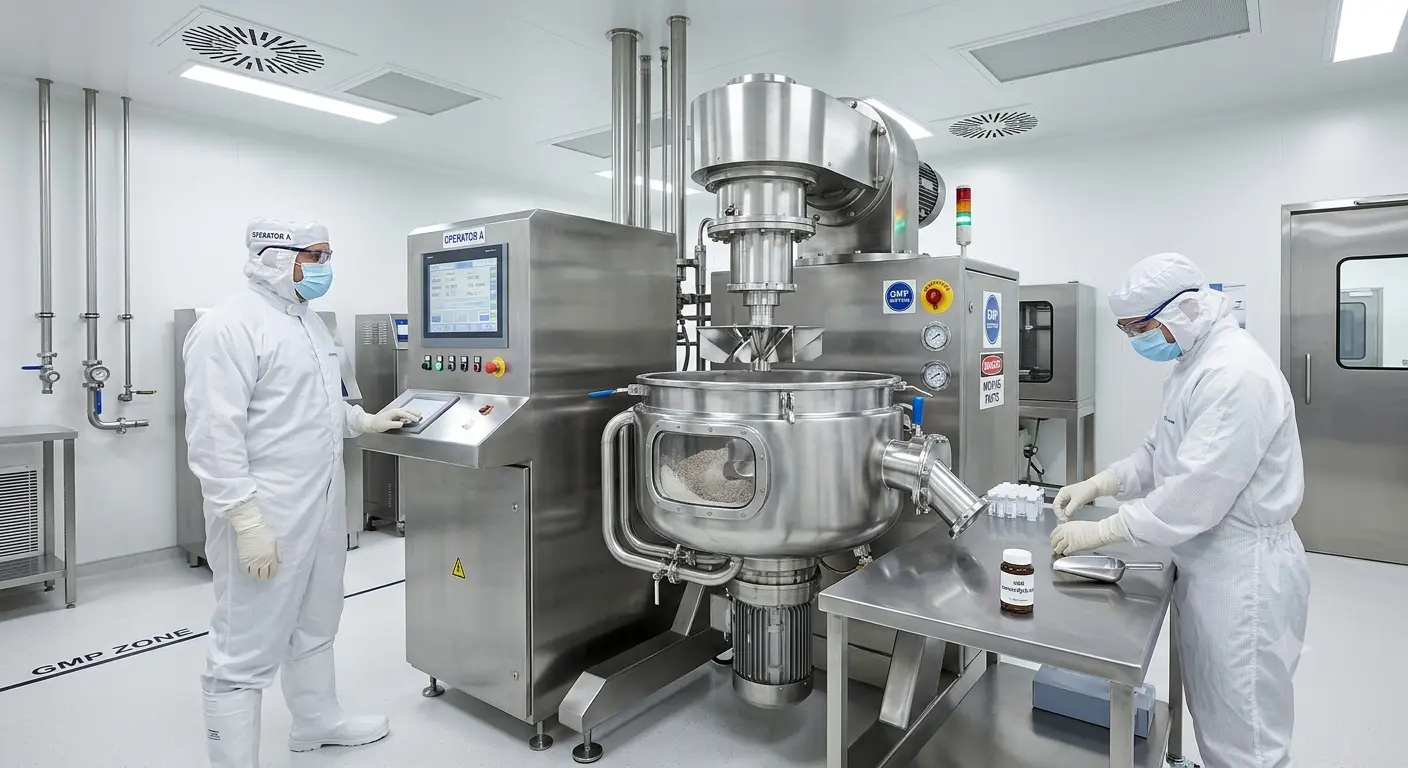
Discover how high shear granulation in pharmaceutical manufacturing turns powder into strong, uniform granules for reliable tablet production.
Introduction
Pharmaceutical companies need strong, stable tablets. That is not easy to achieve. Powders do not stick together on their own. This is where high shear granulation in pharmaceutical manufacturing comes in.
High shear granulation is one of the most common ways to turn loose powder into solid granules. Manufacturers use it every day to make tablets that are strong, uniform, and easy to swallow.
If you work in pharma, or you are studying pharmaceutical sciences, you have probably heard this term many times. But what does it actually mean? How does the process work? And why do so many companies choose this method over others?
This guide walks you through everything. We cover the science behind high shear granulation, the equipment involved, the step-by-step process, and the quality checks that keep it safe and effective. We also compare it with other granulation methods, so you can see where it fits into the bigger picture of pharmaceutical manufacturing.
By the end of this article, you will have a clear, practical understanding of high shear granulation in pharmaceutical manufacturing, whether you are new to the field or simply brushing up your knowledge.
What is High Shear Granulation?
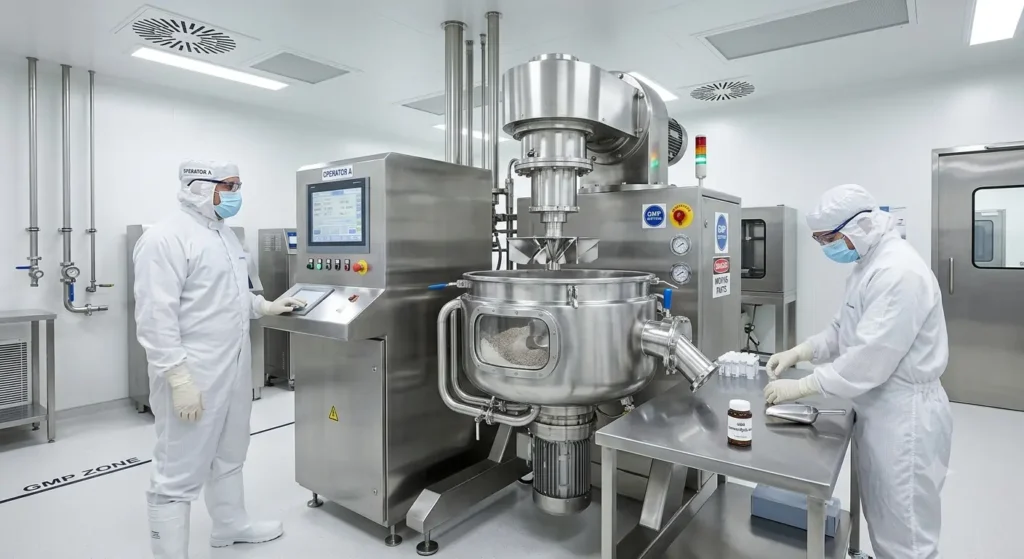
High shear granulation is a wet granulation method. It uses fast-moving blades to mix powder and liquid together. This action turns fine powder into larger, denser granules that are much easier to handle.
The term “high shear” describes the mechanical force used inside the machine. A high shear granulator spins an impeller at high speed. This impeller cuts through the powder bed and pushes particles together. A second blade, called a chopper, breaks up any large clumps that form along the way.
This process is a core part of pharmaceutical granulation. It helps convert powder blends into granules that flow well, compress easily, and stay consistent from batch to batch.
Most tablets you take today, from painkillers to daily vitamins, have likely gone through some form of granulation before becoming the solid tablet you swallow.
Principle of High Shear Granulation
The basic idea behind high shear granulation is simple. Mechanical force, combined with a liquid binder, brings powder particles together into stable granules.
Here is the principle, broken into its core steps:
- Dry powders are mixed inside the mixing bowl.
- A liquid binder solution is sprayed or poured in.
- The impeller and chopper apply shear force to the mixture.
- Particles stick together and start forming granules.
- Granules grow in size as mixing continues.
This differs from dry granulation, which relies on pressure instead of liquid. It also differs from fluid bed granulation, which uses hot, moving air instead of mechanical blades. High shear granulation depends on mechanical energy and moisture working together.
The result is a dense, strong granule that is well suited to tablet manufacturing, especially for formulations that need extra strength or contain a high dose of active ingredient.
How High Shear Granulation Works
Let’s look closely at every stage of the granulation process, from raw powder to a finished, dried granule ready for compression.
Powder Mixing
The process starts with powder mixing. All dry ingredients, including the active drug, fillers, and disintegrants, go into the mixing bowl together.
The impeller begins turning first. It blends the powders evenly before any liquid is added. This step matters a great deal. If the powders are not mixed well here, the final granules will not be uniform either, no matter how carefully the later steps are handled.
Binder Addition
Next comes binder addition. A binder solution, often purified water or a polymer solution, is sprayed onto the moving powder bed through the spray system.
The spray system controls how much liquid goes in and how quickly. Too much binder makes the mass overly wet. Too little, and the granules will not form properly, leaving behind excess fine powder.
Wet Mass Formation
As the binder solution contacts the powder, a wet mass begins to form. The impeller keeps working the mixture, spreading moisture evenly through the entire batch.
This wet mass is soft and slightly sticky. It forms the foundation for proper granule formation in the next stage.
Granule Growth
With continued mixing, small particles clump together and granules grow larger. The chopper blade keeps breaking down any oversized lumps, so the granules stay a reasonable, workable size.
Operators often monitor power consumption and torque during this stage. These readings help them know exactly when the granules have reached the right size and texture, which is known as the process end-point.
Drying
Once granulation is complete, the wet granules move on to the drying process. Excess moisture is removed, usually with a fluid bed dryer or a tray dryer.
Drying is a critical step. Too much residual moisture can cause tablets to degrade over time or encourage microbial growth. Too little moisture, on the other hand, can make granules brittle and prone to breaking.
Milling
After drying, the granules usually go through a milling step. Milling breaks up any hard lumps and creates a consistent granule size across the batch. Common milling equipment includes oscillating granulators and cone mills.
Final Blending
The final stage is blending. Dried, milled granules are combined with the remaining ingredients, such as lubricants and glidants. This final blend is what actually goes into the tablet press or capsule filling machine.
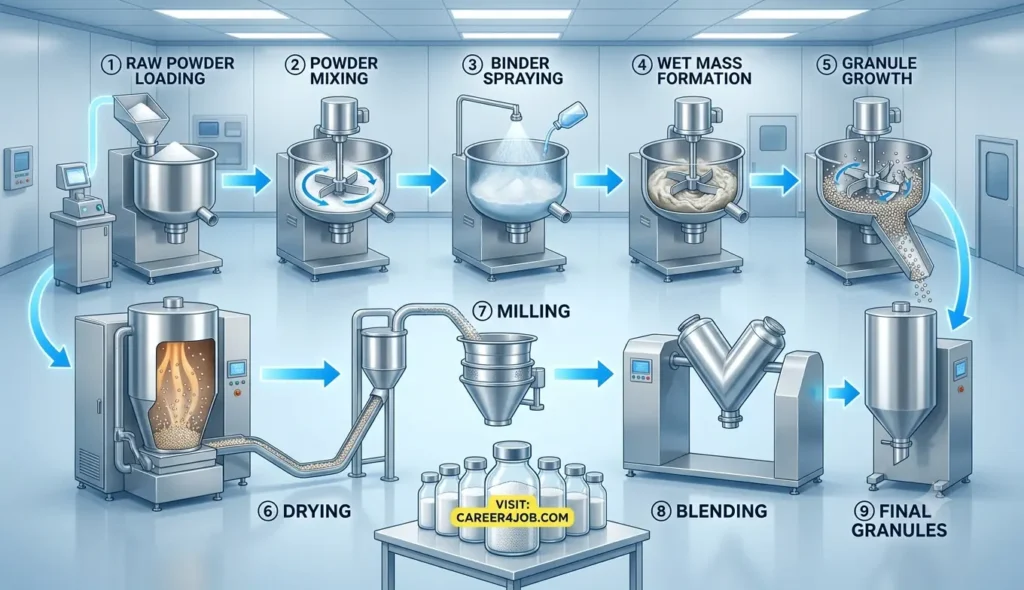
Image Title: High Shear Granulation Process Flow
Components of a High Shear Granulator
Understanding the machine helps you understand the entire process. Here are the main components of a high shear granulator, and what each one does.
Mixing Bowl
The mixing bowl holds the powder and liquid throughout the granulation process. It is usually made of polished stainless steel, which makes cleaning easier and supports GMP compliance.
Impeller
The impeller sits at the bottom of the bowl. It rotates at high speed, mixing the powder and pushing it outward toward the bowl walls, creating the shear force that gives the process its name.
Chopper
The chopper is a smaller, faster-spinning blade. Its job is to break up large wet clumps, keeping the granules within a manageable and consistent size range.
Spray System
The spray system delivers the binder solution into the mixing bowl. It typically includes a nozzle, a pump, and a control mechanism that regulates flow rate and spray pattern.
Discharge System
Once granulation is finished, the discharge system releases the wet mass from the bowl, usually through a bottom valve, so it can move on to drying and further processing.
Control Panel
Modern granulators come equipped with a control panel. This lets operators set mixing speed, spray rate, and mixing time with precision. Many newer systems are fully automated and connected to plant-wide data and monitoring systems.
Equipment Components at a Glance
| Component | Primary Function |
| Mixing Bowl | Holds powder and liquid during granulation |
| Impeller | Mixes powder and generates shear force |
| Chopper | Breaks up large wet clumps |
| Spray System | Delivers binder solution accurately |
| Discharge System | Releases the finished wet mass |
| Control Panel | Manages speed, spray rate, and timing |
Step-by-Step Manufacturing Process
Here is the complete high shear granulation process, from raw material to finished blend, laid out in order.
- Weigh and dispense all raw materials accurately.
- Load dry powders into the mixing bowl.
- Start dry mixing using the impeller.
- Add the binder solution through the spray system.
- Continue wet mixing until the target granule consistency is reached.
- Discharge the wet mass from the bowl.
- Dry the granules to the target moisture level.
- Mill the dried granules to achieve uniform size.
- Blend the granules with lubricants and glidants.
- Send the final blend for tablet compression or capsule filling.
Advantages of High Shear Granulation
- Shorter processing time compared to many other wet granulation methods.
- Produces strong, dense granules with good mechanical strength.
- Works well for high-dose, poorly compressible drugs.
- Suitable for a wide range of formulations and particle types.
- Produces granules with good flow properties for tablet compression.
- Scales well from small lab batches to large commercial batches.
Disadvantages of High Shear Granulation
- Higher capital investment compared to simpler mixing equipment.
- Risk of over-wetting if spray rate and mixing time are not controlled properly.
- Requires skilled, well-trained operators to run consistently.
- Friction inside the bowl generates heat, which can affect heat-sensitive drugs.
- Equipment cleaning and changeover can be time-consuming.
Advantages vs Disadvantages at a Glance
| Advantages | Disadvantages |
| Fast processing time | High equipment cost |
| Strong, dense granules | Risk of over-wetting |
| Good for high-dose drugs | Needs skilled operators |
| Good granule flow properties | Heat build-up during mixing |
| Scales well to large batches | Cleaning can take time |
Applications of High Shear Granulation
High shear granulation is used across many areas of pharmaceutical production, not just standard tablets.
- Tablet manufacturing, the most common application.
- Capsule filling, where uniform granules improve fill accuracy.
- Nutraceutical and dietary supplement production.
- Veterinary pharmaceutical products.
- Effervescent granule production.
- Sachets and powder-for-suspension products.
Factors Affecting Granulation
Several variables influence the quality of the final granules. Manufacturers need to control these carefully to get consistent, repeatable results.
- Binder type and concentration.
- Impeller speed and chopper speed.
- Binder spray rate and addition method.
- Total mixing time and wet massing time.
- Starting powder particle size and density.
- Moisture content during and after granulation.
- Batch size and equipment scale.
Critical Process Parameters
Critical process parameters, often called CPPs, are the settings that most directly affect granule quality. Monitoring these closely is central to a reliable pharmaceutical manufacturing process.
| Parameter | Typical Range or Description |
| Impeller speed | 100–500 rpm, depending on equipment size |
| Chopper speed | 1,000–3,000 rpm |
| Binder addition rate | Controlled, often 50–200 g/min depending on batch size |
| Mixing time (post binder) | 2–10 minutes |
| Wet massing time | 1–5 minutes |
| End-point determination | Power consumption, torque, or granule size monitoring |
| Moisture content of wet granules | Formulation-specific, tracked via Loss on Drying |
Quality Control
Quality control does not stop once granulation is finished. A series of tests confirm that the granules, and later the tablets, meet the required standards.
| Test | Purpose |
| Loss on Drying (LOD) | Measures residual moisture in granules |
| Bulk and Tapped Density | Assesses flow and packing behavior |
| Particle Size Distribution | Confirms granule size uniformity |
| Flow Properties (angle of repose, Carr’s Index) | Confirms flowability for compression |
| Friability (post-tablet) | Confirms tablet and granule strength |
| Content Uniformity | Confirms even distribution of active drug |
| Assay | Confirms correct drug potency |
Validation Requirements
Granulation equipment and processes must be validated before they are used for commercial manufacturing. This is standard practice across the pharmaceutical industry.
- Installation Qualification (IQ) – confirms equipment is installed correctly.
- Operational Qualification (OQ) – confirms equipment operates as intended.
- Performance Qualification (PQ) – confirms the process performs consistently under real conditions.
- Process validation across at least three consecutive commercial-scale batches.
- Cleaning validation to prevent cross-contamination between products.
GMP Considerations
Good Manufacturing Practice, or GMP, guides every part of the high shear granulation process. Following GMP protects product quality and patient safety.
- Equipment must be cleaned, calibrated, and qualified per GMP requirements.
- Batch records must be complete, accurate, and reviewed before release.
- Operators need documented training on the equipment and process.
- Environmental monitoring should be in place where required.
- A formal change control system should govern any process or equipment changes.
Common Problems
Even well-run granulation processes can run into trouble. Here are some of the most common problems manufacturers face.
- Over-wetting, which leads to a sticky, unworkable mass.
- Under-wetting, which leads to weak granules and excess fine powder.
- Uneven binder distribution, which causes inconsistent granule size.
- Equipment fouling, which raises the risk of cross-contamination.
- Excess heat generation, which can degrade heat-sensitive active ingredients.
Troubleshooting Guide
| Problem | Likely Cause | Suggested Solution |
| Sticky, over-wet mass | Too much binder or spray rate too high | Reduce binder amount and slow the spray rate |
| Excessive fine powder | Insufficient binder | Increase binder amount gradually |
| Oversized granules or lumps | Chopper speed too low | Increase chopper speed |
| Inconsistent granule size | Uneven binder spray pattern | Check the nozzle and adjust the spray pattern |
| High moisture after drying | Drying time or temperature too low | Extend drying time or raise temperature |
| Granules too hard | Excess binder or mixing time | Reduce binder amount or mixing time |
High Shear Granulation vs Fluid Bed Granulation
Both methods are widely used forms of wet granulation, but they work quite differently and suit different formulations.
| Feature | High Shear Granulation | Fluid Bed Granulation |
| Mechanism | Mechanical shear plus liquid binder | Hot air suspension plus spray |
| Granule density | Dense | Porous, less dense |
| Processing time | Generally shorter | Generally longer |
| Equipment cost | Moderate to high | High |
| Best suited for | High-dose, poorly compressible drugs | Moisture-sensitive, light formulations |
| Drying step | Separate step usually required | Often built into the same equipment |
High Shear Granulation vs Roller Compaction
Roller compaction is a dry granulation method, which makes it a useful point of comparison, especially for moisture-sensitive formulations.
| Feature | High Shear Granulation | Roller Compaction |
| Process type | Wet granulation | Dry granulation |
| Water or solvent use | Yes | No |
| Best suited for | Standard tablet formulations | Moisture-sensitive drugs |
| Equipment complexity | Moderate | Moderate |
| Granule strength | Strong and dense | Strong, but more variable |
| Industry trend | Widely used, well established | Growing, especially in continuous manufacturing |
Latest Industry Trends
The pharmaceutical manufacturing process is evolving quickly, and granulation is no exception.
- Growing adoption of continuous manufacturing lines.
- Wider use of Process Analytical Technology (PAT) for real-time monitoring.
- Sensor-based tracking of granule size and moisture during production.
- Automation and Industry 4.0 connectivity across pharmaceutical equipment.
- Stronger focus on data integrity and digital batch records.
Future of High Shear Granulation
Looking ahead, high shear granulation is likely to become even more precise and connected.
- Greater use of AI-based end-point prediction to reduce batch variability.
- Tighter integration with continuous manufacturing lines.
- Improved sensor technology for real-time in-process quality checks.
- Sustainability-focused equipment design that reduces energy and water use.
Best Practices
Following a few core best practices can make a real difference in granule quality and process reliability.
☐ Validate equipment thoroughly before routine use.
☐ Use only qualified, tested raw materials.
☐ Monitor the granulation end-point using consistent, documented parameters.
☐ Train operators regularly and document that training.
☐ Maintain complete and accurate batch documentation.
☐ Perform routine preventive maintenance on granulation equipment.
☐ Follow GMP guidelines strictly at every stage.

Conclusion
High shear granulation in pharmaceutical manufacturing is one of the most reliable ways to turn loose powder into strong, uniform granules. It combines mechanical force and a liquid binder to create granules that flow well, compress evenly, and hold up during tablet manufacturing.
From powder mixing and binder addition, through granule growth, drying, milling, and final blending, each stage plays a role in the quality of the finished tablet. Understanding the equipment, the critical process parameters, and the common problems that can arise helps manufacturers keep their process consistent and GMP-compliant.
Whether you compare it with fluid bed granulation or roller compaction, high shear granulation continues to hold a strong place in pharmaceutical production, and it is likely to remain a core part of the pharmaceutical manufacturing process for years to come.
Related articles
- Wet granulation process
- Fluid bed drying in pharma manufacturing
- Tablet compression machine
- GMP guidelines for pharmaceutical manufacturing
- Pharmaceutical equipment validation: IQ, OQ, and PQ validation.
References
- U.S. Food & Drug Administration (FDA) – Guidance for Industry on process validation and current Good Manufacturing Practice.
- International Council for Harmonisation (ICH) – Q8 Pharmaceutical Development guideline, covering granulation and formulation design.
- World Health Organization (WHO) – GMP guidelines for pharmaceutical products, including granulation and tablet manufacturing.
Frequently Asked Questions
What is high shear granulation used for?
High shear granulation is used mainly to turn powder blends into strong, uniform granules before tablet compression or capsule filling. It is common in pharmaceutical manufacturing because it produces dense granules with good flow properties. Manufacturers rely on it for both standard tablets and high-dose formulations that are otherwise hard to compress. It also supports consistent granule size across large commercial batches, which helps keep tablet weight and drug content uniform. Beyond tablets, it is used in nutraceuticals, veterinary products, and effervescent formulations, making it one of the most versatile granulation methods available in pharmaceutical production today.
How does a high shear granulator work?
A high shear granulator works by combining mechanical force with a liquid binder. Dry powders are loaded into a mixing bowl, where a fast-spinning impeller blends them thoroughly. A binder solution is then sprayed onto the moving powder bed through a spray system. As mixing continues, the impeller and chopper apply shear force, causing particles to stick together and form granules. The chopper also breaks down any oversized clumps, keeping granule size consistent. Once the wet mass reaches the desired consistency, it is discharged for drying, milling, and final blending before moving to tablet compression.
What is the difference between wet granulation and high shear granulation?
Wet granulation is a broad category of processes that use liquid binders to form granules from powder. High shear granulation is one specific type of wet granulation. It uses a fast-spinning impeller and chopper inside a mixing bowl to apply mechanical shear force while liquid binder is added. Other wet granulation methods, such as fluid bed granulation, use different mechanisms, like hot air suspension, instead of mechanical blades. So while all high shear granulation is wet granulation, not all wet granulation uses the high shear method. The choice depends on the formulation and desired granule properties.
Why is granule size important in tablet manufacturing?
Granule size directly affects how well powder flows into the tablet press and how consistently tablets are formed. If granules are too small, they may not flow evenly, leading to weight variation between tablets. If granules are too large or uneven, they can cause capping, lamination, or poor content uniformity. Consistent granule size also affects tablet hardness, dissolution rate, and disintegration time. This is why particle size distribution testing is a standard quality control check after granulation. Getting granule size right is one of the most important goals of the entire granulation process.
What causes over-wetting during high shear granulation?
Over-wetting usually happens when too much binder solution is added, or when the spray rate is too fast for the powder bed to absorb evenly. It can also occur if mixing continues for too long after the binder has been added. Over-wetting creates a sticky, dense mass that is difficult to discharge and dry properly. It can also lead to oversized granules or lumps that need extra milling. To prevent over-wetting, operators monitor power consumption, torque, and visual appearance of the wet mass closely, and follow validated spray rate and mixing time parameters for each formulation.
How long does the high shear granulation process take?
The exact time varies by batch size, formulation, and equipment, but high shear granulation is generally faster than fluid bed granulation. Dry mixing typically takes a few minutes, binder addition takes a few more, and wet massing usually finishes within 1 to 5 minutes after the binder has been added. Including drying and milling, the entire process, from raw powder to finished granules, can often be completed within an hour or two for a standard batch. Larger commercial batches may take longer, depending on batch size and the drying method used afterward.
What equipment is needed for high shear granulation?
The core equipment is the high shear granulator itself, which includes a mixing bowl, an impeller, a chopper, a spray system, a discharge system, and a control panel. Beyond the granulator, manufacturers also need a drying system, such as a fluid bed dryer or tray dryer, and a milling machine to size the dried granules uniformly. A blender is used afterward to combine the granules with lubricants and glidants. Supporting equipment includes weighing and dispensing systems, along with in-process testing tools for moisture content, particle size, and flow properties.
Is high shear granulation better than fluid bed granulation?
Neither method is universally better; each suits different formulations. High shear granulation tends to be faster and produces denser, stronger granules, which works well for high-dose or poorly compressible drugs. Fluid bed granulation produces more porous granules and is often gentler on moisture-sensitive or heat-sensitive ingredients, since drying happens in the same equipment. The right choice depends on the drug’s properties, the desired tablet characteristics, and existing equipment at the manufacturing site. Many pharmaceutical companies use both methods, choosing between them based on the specific formulation being produced.
What are the critical process parameters in high shear granulation?
The main critical process parameters include impeller speed, chopper speed, binder addition rate, mixing time, wet massing time, and the method used to determine the process end-point, such as power consumption or torque monitoring. Moisture content of the wet granules is another key parameter, usually tracked through Loss on Drying testing. These parameters need to be defined during process development and confirmed through validation. Keeping them within validated ranges is essential for producing granules with consistent size, density, and strength from batch to batch, which supports reliable tablet quality.
What quality control tests are done after granulation?
After granulation, manufacturers typically run several tests, including Loss on Drying to check moisture content, bulk and tapped density to assess flow and packing, and particle size distribution to confirm granule uniformity. Flow property tests, such as angle of repose or Carr’s Index, confirm the granules will move smoothly into the tablet press. Content uniformity and assay testing confirm the active drug is evenly distributed and present at the correct strength. These tests, together, help confirm the granules meet the required specifications before moving on to tablet compression or capsule filling.
What GMP requirements apply to high shear granulation?
Good Manufacturing Practice requirements cover nearly every part of the granulation process. Equipment must be qualified, calibrated, and cleaned according to validated procedures. Batch records need to be complete, accurate, and reviewed before a batch is released. Operators must be trained, and that training must be documented. Any changes to the process or equipment should go through a formal change control system. Cleaning validation is also required to prevent cross-contamination between different products made on the same equipment. Following these requirements protects both product quality and patient safety.
Can high shear granulation be used for continuous manufacturing?
Yes, high shear granulation can be adapted for continuous manufacturing, and this is becoming a growing trend in the pharmaceutical industry. In a continuous setup, powder and binder are fed into the granulator at a steady rate, rather than in separate batches, and the process runs alongside continuous drying and milling steps. This approach can improve efficiency and reduce batch-to-batch variability, since the process runs under a steady state rather than restarting for each batch. Process Analytical Technology plays an important role here, allowing real-time monitoring of granule quality as production continues.