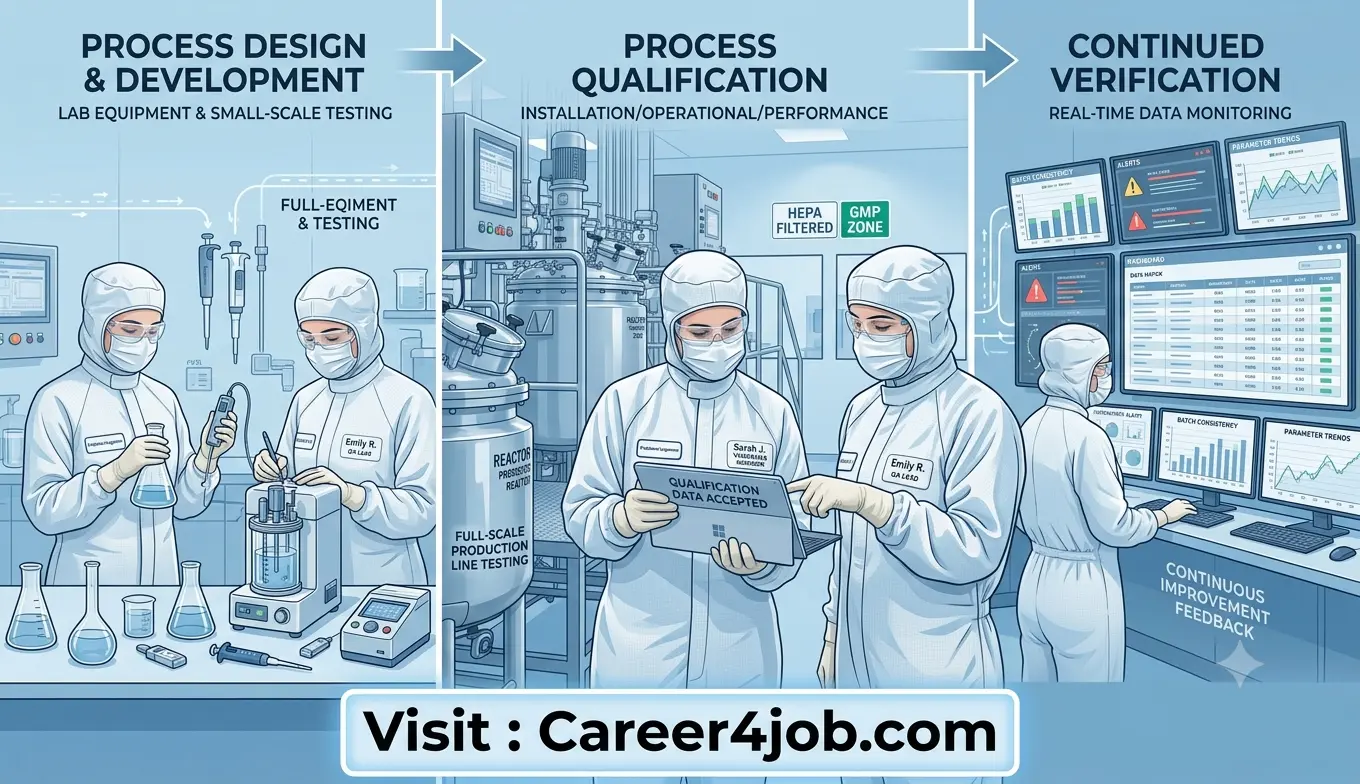
Learn pharmaceutical process validation from A to Z — stages, protocols, CPP, CQA, regulatory rules, and best practices for consistent product quality.
Introduction
Walk into any pharmaceutical manufacturing plant and you’ll notice something right away: nothing happens by accident. Every batch of tablets, every vial of injectable medicine, and every capsule on the shelf exists because a process was tested, measured, and proven to work the same way, every single time. That proof has a name — process validation.
If you’re new to the pharmaceutical industry, the term can sound intimidating. If you’re a seasoned quality professional, you already know it’s one of the most important pillars of Good Manufacturing Practice (GMP). Either way, this guide breaks down pharmaceutical process validation in plain English, covering everything from the basic definition to the latest digital trends shaping the field.
By the end of this article, you’ll understand why regulators like the FDA and EMA treat process validation as non-negotiable, how the three validation stages fit together, and what documents and best practices keep a validation program audit-ready.

What is Pharmaceutical Process Validation?
| ⚡ Quick Answer: What is Pharmaceutical Process Validation? Pharmaceutical process validation is the documented practice of proving that a manufacturing process consistently produces a product that meets its predetermined quality specifications. It combines scientific evidence, data collection, and statistical analysis to confirm a process is reliable, repeatable, and controlled. |
In simple terms, process validation answers one question: can this process make the same high-quality product, batch after batch, without fail? It’s not a one-time test. It’s an ongoing commitment that starts during product development and continues throughout the product’s commercial life.
The concept applies to nearly every step of drug manufacturing — mixing, granulation, coating, filling, sterilization, packaging, and more. Each step must be shown, with real data, to perform within defined limits.
Regulatory agencies define process validation as establishing documented evidence that provides a high degree of assurance that a specific process will consistently produce a product meeting its predetermined specifications and quality attributes. That definition, first popularized by the U.S. Food and Drug Administration (FDA), remains the backbone of validation programs worldwide.
Why Process Validation is Important
| ⚡ Quick Answer: Why is Process Validation Important? Process validation matters because it protects patient safety, ensures consistent product quality, and satisfies regulatory requirements. Without it, manufacturers cannot reliably guarantee that every batch of a drug will work the same way, which increases the risk of defects, recalls, and patient harm. |
Think about it from a patient’s perspective. When someone takes a blood pressure tablet, they trust that it contains the exact dose printed on the label — not too much, not too little. Process validation is what makes that trust possible.
Beyond patient safety, there are business and regulatory reasons validation matters:
- It reduces the risk of costly product recalls and batch rejections.
- It supports regulatory approval and inspection readiness.
- It minimizes variability, which lowers manufacturing costs over time.
- It builds a documented history that protects the company during audits or legal review.
- It supports continuous improvement by highlighting process weaknesses early.
In short, process validation isn’t just paperwork — it’s the scientific foundation that keeps medicines safe, effective, and consistent.
Objectives of Process Validation
Every validation activity should tie back to a clear set of objectives. These goals guide how a validation program is designed and measured for success.
- Confirm that the manufacturing process performs as intended under normal operating conditions.
- Demonstrate that critical process parameters stay within approved limits.
- Verify that the finished product consistently meets its critical quality attributes.
- Provide documented, objective evidence that can withstand regulatory scrutiny.
- Identify sources of variability so they can be controlled or eliminated.
- Support the product’s lifecycle, from development through commercial production and eventual discontinuation.
Regulatory Requirements
Process validation isn’t optional — it’s a legal and regulatory expectation in nearly every country that manufactures or imports pharmaceuticals. Several major agencies and organizations have published guidance that shapes how companies validate their processes.
The U.S. Food and Drug Administration (FDA) guidance, Process Validation: General Principles and Practices, introduced the modern three-stage lifecycle approach that most of this article is built around.
The European Medicines Agency (EMA) provides similar guidance for the European Union, aligning closely with the FDA’s lifecycle model while emphasizing continuous process verification.
The International Council for Harmonisation (ICH) publishes globally recognized quality guidelines, including ICH Q8 (Pharmaceutical Development), ICH Q9 (Quality Risk Management), and ICH Q10 (Pharmaceutical Quality System), all of which directly influence how validation programs are designed.
Beyond these three, regional bodies such as the World Health Organization (WHO), the UK’s MHRA, and various national health authorities publish their own GMP requirements. Companies that manufacture for global markets typically design their validation programs to satisfy the strictest applicable standard, which usually means following FDA and ICH principles as a baseline.
Types of Process Validation
Not every validation project looks the same. Depending on when the validation activity happens relative to commercial production, it falls into one of four categories.
| Type | When It’s Used | Key Characteristic |
| Prospective Validation | Before commercial distribution begins | Planned and executed prior to routine production |
| Concurrent Validation | During actual production | Data collected while product is simultaneously released |
| Retrospective Validation | After production, using historical data | Rarely used today; largely phased out by regulators |
| Revalidation | After a significant change or periodically | Confirms the process still performs as validated |
Prospective Validation
Prospective validation happens before a product is released to the market. It’s the preferred and most common approach today. Manufacturers run a series of trial batches under controlled conditions, collect data, and confirm the process meets predefined acceptance criteria before any commercial batch is sold.
Concurrent Validation
Concurrent validation takes place while the product is already being manufactured and distributed. It’s typically reserved for situations where there’s a compelling reason to release batches before full validation data is available — for example, during a drug shortage. It requires strong justification and rigorous monitoring.
Retrospective Validation
Retrospective validation relies on historical production and testing data to confirm a process is under control. Because it doesn’t involve real-time monitoring or fresh experimental data, most regulatory agencies, including the FDA, no longer accept it as a standalone validation strategy.
Revalidation
Revalidation is triggered whenever something changes — a new raw material supplier, an equipment upgrade, a formulation tweak, or even a shift in batch size. It confirms the modified process still consistently delivers a quality product. Some companies also schedule periodic revalidation as a preventive measure.
Stages of Process Validation
| ⚡ Quick Answer: What are the Three Stages of Process Validation? The three stages of process validation are Stage 1 (Process Design), Stage 2 (Process Qualification), and Stage 3 (Continued Process Verification). Together, they form a lifecycle approach that begins during development and continues through the entire commercial life of the product. |
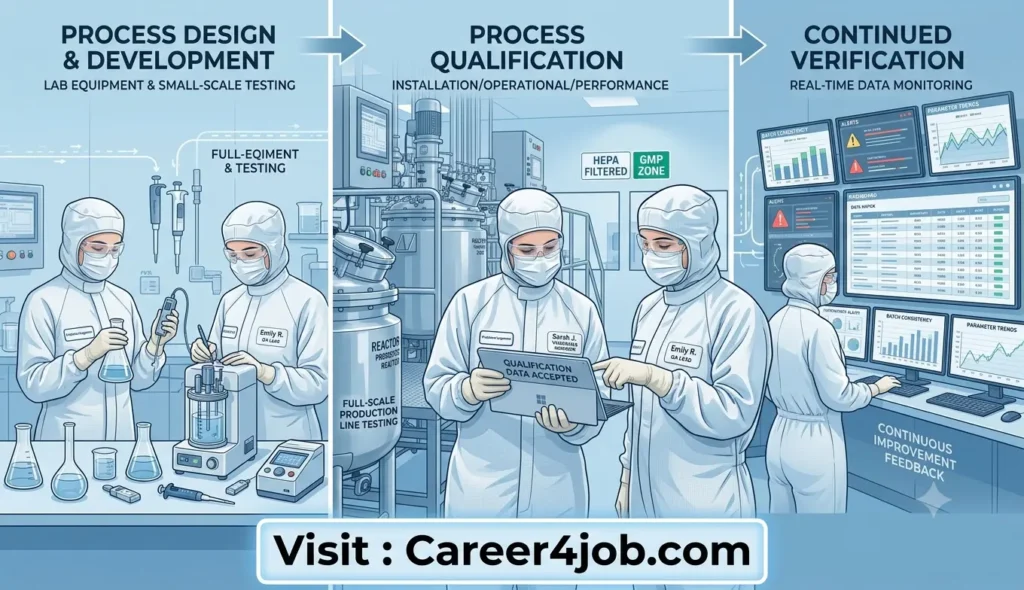
Modern process validation, as outlined by the FDA, follows a lifecycle model rather than a single event. This means validation doesn’t stop once a few batches pass — it continues for as long as the product is manufactured.
| Stage | Focus | Typical Activities |
| Stage 1: Process Design | Building process knowledge | Lab studies, risk assessments, defining CPPs and CQAs |
| Stage 2: Process Qualification | Confirming the process works | Facility/equipment qualification, process performance qualification (PPQ) batches |
| Stage 3: Continued Process Verification | Ongoing assurance | Routine monitoring, trend analysis, periodic review |
Stage 1: Process Design
This is where the process is defined, based on knowledge gained during development and scale-up. Teams use lab-scale and pilot-scale studies, along with quality risk management tools, to identify which process parameters and material attributes are truly critical to product quality.
Stage 2: Process Qualification
Once the process design is set, it’s time to confirm the facility, equipment, and process can actually perform as intended in a real manufacturing environment. This stage includes qualifying equipment (through DQ, IQ, OQ, and PQ) and running process performance qualification (PPQ) batches under actual production conditions.
Stage 3: Continued Process Verification
Validation doesn’t end once PPQ batches pass. Stage 3 involves continuous monitoring of the commercial process to catch drift, variability, or emerging trends before they turn into quality problems. This stage keeps the process in a state of control for the life of the product.
Validation Master Plan (VMP)
A Validation Master Plan is the roadmap for an organization’s entire validation program. It’s typically a single, high-level document that outlines what needs to be validated, in what order, using what approach, and by when.
A well-written VMP usually includes:
- The scope and objectives of the validation program
- An organizational chart showing roles and responsibilities
- A list of systems, equipment, and processes requiring validation
- The overall validation strategy and acceptance criteria philosophy
- A schedule or timeline for validation activities
- Reference to related SOPs and regulatory guidance
Auditors and inspectors often ask to see the VMP early in an inspection because it shows, at a glance, how mature and organized a company’s quality system really is.
Process Validation Protocol
A validation protocol is a detailed, pre-approved document describing exactly how a specific validation study will be carried out. Think of it as the instruction manual and rulebook combined — it’s written and approved before any testing begins.
A solid process validation protocol checklist typically includes:
- Purpose and scope of the validation study
- Product and process description
- Roles and responsibilities of the validation team
- List of critical process parameters and quality attributes to be monitored
- Sampling plan and testing methods
- Predefined acceptance criteria
- Equipment and materials to be used
- Deviation-handling procedure
- Approval signatures from quality, production, and other stakeholders
Nothing should be tested before the protocol is reviewed and signed off. This sequence protects the integrity of the data — you can’t move the goalposts after seeing the results.
Process Validation Report
Once the protocol has been executed, the results are compiled into a validation report. This document summarizes what was done, what data was collected, and whether the process met its predefined acceptance criteria.
A complete process validation report generally covers:
- A summary of the study and any deviations encountered
- Raw data, test results, and statistical analysis
- A comparison of results against the acceptance criteria in the protocol
- Conclusions on whether the process is validated
- Recommendations for routine monitoring or follow-up actions
If the process meets all acceptance criteria, the report typically concludes that the process is validated and approved for commercial use. If not, the deviations must be investigated, and a course of action — such as re-testing or process adjustment — must be documented.
Critical Process Parameters (CPP)
A Critical Process Parameter is a process input — like temperature, pressure, mixing speed, or time — whose variability has a direct impact on a critical quality attribute. In other words, if you change a CPP even slightly, the finished product could be affected.
Examples of common CPPs in pharmaceutical manufacturing include:
- Granulation time and speed
- Drying temperature and duration
- Compression force during tableting
- Coating spray rate
- Sterilization temperature and hold time
Identifying CPPs early, usually during Stage 1 (Process Design), allows manufacturers to build tighter process controls around the parameters that matter most.
Critical Quality Attributes (CQA)
A Critical Quality Attribute is a physical, chemical, biological, or microbiological property that must fall within an approved range to ensure the desired product quality. CQAs describe the finished product itself, not the process that creates it.
Typical CQAs include:
- Assay or potency (how much active ingredient is actually present)
- Dissolution rate
- Content uniformity
- Sterility for injectable products
- Appearance, hardness, and friability of tablets
CPP vs CQA: What’s the Difference?
This is one of the most common points of confusion for newcomers, so here’s a side-by-side comparison.
| Aspect | Critical Process Parameter (CPP) | Critical Quality Attribute (CQA) |
| Definition | A process input that affects product quality | A product property that must meet specification |
| Relates To | The manufacturing process | The finished product |
| Example | Mixing speed, drying temperature | Potency, dissolution rate, sterility |
| Controlled By | Process controls and equipment settings | Formulation design and process control |
| Measured During | Process monitoring | Product testing and release |
Risk Assessment in Process Validation
Risk assessment is the practice of identifying, evaluating, and controlling risks that could affect product quality before they cause a problem. It’s a core requirement under ICH Q9 (Quality Risk Management) and is woven into every stage of the validation lifecycle.
Common risk assessment tools used in pharmaceutical validation include:
- Failure Mode and Effects Analysis (FMEA)
- Fishbone (Ishikawa) diagrams for root-cause analysis
- Hazard Analysis and Critical Control Points (HACCP)
- Risk ranking and filtering matrices
Using these tools, teams can focus validation resources on the parameters and attributes that carry the highest risk to patient safety, rather than treating every variable as equally important.
Equipment Qualification
Before a process can be validated, the equipment used to run that process must be qualified. Equipment qualification follows a four-stage sequence, often remembered by the acronym DQ, IQ, OQ, PQ.
| Stage | Full Name | Purpose |
| DQ | Design Qualification | Confirms the equipment design meets the intended purpose before purchase or installation |
| IQ | Installation Qualification | Verifies the equipment is installed correctly according to specifications |
| OQ | Operational Qualification | Confirms the equipment operates correctly across its intended operating ranges |
| PQ | Performance Qualification | Demonstrates the equipment consistently performs as intended under real production conditions |
Each stage builds on the one before it. Skipping a stage — or rushing through it — creates gaps that can undermine the entire validation program later on.
Cleaning Validation
Cleaning validation proves that a cleaning procedure reliably removes product residue, cleaning agents, and microbial contamination from equipment surfaces to a scientifically justified acceptable limit. This is especially critical when the same equipment is used to manufacture multiple products.
A typical cleaning validation study looks at:
- Worst-case product selection based on solubility and toxicity
- Sampling methods, such as swab testing and rinse sampling
- Analytical methods used to detect residues
- Acceptable residue limits, often calculated using toxicological data
Without proper cleaning validation, there’s a real risk of cross-contamination between products, which can put patients at serious risk.
Sampling Plan
A sampling plan defines how many samples are taken, from where, and at what stage of the process, to give a statistically sound picture of batch quality. A poorly designed sampling plan can miss real problems or create false alarms.
Good sampling plans typically specify sample size, sampling locations (such as beginning, middle, and end of a compression run), sampling frequency, and the statistical rationale behind those choices. Many companies rely on acceptable quality limit (AQL) tables or statistically derived sample sizes rather than guesswork.
Acceptance Criteria
Acceptance criteria are the predefined, measurable limits a process or product must meet to be considered successful. They’re set before testing begins, based on scientific knowledge, regulatory requirements, and historical data.
For example, a tablet potency acceptance criterion might require the assay result to fall between 95% and 105% of the labeled strength. If a batch falls outside that range, it fails — no exceptions, no renegotiating after the fact.
Documentation Requirements
In pharmaceutical manufacturing, there’s a well-known saying: if it isn’t documented, it didn’t happen. Documentation is the backbone of process validation, and regulators expect a complete, traceable paper (or electronic) trail.
| Document | Purpose |
| Validation Master Plan (VMP) | Provides the overall validation strategy and schedule |
| Validation Protocol | Defines how a specific validation study will be conducted |
| Standard Operating Procedures (SOPs) | Describe step-by-step how routine tasks are performed |
| Batch Manufacturing Records (BMR) | Document what actually happened during each production batch |
| Validation Report | Summarizes results and conclusions of a validation study |
| Change Control Records | Track and justify modifications to validated processes |
| Deviation Reports | Document and investigate unexpected events during production |
Good documentation practices — often summarized with the acronym ALCOA+ (Attributable, Legible, Contemporaneous, Original, Accurate, plus Complete, Consistent, Enduring, and Available) — apply to every document listed above.
Common Challenges
Even experienced quality teams run into recurring obstacles when managing process validation programs. Recognizing these challenges early makes them easier to manage.
- Incomplete process understanding during development, leading to poorly chosen CPPs
- Inconsistent raw material quality that introduces unexpected variability
- Equipment that isn’t properly qualified before validation studies begin
- Weak or vague acceptance criteria that are open to interpretation
- Poor cross-department communication between R&D, quality, and manufacturing
- Outdated or overly generic protocols copied from other products without adaptation
- Insufficient resources or time allocated for Stage 3 ongoing monitoring
Best Practices
The strongest validation programs share a set of common habits. Use this checklist as a quick self-assessment for your own program.
- Start validation planning early, during process development, not after
- Base CPP and CQA selection on solid risk assessment, not assumptions
- Keep protocols specific to the actual product and process, not generic templates
- Involve cross-functional teams — quality, production, engineering, and regulatory — from the start
- Invest in proper equipment qualification before process qualification begins
- Use statistically sound sampling plans instead of arbitrary sample sizes
- Maintain thorough, contemporaneous documentation at every step
- Treat Stage 3 continued verification as an ongoing priority, not a formality
- Review and update the Validation Master Plan regularly
Latest Industry Trends
Pharmaceutical process validation continues to evolve alongside manufacturing technology and regulatory expectations. A few trends are shaping the field right now.
- Greater adoption of Quality by Design (QbD) principles, building quality into the process from the earliest development stages
- Increased use of Process Analytical Technology (PAT) for real-time, in-line monitoring of critical parameters
- A shift toward continuous manufacturing, which requires new validation approaches compared to traditional batch processes
- Growing regulatory focus on data integrity and electronic records
- More emphasis on lifecycle-based validation rather than one-time qualification events
Digital Validation
Digital validation refers to the use of software platforms and electronic systems to plan, execute, document, and manage validation activities — replacing paper-based binders full of protocols and reports.
Digital validation tools typically offer:
- Centralized document control and version history
- Automated workflows for protocol approval and sign-off
- Real-time dashboards showing validation status across a facility
- Built-in audit trails that support data integrity requirements
- Easier retrieval of historical validation records during inspections
For companies managing dozens or hundreds of validated systems, digital tools significantly reduce the administrative burden while improving traceability and audit readiness.
AI and Automation in Process Validation
Artificial intelligence and automation are beginning to reshape how manufacturers approach process validation, though human oversight and scientific judgment remain essential.
Some emerging applications include:
- Predictive analytics that flag potential process drift before it causes an out-of-specification result
- Machine learning models that help identify which process parameters are most likely to be critical, supporting risk assessments
- Automated data collection from sensors and process equipment, reducing manual transcription errors
- AI-assisted document review, helping teams spot inconsistencies across protocols and reports faster
It’s worth noting that regulators still expect validation conclusions to be backed by sound science and human review. AI and automation are best viewed as tools that support decision-making, not replacements for a qualified validation team.
Frequently Asked Questions
What is pharmaceutical process validation in simple terms?
It’s the documented process of proving that a manufacturing process reliably makes a product that meets its quality specifications every single time, using real data and testing rather than assumptions.
What are the three stages of process validation?
The three stages are Process Design (Stage 1), Process Qualification (Stage 2), and Continued Process Verification (Stage 3). Together, they form a lifecycle that begins in development and continues through commercial manufacturing.
What is the difference between IQ, OQ, and PQ?
IQ (Installation Qualification) confirms equipment is installed correctly. OQ (Operational Qualification) confirms it works correctly across its operating range. PQ (Performance Qualification) confirms it performs consistently under real production conditions.
What is the difference between a CPP and a CQA?
A Critical Process Parameter (CPP) is a process input, like temperature or mixing speed, that affects product quality. A Critical Quality Attribute (CQA) is a property of the finished product itself, like potency or dissolution rate.
Why is retrospective validation no longer commonly accepted?
Retrospective validation relies only on historical data without real-time monitoring or controlled experimentation, which doesn’t provide the same level of assurance as prospective or concurrent validation. Most regulators, including the FDA, no longer accept it as a primary approach.
How often should revalidation be performed?
Revalidation should occur whenever there’s a significant change to the process, equipment, materials, or facility. Some companies also schedule periodic revalidation reviews, even without a specific trigger, as a precaution.
What is a Validation Master Plan used for?
A Validation Master Plan (VMP) is a high-level document that outlines an organization’s overall validation strategy, scope, responsibilities, and schedule. It gives auditors and internal teams a clear picture of the entire validation program.
What documents are required for process validation?
Common documents include the Validation Master Plan, validation protocols, SOPs, batch manufacturing records, validation reports, change control records, and deviation reports. Together, they create a complete, traceable history of the process.
What is cleaning validation and why does it matter?
Cleaning validation proves that a cleaning procedure removes product residue, cleaning agents, and contamination to a safe, scientifically justified level. It’s essential for preventing cross-contamination when equipment is shared between products.
How is AI changing process validation?
AI supports process validation through predictive analytics, automated data collection, and smarter risk assessments. It helps teams spot potential issues earlier, but final validation decisions still require human scientific judgment and regulatory compliance.
What happens if a validation study fails to meet acceptance criteria?
If results fall outside the predefined acceptance criteria, the deviation must be investigated. Depending on the root cause, the team may need to adjust the process, retrain staff, repeat testing, or revise the protocol before moving forward.
Conclusion
Pharmaceutical process validation isn’t a box to check once and forget. It’s a living, evidence-based practice that protects patients, satisfies regulators, and keeps manufacturing consistent from the first pilot batch to the millionth commercial unit.
We covered a lot of ground in this guide — from the basic definition and the three-stage lifecycle to critical process parameters, equipment qualification, documentation, and where AI is starting to fit in. Here’s a quick recap of the essentials.
Key Takeaways
- Process validation proves, with documented evidence, that a process consistently makes a quality product.
- The modern lifecycle approach has three stages: Process Design, Process Qualification, and Continued Process Verification.
- CPPs affect the process; CQAs describe the finished product — both must be identified and controlled.
- Equipment qualification (DQ, IQ, OQ, PQ) must happen before process qualification.
- Strong documentation and risk assessment are what make a validation program audit-ready.
- Digital tools and AI are streamlining validation, but human scientific judgment remains essential.
Actionable Recommendations
- Review your current Validation Master Plan and confirm it reflects your actual product portfolio and equipment.
- Audit your CPP and CQA documentation to make sure they’re backed by risk assessment, not guesswork.
- Check that Stage 3 continued process verification is actively monitored, not just documented as a formality.
- Evaluate whether digital validation tools could reduce your team’s administrative workload.
- Schedule a documentation audit to confirm ALCOA+ principles are followed across all validation records.
Process validation touches nearly every corner of pharmaceutical manufacturing, from equipment qualification to cleaning procedures to digital transformation. If you found this guide helpful, explore our related articles on GMP compliance, equipment qualification, and quality risk management to keep building your validation knowledge.
External References
- FDA — Process Validation: General Principles and Practices
- European Medicines Agency (EMA) — Guideline on Process Validation
- ICH — Quality Guidelines (Q8, Q9, Q10)
Related articles
- A Beginner’s Guide to Good Manufacturing Practice (GMP) in Pharma
- Equipment Qualification Explained: DQ, IQ, OQ, and PQ
- How to Write an Effective Standard Operating Procedure (SOP)
- Quality Risk Management in Pharmaceutical Manufacturing: An Overview
- Cleaning Validation Best Practices for Multi-Product Facilities