Learn how to reduce manufacturing defects with proven quality control methods, root cause analysis, Lean, Six Sigma, and practical process improvement strategies.
Every production line when a batch is manufacturing mostly, we get Yield of 95 – 99 %. A batch of products comes off the line, and some of them are just not right. Maybe a part does not fit. Maybe the paint is uneven. Maybe a machine cut a hole in the wrong place. These are manufacturing defects, and they cost time, money, and trust.
That most defects are not random. They come from clear causes, and that can be fixed. In this article, we will walk through why defects happen, and what you can do, step by step, to reduce Manufacturing Defects.
What Is a Manufacturing Defect?
A manufacturing defect is any flaw in a product that happens during the making of it. This is different from a design flaw, which happens on paper before the product is ever built. A defect can be small, like a scratch on the surface. It can also be big, like a part that breaks under normal use.
Common types of manufacturing defects include:
- Wrong size or shape
- Weak joints or welds
- Missing parts
- Poor finish, such as bubbles in paint or rough edges
- Parts that do not work together correctly
- Damage from packing or handling
Some defects are easy to spot. Others hide until the customer uses the product, which is the worst time to find them.
Why Do Manufacturing Defects Happen?
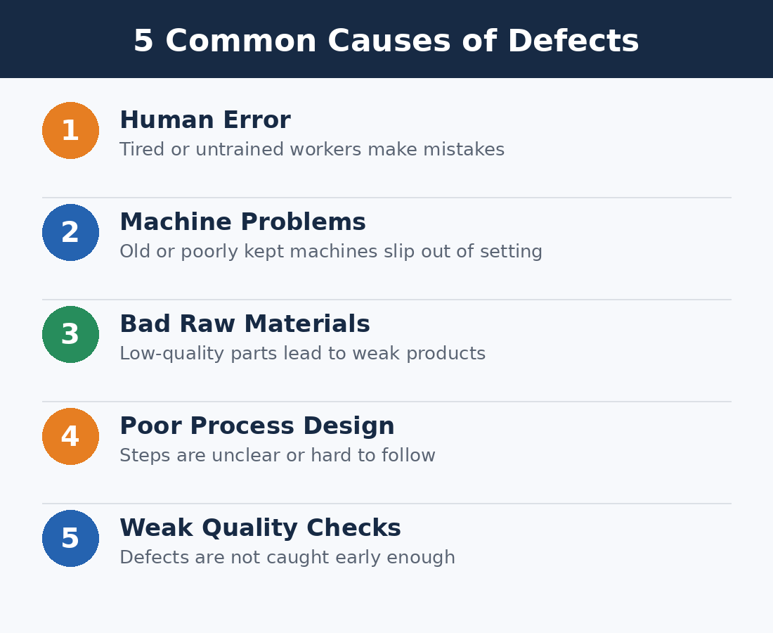
Most defects trace back to one of four root areas: people, machines, materials, or process. Understanding which one is at fault is the first step toward a real fix.
Human Error
People get tired. People get rushed. People skip steps when no one is watching. This is not about blaming workers; it is about building a system where mistakes are hard to make in the first place.
Machine Problems
Machines drift out of setting over time. A drill that was perfectly aligned last month may now be a hair off. Without regular checks, this small drift turns into a steady stream of bad parts.
Raw Materials Quality
You cannot make a good product from bad material. If the metal, plastic, or fabric coming into your factory is already weak or inconsistent, the defect is baked in before work even starts.
Weak Manufacturing Process
Sometimes the process itself is the problem. If steps are unclear, if there is no standard way to do a task, or if quality checks only happen at the very end, defects will slip through no matter how hard people try.
Why Reducing Defects Matters
Cutting defects is not just about looking good. It has a direct effect on your bottom line and your reputation. Here is why it matters:
- Lower cost. Rework, scrap, and returns all cost money. Fixing a problem after the fact is almost always more expensive than preventing it.
- Happier customers. A product that works the first time builds trust. A product that fails does the opposite.
- Better safety. In many industries, a defect is not just a quality issue. It can be a safety risk for the people who use the product.
- Stronger brand. Word travels fast when quality drops. A good reputation takes years to build and can be damaged quickly.
- Less waste. Fewer defects mean less scrap material, which is also better for the environment.
The American Society for Quality (ASQ) has long noted that the cost of poor quality can reach a large share of a company’s total sales when defects, rework, and returns are added up. That is a strong reason to treat defect reduction as a core part of the business, not a side task.
Proven Ways to Reduce Manufacturing Defects
There is no single fix that solves everything. Instead, defect reduction comes from a mix of small, steady habits. Here are the methods that work best in real factories.
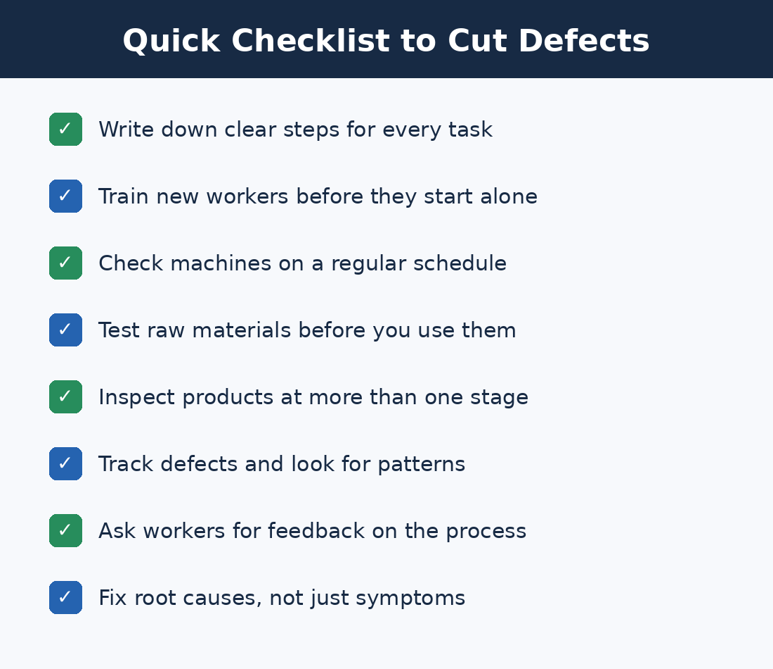
1. Standardize Your Process
Write down the exact steps for every task. This is often called a standard operating procedure, or SOP. When every worker follows the same steps, in the same order, results become far more consistent. Standard work also makes it easy to spot when something has gone wrong, because the normal process is clearly defined.
2. Train Workers the Right Way
Training should not be a one-time event on day one. It should be ongoing. New workers need hands-on practice before they are trusted to work alone. Experienced workers need refresher training when a process changes. A well-trained worker is your best defense against defects.
3. Inspect Quality at Every Stage
Many factories only check quality at the end of the line. By then, it is too late; the defect has already used up time, material, and labor. Instead, add checks at each major stage of production. Catching a problem early is always cheaper than catching it late.
4. Keep Machines in Good Shape
Set a fixed schedule for machine maintenance and stick to it. Do not wait for a machine to fail. Small issues, like a loose part or worn blade, are easy to fix today and expensive to fix after they cause a run of bad products.
5. Choose Quality Raw Materials
Work closely with suppliers who can prove their materials meet your standards. Test incoming materials before they enter production, especially for parts that matter most to the final product. A cheaper material that causes defects is not actually cheaper once you count the rework.
6. Use Data to Find Root Causes
Track every defect: what it was, where it happened, and when. Over time, patterns appear. Maybe most defects happen on the night shift. Maybe they cluster around one machine. This kind of data turns guesswork into a clear plan of action. A simple tool called the “5 Whys” can help here: ask “why” five times in a row until you reach the true root cause, not just the surface symptom.
7. Build a Culture of Quality
The strongest defect-reduction systems are not just about tools and checklists. They are about culture. Workers need to feel safe reporting a problem instead of hiding it. Supervisors need to treat a reported defect as useful information, not a reason to punish someone. When quality becomes everyone’s job, not just the inspector’s job, defects drop.
Tools and Methods That Help
Several well-known quality methods can support your defect-reduction efforts. You do not need to use all of them, but it helps to know what each one does.
| Method | What It Does | Best For |
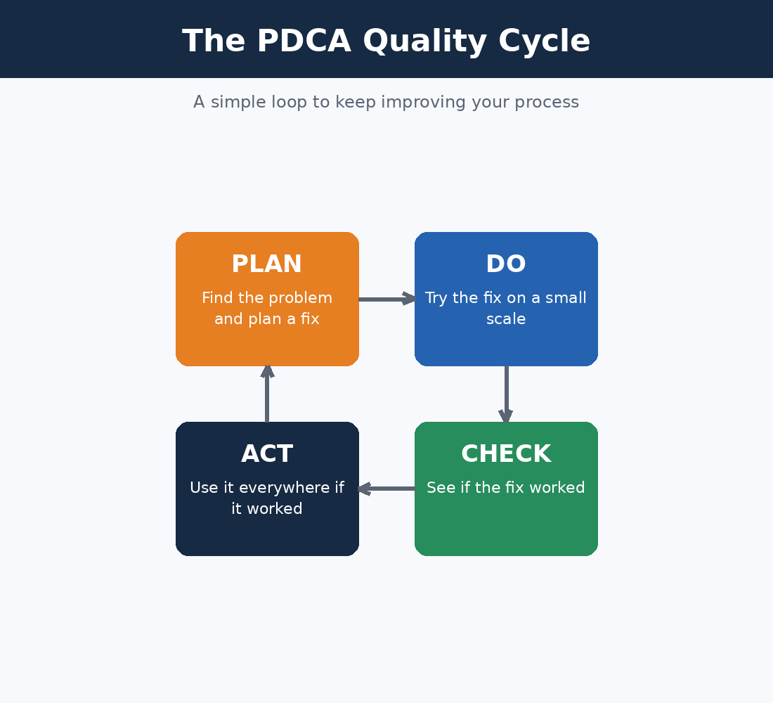
| PDCA (Plan-Do-Check-Act) | A simple loop for testing and improving a process | Small, ongoing improvements |
| Six Sigma | A data-driven method to reduce process variation | Large factories with lots of data |
| FMEA (Failure Mode and Effects Analysis) | Looks ahead to find where a process might fail | New products or new processes |
| SPC (Statistical Process Control) | Uses charts to track a process and catch drift early | Processes with repeat, measurable output |
| 5 Whys | Asks “why” repeatedly to find the true root cause | Quick investigations after a defect |
The International Organization for Standardization (ISO) also publishes widely used quality management standards, such as ISO 9001, which many factories use as the backbone of their quality system.
Common Mistakes to Avoid
Even well-meaning teams can slow down their own progress. Watch out for these common mistakes:
- Fixing symptoms, not causes. Reworking a bad part without asking why it happened means the same defect will return.
- Ignoring small defects. A “minor” issue today can become a major recall tomorrow if it is never addressed.
- Skipping documentation. If a fix is not written down, it is easy to forget and the old mistake creeps back in.
- Blaming workers instead of the system. Most defects come from a weak process, not a careless person.
- Treating quality as one department’s job. Quality control works best when it involves everyone, from the supply chain to the shop floor.
- Making changes without testing. A new process should be tested on a small scale before it is rolled out everywhere.
Frequently Asked Questions
What is the main cause of manufacturing defects?
There is rarely just one cause. Most defects come from a mix of human error, machine drift, poor materials, or weak process design. The exact mix is different for every factory, which is why tracking your own defect data matters so much.
How can a small factory reduce defects without a big budget?
Start with the basics: write down clear steps for each task, train workers well, and check quality at more than one stage. These steps cost very little but often bring the biggest early improvement.
What is the difference between a defect and a design flaw?
A design flaw exists in the product plan itself, before anything is built. A manufacturing defect happens during production, even when the design was correct.
How often should machines be checked for maintenance?
This depends on the machine and how heavily it is used, but a fixed schedule, checked weekly or monthly, is far better than waiting until something breaks.
What is Six Sigma in simple terms?
Six Sigma is a method that uses data to find and remove the causes of errors in a process. The goal is to make the process so consistent that defects become extremely rare.
Can better training really reduce defects?
Yes. Factory case reports consistently show that a large share of defects trace back to unclear instructions or under-trained staff, which good training and standard work can directly fix.
How do I know if my defect-reduction plan is working?
Track your defect rate over time. If the number of defects per batch is falling month over month, your plan is working. If not, revisit your root cause analysis.
Is zero defects actually possible?
Zero defects is a goal to aim for, and some highly controlled processes get very close. In practice, most factories aim for a very low, steady defect rate rather than a literal zero, since that is a more realistic and sustainable target.
Conclusion
Reducing manufacturing defects is not about one big fix. It is about steady, small improvements: clear steps, trained workers, checks at every stage, well-kept machines, good materials, and a culture where problems are reported, not hidden. Start with the area causing you the most trouble today, apply one of the methods above, and measure the result. Over time, these small changes add up to a factory that makes fewer mistakes, spends less money on rework, and earns more trust from its customers.