Learn what Six Sigma is, how the DMAIC methodology works, the different Six Sigma belt levels, key benefits, and how to get started with Six Sigma certification.
If you have heard the term “Six Sigma” at work, in a job post, or in a training course, you may have wondered what it really means. The good news is that the idea behind it is simple, even if the name sounds technical.
Six Sigma is a way of working that helps a business find problems, understand why they happen, and fix them for good. It is used by small shops and huge companies alike, from hospitals to car makers to banks. In this guide, we will explain what Six Sigma is, how it works, the belt levels, and how you can learn it yourself. We will keep the words simple and skip the jargon where we can.
What Does Six Sigma Mean?
Six Sigma is a set of tools and steps that help a team find the real cause of a problem in a process, then fix it in a lasting way. The goal is to make a process almost free of mistakes.
The word “sigma” comes from math. It is a Greek letter (σ) used to measure how much a result varies from the average, or normal, result. A process that reaches “six sigma” makes only about 3.4 mistakes for every 1 million chances. That is close to perfect.
In plain terms, companies use Six Sigma to:
- Find the real, root cause of a problem instead of just treating the symptom
- Cut down on waste, rework, and wasted time
- Make products and services more consistent and reliable
- Save money by catching issues early, before they turn into bigger costs
- Make choices based on real data instead of guesswork
A Short History of Six Sigma
Six Sigma began at Motorola in 1986. An engineer named Bill Smith wanted a better way to measure and reduce defects on the factory floor. His method worked so well that Motorola later said it saved billions of dollars because of it.
The idea became famous in the 1990s when Jack Welch, the CEO of General Electric, made Six Sigma a core part of how the company ran its business. GE reported major savings within a few years, and other large companies such as Honeywell, Ford, and Amazon later adopted similar methods.
Today, Six Sigma is no longer only for factories. Hospitals use it to reduce errors in patient care. Banks use it to speed up loan approvals. Software teams use it to cut down on bugs. The core idea stayed the same: measure the problem, find the cause, and fix it for good.
How Does Six Sigma Work? The DMAIC Method
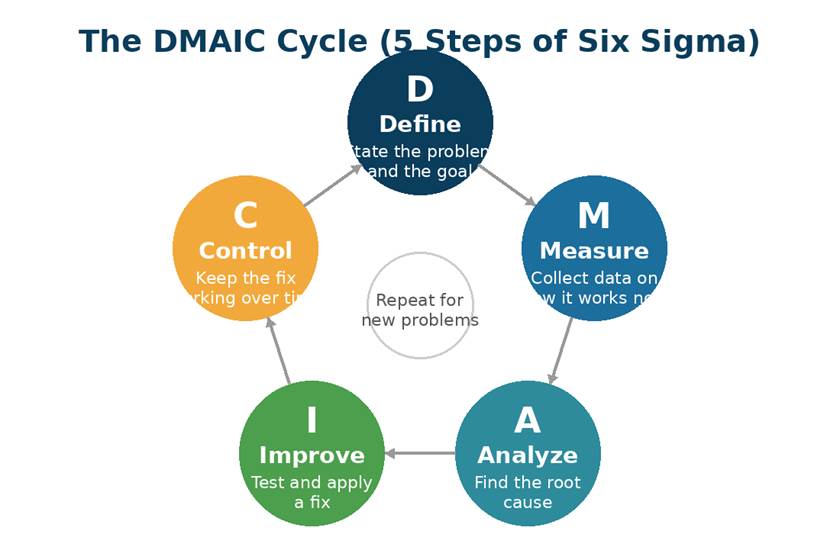
Most Six Sigma projects follow five steps, known by the short name DMAIC. Each letter stands for one step in the process, done in order.
1. Define
The team writes down the problem in plain words. What is going wrong? Who does it affect? What does success look like? This step sets a clear target for the whole project.
2. Measure
The team collects data about how the process works right now. This gives a starting point, so the team can later prove whether things actually got better.
3. Analyze
The team studies the data to find the root cause of the problem, not just the symptoms. Simple charts and cause-and-effect diagrams often help at this stage.
4. Improve
The team tests a possible fix on a small scale first. If it works, the fix is rolled out to the full process.
5. Control
The team keeps an eye on the process over time to make sure the fix keeps working, and the old problem does not creep back in. This step is often skipped by beginners, and it is the one that makes results last.
Six Sigma Levels: How Good Is “Good Enough”?
Not every process needs to reach six sigma. The table below shows how the sigma level connects to the number of mistakes made per one million chances.
| Sigma Level | Mistakes per Million | Percent Correct |
| 1 Sigma | 690,000 | 31.0% |
| 2 Sigma | 308,000 | 69.2% |
| 3 Sigma | 66,800 | 93.3% |
| 4 Sigma | 6,210 | 99.38% |
| 5 Sigma | 233 | 99.977% |
| 6 Sigma | 3.4 | 99.99966% |
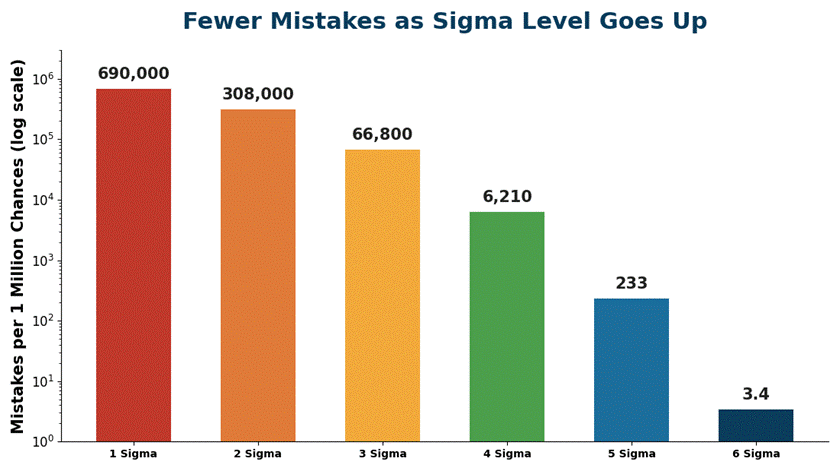
Most everyday businesses run somewhere around 3 to 4 sigma, and that is often good enough. Reaching a true six sigma level takes a lot of time, training, and money, so it tends to matter most in fields where mistakes are costly or dangerous, such as healthcare, aviation, and electronics manufacturing.
Six Sigma Belt Levels (Who Does What)
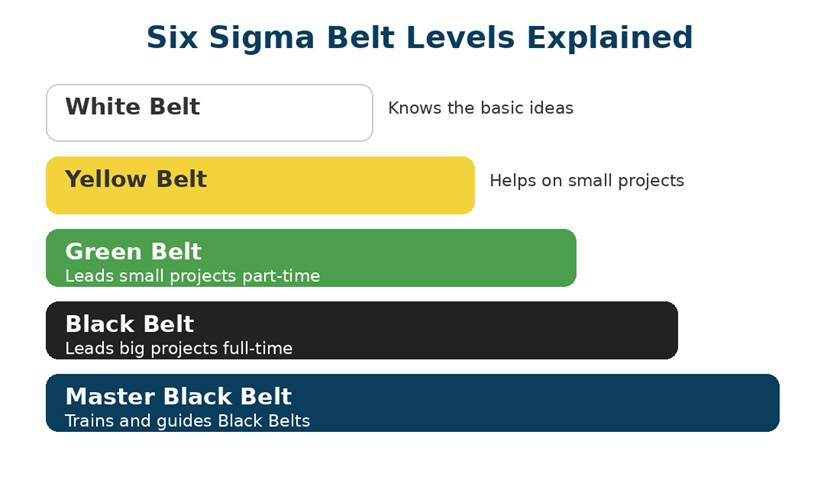
Like martial arts, Six Sigma uses “belt” names to show a person’s level of training and the size of project they can lead.
| Belt Level | What They Typically Do |
| White Belt | Learns the basic ideas and supports a project team |
| Yellow Belt | Works on small, well-defined tasks within a project |
| Green Belt | Leads small to medium projects, usually part-time |
| Black Belt | Leads large, complex projects full-time and mentors Green Belts |
| Master Black Belt | Trains other belts and guides Six Sigma strategy across the company |
Six Sigma vs. Lean Six Sigma: What’s the Difference?
People often mix up Six Sigma and Lean, but they focus on different things:
- Six Sigma focuses on reducing mistakes and variation in a process
- Lean focuses on removing waste and speeding up how work flows
- Lean Six Sigma combines both ideas: fewer mistakes and less wasted effort
Most companies today use Lean Six Sigma rather than either method alone, since the two approaches work well together. Lean helps a team move faster, while Six Sigma helps make sure that faster work is still accurate.
Benefits of Using Six Sigma
- Saves money by reducing waste, rework, and returns
- Improves the quality and consistency of products or services
- Increases customer satisfaction and trust
- Builds a habit of ongoing, steady improvement instead of one-time fixes
- Helps teams make decisions based on real data, not guesses
- Gives employees a shared way to talk about problems and solutions
Who Uses Six Sigma?
Six Sigma started in manufacturing, but many other fields use it today, including:
- Manufacturing and factories
- Healthcare and hospitals
- Banking and finance
- Software and IT services
- Retail and supply chains
- Government and public services
How to Get Six Sigma Certified
There is no single worldwide body that controls Six Sigma certification, unlike some other professional licenses. Instead, certificates come from groups such as the American Society for Quality (ASQ), the International Association for Six Sigma Certification (IASSC), and many universities and private training providers.
In general, the steps to get certified look like this:
- Pick a belt level to start with (Yellow Belt or Green Belt is common for beginners)
- Take a training course, either online or in person
- Study the DMAIC method and basic data tools
- Pass an exam to earn the certificate
- Apply the skills on a real project, which some Black Belt programs require
Common Mistakes Companies Make When Starting Six Sigma
Six Sigma sounds simple on paper, but many companies stumble in the same few ways when they try it for the first time. Knowing these mistakes ahead of time can save a lot of wasted effort.
- Treating it as a one-time project instead of an ongoing habit
- Training too few people, so the effort stalls once the original team moves on
- Picking big, flashy projects before the team has practiced on smaller, clearer ones
- Skipping the Control step, so old problems slowly creep back after the project ends
- Collecting data without asking what question the data is supposed to answer
Frequently Asked Questions
What is Six Sigma in simple words?
Six Sigma is a way to find problems in how work gets done, figure out why they happen, and fix them so the business makes far fewer mistakes.
Is Six Sigma a certification or a method?
It is both. Six Sigma is first a method for solving problems and improving processes. Certifications, such as Yellow, Green, and Black Belt, are a way to prove that a person has learned this method.
How long does it take to get Six Sigma certified?
It depends on the belt level. A Yellow Belt course may take a few days, a Green Belt course a few weeks, and a Black Belt program several months, since it usually includes a real project.
Is Six Sigma still used today?
Yes. Many large and mid-sized companies still use Six Sigma or Lean Six Sigma, especially in manufacturing, healthcare, logistics, and finance.
What is the difference between Six Sigma and Lean Six Sigma?
Six Sigma focuses on cutting mistakes and variation. Lean focuses on cutting waste and speeding up work. Lean Six Sigma blends the two approaches together.
Can Six Sigma be used outside manufacturing?
Yes. Hospitals, banks, software teams, retailers, and government offices all use Six Sigma ideas to reduce errors and improve service.
How much does Six Sigma certification cost?
Costs vary widely by provider and belt level, ranging from under one hundred dollars for some online Yellow Belt courses to a few thousand dollars for in-depth Black Belt programs.
What is a good sigma level for a small business?
Most small businesses do well by aiming for 3 to 4 sigma first. Reaching a true 6 sigma level takes significant time and resources, so it usually makes sense only once the basics are solid.
Conclusion
Six Sigma is not as complicated as it sounds. At its core, it is a clear, step-by-step way to find out what is going wrong in a process, understand why, and fix it so the problem does not come back. Whether you run a small business or work inside a large company, the basic ideas of DMAIC, data-based decisions, and steady improvement can help cut down on mistakes and save time and money.
If you are thinking about learning Six Sigma, starting with a Yellow or Green Belt course is a practical first step. From there, you can decide if going further, toward a Black Belt or Master Black Belt, fits your career goals.