A simple, no-jargon guide to the questions that come up again and again in Pharma Quality Assurance interviews.
Walking into a Quality Assurance interview in the pharma world can feel a bit nerve-wracking. The questions cover everything from basic GMP terms to how you’d handle an angry auditor. The good news is, most interviewers are asking the same core set of questions, just worded a little differently each time.
This list pulls together the 100 questions that show up most often, with answers written in plain, everyday language. No heavy jargon, no textbook definitions you have to decode twice. Just clear answers you can actually remember and explain in your own words. Grab a cup of tea, read through a section or two a day, and you’ll walk into that interview room feeling ready.
One more tip before we start: interviewers aren’t looking for a word-perfect definition. They want to know you understand the idea behind it. So read each answer, then try explaining it out loud in your own words. That’s the version that will actually stick.
Part 1: QA Basics
1. What is Quality Assurance (QA) in the pharma industry?
QA is the part of a pharma company that makes sure every medicine is made the right way, every single time. It’s not about testing one tablet at the end. It’s about building good habits into every step, from buying raw material to shipping the final pack, so the product is safe and works as promised.
2. What is the difference between QA and QC?
People mix these up all the time, but they are not the same job.
| Point | QA (Quality Assurance) | QC (Quality Control) |
| Main focus | The process | The product |
| Goal | Stop mistakes before they happen | Catch mistakes in the sample |
| Work | SOPs, audits, training, documents | Testing raw material, in-process, and finished goods |
| Where it sits | Across the whole company | Mostly in the lab |
| Simple way to remember | QA builds the system | QC checks the output |
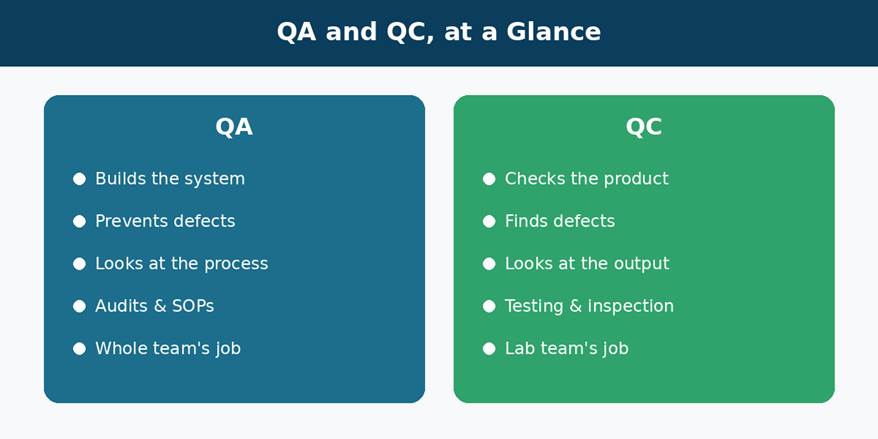
QA vs QC, side by side
3. Why does QA matter in drug manufacturing?
A mistake in a factory can end up in someone’s medicine cabinet. QA exists to catch problems early, before a bad batch ever leaves the plant. It also keeps the company on the right side of the law, since regulators like the FDA can shut down a site that doesn’t follow the rules.
4. What is GMP (Good Manufacturing Practice)?
GMP is a set of rules that tell a factory how to make products cleanly, safely, and the same way every time. It covers everything, from how staff wash their hands to how equipment is cleaned and how records are kept. You can read the official cGMP regulations on the FDA website if you want to see the real rule text.
5. What are the 5 P’s of GMP?
Interviewers love this one because it’s easy to remember and shows you understand the basics.
- People – trained staff who know what they’re doing
- Premises – a clean, well-kept building
- Processes – written steps that are followed the same way each time
- Products – raw material and packaging that meet the spec
- Procedures – SOPs that guide daily work
6. What is a Quality Management System (QMS)?
A QMS is the whole structure a company uses to plan, control, and improve quality. Think of it as the rulebook and the toolkit combined: SOPs, training records, audits, deviations, CAPA, and change control all live inside it.
7. What are the main elements of a QMS?
Most regulators expect these building blocks to be in place:
- Management responsibility and a quality policy
- Document control
- Training
- Deviation and CAPA handling
- Change control
- Internal audits (self-inspection)
- Supplier and vendor management
- Product quality review
8. What is the role of a QA officer?
A QA officer reviews documents, checks that SOPs are followed, releases or holds batches, handles deviations, and gets the site ready for audits. In short, they are the person who makes sure the paperwork and the reality on the shop floor actually match.
9. What is Good Documentation Practice (GDP)?
GDP means writing things down properly. No pencil, no correction fluid, no blank spaces. If you make a mistake while writing, you draw one line through it, write the correct entry, and sign and date it. Simple, but auditors check this closely.
10. What does ALCOA+ stand for?
ALCOA+ is a checklist for good data. Every record, paper or electronic, should be:
- Attributable – you can tell who wrote it
- Legible – you can actually read it
- Contemporaneous – written at the time the work was done
- Original – the first record, not a copy
- Accurate – it reflects what really happened
- Plus: Complete, Consistent, Enduring, and Available when needed
Part 2: Documentation and Records
11. What is an SOP?
SOP stands for Standard Operating Procedure. It’s a written, step-by-step guide that tells staff exactly how to do a task, like cleaning a machine or handling a complaint, so the job is done the same way no matter who does it.
12. What should a good SOP contain?
A useful SOP is clear enough that a new employee could follow it without asking someone else. It usually has:
- A title and purpose
- Scope – who and what it applies to
- Responsibilities
- Step-by-step procedure
- References to related documents
- Version number, effective date, and approval signatures
13. What is a Batch Manufacturing Record (BMR)?
A BMR is the document that captures the full story of one batch, what raw materials were used, which machines ran, who did each step, and what the results were. If there’s ever a complaint about that batch, the BMR is the first place investigators look.
14. What is the difference between a BMR and a BPR?
A BMR (Batch Manufacturing Record) covers the manufacturing steps, like mixing and granulation. A BPR (Batch Packing Record) covers packing steps, like filling, labelling, and cartoning. Together, they tell the complete life story of a batch, from powder to finished pack.
15. What is document control?
Document control is the process of making sure only the current, approved version of a document is in use. Old versions are pulled out, new versions are numbered, and everyone knows which copy is the real one. Without this, people can end up working from an outdated SOP by mistake.
16. How long should pharma records be kept?
It depends on local rules and the type of product, but a common rule of thumb is at least one year after the product’s expiry date, or longer if the regulator asks for it. Some documents, like validation reports, are often kept for the life of the product plus a few years.
17. What is a master formula record?
This is the approved recipe for a product: the exact list of ingredients, quantities, equipment, and method needed to make one batch. Every BMR is created by copying this master document, so there’s no room for guesswork.
18. What is version control in QA documents?
Version control means every change to a document gets a new number (like v1.0, v2.0) along with a date and the reason for the change. This way, anyone can look back and see exactly how a document evolved over time.
19. What happens if a document is filled with wrong data by mistake?
You never scratch it out completely or use whitener. You draw a single line through the wrong entry so it’s still readable, write the correct value beside it, then sign and date the change. This keeps the record honest and shows nothing was hidden.
20. What is a logbook and why is it used?
A logbook is a running record for a piece of equipment or a room, like a balance or a cleanroom. It tracks usage, cleaning, and maintenance in date order, so anyone can see the full history at a glance.
Part 3: Deviations, CAPA, and Change Control
21. What is a deviation in pharma?
A deviation is any time something doesn’t go according to the approved procedure, for example, a temperature that drifted out of range, or a step that got skipped by accident. It doesn’t always mean the product is bad, but it must always be recorded and looked into.
22. What are the types of deviations?
Deviations are usually grouped by how much risk they carry:
- Minor – small, no real impact on product quality
- Major – could affect product quality if not fixed
- Critical – direct risk to patient safety or product quality
- Planned – known in advance and approved before it happens
- Unplanned – an unexpected event
23. What is root cause analysis?
Root cause analysis is the process of digging past the obvious symptom to find the real reason a problem happened. Fixing the symptom might solve it for a day; fixing the root cause stops it from coming back.
24. What tools are used for root cause analysis?
A few tools come up again and again in interviews and on the job:
- 5 Why analysis – keep asking “why” until you hit the real cause
- Fishbone (Ishikawa) diagram – sorts causes into categories like man, machine, method, material
- Fault tree analysis – maps out the chain of events that led to failure
- Pareto analysis – finds the small number of causes behind most problems
25. What is CAPA?
CAPA stands for Corrective Action and Preventive Action. Corrective action fixes the problem that already happened. Preventive action stops a similar problem from happening in the future, even in a different area.
26. What are the steps in a CAPA process?
A typical CAPA moves through these stages:
- Identify and record the problem
- Investigate and find the root cause
- Plan the corrective and preventive actions
- Carry out the actions
- Check that the actions actually worked (effectiveness check)
- Close the CAPA with a final review
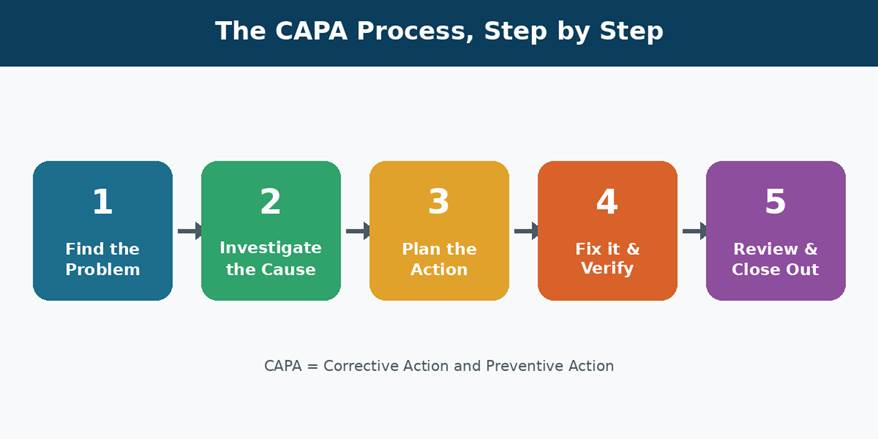
The CAPA process in five simple steps
27. What is the difference between correction and corrective action?
A correction is the quick fix, like re-cleaning a machine that failed a swab test. A corrective action goes deeper, asking why the cleaning failed in the first place and fixing that underlying issue so it doesn’t happen again.
28. What is change control?
Change control is the formal process a company follows before changing anything that could affect product quality, like a new supplier, a new machine, or an updated SOP. The idea is simple: think it through and get approval before you change it, not after.
29. What are the steps in a change control process?
Most change control systems follow this basic path:
- Raise a change request with a clear reason
- Assess the risk and impact
- Get approval from QA and other affected teams
- Carry out the change
- Verify the change worked as expected
- Close the change record
30. What is an OOS (Out of Specification) result?
An OOS result is a test result that falls outside the approved limits, for example, a tablet that doesn’t dissolve fast enough. It triggers an investigation to check if it was a lab mistake or a real product problem, and the batch cannot move forward until that investigation is closed.
Part 4: Audits and Inspections
31. What is a quality audit?
An audit is a planned check to see if a company is really doing what its own procedures say it should be doing. It can be done by the company itself, by a customer, or by a government regulator.
32. What are the different types of audits in pharma?
Here’s a quick way to tell them apart.
| Audit Type | Who Does It | Purpose |
| Internal (self-inspection) | The company’s own QA team | Find gaps before an outside body does |
| Supplier/vendor audit | The buying company | Check that a supplier meets quality standards |
| Customer audit | A client company | Confirm the manufacturer can be trusted |
| Regulatory audit | Agencies like the FDA or WHO | Confirm the site follows the law |
| Certification audit | Bodies like ISO auditors | Grant or renew a quality certificate |
33. What is a self-inspection?
A self-inspection is an internal audit a company runs on itself, usually once or twice a year. It’s a chance to find and fix small problems privately, before a government inspector finds them first.
34. How do you prepare for an FDA inspection?
Good preparation usually includes keeping documents current and easy to find, training staff on how to answer questions calmly, doing a mock audit beforehand, and making sure any open CAPAs or deviations are up to date, not sitting untouched for months.
35. What is a 483 observation?
Form 483 is what an FDA inspector issues when they spot something during an inspection that could break GMP rules. It’s not a final penalty, it’s a list of concerns, and the company is expected to respond in writing with a plan to fix each point.
36. What is a warning letter?
A warning letter is a more serious step from the FDA. It usually follows a 483 that wasn’t fixed properly, or a very serious problem, and it puts the company on notice that it must correct the issue quickly or face further action, like import bans.
37. What is a vendor or supplier audit?
This is when a pharma company sends its own auditors to check a supplier’s site, say, a company that supplies raw material. The goal is to confirm the supplier’s quality practices are solid before any material is trusted for use in medicine.
38. What is a mock audit?
A mock audit is a practice run. Someone from the company, or an outside consultant, acts like a real inspector and walks through the site asking tough questions. It helps staff get comfortable and helps QA find weak spots ahead of time.
39. What should you do if an auditor asks a question you don’t know?
Never guess. The safest answer is something like, “I’m not sure, let me check and get back to you.” Auditors respect honesty far more than a confident wrong answer, and giving false information can cause much bigger problems later.
40. What is data integrity and why do auditors check it?
Data integrity means the data is complete, consistent, and honest, matching what actually happened. Auditors dig into this because faked or edited data is one of the fastest ways trust breaks down between a company and a regulator.
Part 5: Validation and Qualification
41. What is validation in pharma?
Validation is documented proof that a process, method, or system consistently does what it’s supposed to do. It’s not a one-time test, it’s a planned study that builds confidence the process will keep working correctly, batch after batch.
42. What are the different types of validation?
Different situations call for different validation approaches.
| Type | When It’s Used |
| Prospective validation | Before the product is sold, using planned test batches |
| Concurrent validation | During actual production, in special or urgent cases |
| Retrospective validation | Based on past production data (rarely used today) |
| Revalidation | After a major change or a set time interval |
43. What is the difference between validation and qualification?
Qualification usually refers to equipment or systems, proving a machine works correctly. Validation is a broader word that usually covers a whole process or method. In short, you qualify equipment, and you validate a process.
44. What is IQ, OQ, and PQ?
These three steps are how equipment gets qualified for use:
- IQ (Installation Qualification) – confirms the equipment is installed correctly
- OQ (Operational Qualification) – confirms it operates correctly across its working range
- PQ (Performance Qualification) – confirms it performs consistently under real, everyday conditions
45. What is Design Qualification (DQ)?
DQ happens even earlier than IQ. It’s the documented proof that the equipment or facility was designed correctly for its intended purpose, before it’s even built or bought.
46. What is process validation?
Process validation proves that a manufacturing process will reliably produce a product that meets its quality specs, batch after batch. It’s usually done across three or more consecutive batches before the process is trusted for regular production.
47. What is cleaning validation?
Cleaning validation proves that the cleaning method used on equipment removes leftover product and cleaning agent down to a safe, acceptable level. This matters a lot when the same machine is used to make different products, since leftover residue could contaminate the next batch.
48. What is a Validation Master Plan (VMP)?
A VMP is the overall roadmap for all validation activities at a site: what needs validating, in what order, with what resources, and by when. It gives everyone, including auditors, a clear picture of the site’s validation strategy.
49. What is analytical method validation?
This is proof that a lab testing method actually gives accurate, reliable results. It looks at things like accuracy, precision, and how the method holds up under small, real-world changes, before that method is trusted to test real product.
50. What is re-validation and when is it needed?
Re-validation is repeating the validation study, usually triggered by a major change (like a new supplier, machine, or formula), a shift in process performance, or simply because a set review period has passed.
Part 6: Manufacturing and Batch Release
51. What is a batch or lot in pharma?
A batch (or lot) is a specific quantity of product made in one continuous manufacturing run, using the same raw materials and process. Every batch gets its own unique number so it can be tracked from start to finish.
52. What is batch release?
Batch release is the final QA decision that confirms a batch met every quality requirement and is approved to be sold or shipped. Nothing leaves the warehouse for sale until this sign-off happens.
53. Who can release a batch for sale?
In most countries, only a designated, qualified person, often called the Qualified Person (QP) or an authorized QA head, has the legal authority to release a batch. This isn’t a job that can be handed to just anyone.
54. What is a Certificate of Analysis (CoA)?
A CoA is a document that lists the test results for a batch, showing it meets its approved specifications. It usually travels with the batch and gives the customer proof of quality without them needing to retest everything.
55. What is line clearance?
Line clearance is a check done before starting a new batch on a production line, making sure nothing from the last product, materials, labels, or leftover product, is still sitting around. It’s a simple step that prevents mix-ups between products.
56. What is in-process quality control (IPQC)?
IPQC means checking quality while the product is still being made, not just at the end. For example, checking tablet weight during compression. Catching a problem mid-process saves an entire batch from being wasted.
57. What is a hold time study?
This study checks how long a material or product can sit at a certain stage, say, bulk solution before filling, without its quality dropping. It sets a safe time limit so nothing sits around too long and quietly degrades.
58. What is a Bill of Materials (BOM) in manufacturing?
A BOM is a complete list of every raw material, component, and packaging item needed to make one batch of a product, along with the exact quantities. It’s used to plan and check that the right materials are pulled for production.
59. What is reprocessing and reworking? What’s the difference?
Reprocessing means repeating an approved step of the normal process, like re-drying a batch that came out too wet. Reworking means using a different, unplanned method to fix an out-of-spec batch. Reprocessing is closer to routine; reworking needs much closer scrutiny and approval.
60. What is a Product Quality Review (PQR) or Annual Product Review (APR)?
This is a yearly look-back at everything related to a product: batches made, deviations, complaints, and test trends. It helps a company spot slow, creeping problems that wouldn’t be obvious by looking at just one batch at a time.
Part 7: Regulatory and Compliance
61. What is 21 CFR Part 11?
This is the FDA rule that covers electronic records and electronic signatures. It says that if a company keeps records on a computer instead of paper, that electronic system must be just as trustworthy, secure, and traceable as a paper record.
62. What are 21 CFR Part 210 and 211?
These are the core U.S. GMP regulations for pharmaceuticals. Part 210 covers general rules, and Part 211 lays out detailed requirements for manufacturing, processing, packing, and holding drug products.
63. What is ICH?
ICH stands for the International Council for Harmonisation. It brings regulators and industry experts from around the world together to agree on common quality, safety, and efficacy guidelines, so a company doesn’t need a completely different rulebook for every country. You can browse their guidelines on the ICH website.
64. What is ICH Q10?
ICH Q10 is the guideline that describes a modern Pharmaceutical Quality System, one that covers the entire life of a product, from development through manufacturing all the way to discontinuation, not just the manufacturing stage alone.
65. What is a Drug Master File (DMF)?
A DMF is a confidential document filed with a regulator that gives detailed information about a facility, process, or ingredient, often submitted by a raw material supplier so drug companies can reference it without the supplier revealing its secrets to a competitor.
66. What is a regulatory dossier or CTD?
CTD stands for Common Technical Document. It’s the standard, organized format companies use to submit all the information regulators need to approve a drug, quality data, safety data, and clinical data, arranged in the same structure worldwide.
67. What is pharmacovigilance and how does it connect to QA?
Pharmacovigilance is the ongoing job of tracking and reporting side effects once a medicine is out on the market. It connects to QA because any pattern of complaints or adverse events can point back to a quality problem at the manufacturing site.
68. What is the role of the WHO in pharma quality?
The World Health Organization sets globally recognized GMP guidelines, especially useful for countries that don’t yet have their own strong regulatory framework. Many manufacturers follow WHO GMP standards to sell products internationally.
69. What is a Quality Agreement between companies?
A Quality Agreement is a written contract between two companies, say, a manufacturer and a supplier, that spells out exactly who is responsible for what quality task. It avoids the classic “I thought you were checking that” problem.
70. What happens if a company fails to follow GMP?
Consequences can range from a warning letter, to an import ban, to a full plant shutdown, and in serious cases, criminal charges against responsible individuals. Beyond the legal side, patients can be put at real risk, which is the whole reason these rules exist.
Part 8: Lab, QC, and Testing
71. What is stability testing?
Stability testing checks how a product’s quality changes over time under different storage conditions, like heat and humidity. The results are used to set the product’s shelf life and storage instructions on the label.
72. What are stability zones or climatic zones?
The world is divided into climatic zones (I, II, III, IVA, IVB) based on temperature and humidity, from mild climates to hot, very humid ones. A product sold in a hot country needs to be tested under conditions matching that zone, not a cooler one.
73. What is a specification in QC?
A specification is the approved list of tests, and the acceptable limits for each test, that a product or material must pass. If a result falls outside these limits, it’s flagged as an OOS result.
74. What is calibration and why is it important?
Calibration is checking an instrument, like a balance or pH meter, against a known, trusted standard, and adjusting it if needed. Without regular calibration, you can’t trust any of the numbers that instrument produces.
75. What is the difference between calibration and validation?
Calibration checks that a single instrument gives accurate readings. Validation is bigger; it proves that an entire process or system consistently produces the right result. Calibration is often just one small piece inside a larger validation study.
76. What is a reference standard?
A reference standard is a highly pure, well-characterized sample used to compare against test samples during lab analysis. It’s the trusted “answer key” that other measurements are checked against.
77. What is method transfer?
Method transfer is the process of moving a tested analytical method from one lab to another, say, from a research lab to a manufacturing site’s QC lab, and proving the new lab can get the same reliable results.
78. What is the shelf life of a drug product?
Shelf life is the length of time a product is expected to stay within its approved specifications when stored correctly. It’s set based on stability study data, not just a guess or an industry average.
79. What is retesting versus resampling?
Retesting means testing the same original sample again, often because of a suspected lab error. Resampling means going back and pulling a brand-new sample from the batch. Which one is appropriate depends on the outcome of the OOS investigation.
80. What is a control sample or retention sample?
This is a sample from every batch that’s kept aside and stored properly for a set period after the batch is released. If a complaint comes in later, this saved sample can be tested to help figure out what went wrong.
Part 9: Risk Management and Quality Systems
81. What is Quality Risk Management (QRM)?
QRM is a structured way of thinking about risk, identifying what could go wrong, how likely it is, and how bad it would be, so a company can focus its time and resources on the risks that matter most.
82. What is FMEA?
FMEA stands for Failure Mode and Effects Analysis. It’s a tool used to list out every way a process could fail, rate how severe and likely each failure is, and then prioritize fixing the riskiest ones first.
83. What is a risk assessment matrix?
It’s a simple grid that plots how likely a problem is against how severe its impact would be. Problems that land in the high-likelihood, high-severity corner get addressed first; low-risk items can often wait.
84. What is Continuous Process Verification (CPV)?
CPV is an ongoing way of checking that a process stays in control, using ongoing data collection and trending, rather than only checking during the initial validation batches and then never looking again.
85. What is Quality by Design (QbD)?
QbD is an approach where quality is built into the product from the very start of development, by deeply understanding the process and materials, instead of trying to test quality into the product at the very end.
86. What is a Critical Quality Attribute (CQA)?
A CQA is a property of the product, like its strength, purity, or how fast it dissolves, that must stay within a certain range to make sure the product is safe and works as intended.
87. What is a Critical Process Parameter (CPP)?
A CPP is a process setting, like temperature or mixing time, that has a direct effect on a Critical Quality Attribute. If a CPP drifts out of range, the CQA, and therefore the product, can be affected.
88. What is contamination control?
Contamination control is the set of practices, like gowning, cleanrooms, and air filtration, used to stop unwanted particles, microbes, or other products from getting into a drug product during manufacturing.
89. What is cross-contamination and how is it prevented?
Cross-contamination happens when one product accidentally mixes with another, often through shared equipment or air systems. It’s prevented through proper cleaning validation, dedicated equipment where needed, line clearance, and controlled airflow between production areas.
90. What is a pest control program in a pharma plant?
This is a planned, documented system for keeping insects and rodents out of a manufacturing facility. Even a small pest problem can contaminate a product or raw material, so most sites treat this program very seriously and inspect it regularly.
Part 10: Behavioral and HR-Style Questions
91. Why do you want to work in Quality Assurance?
There’s no single right answer here, but a good response usually connects to something genuine, like caring about patient safety, enjoying detailed and structured work, or wanting a job where accuracy really matters. Avoid a generic answer that could apply to any job.
92. Tell us about a time you found a mistake in a document. What did you do?
Use a real example if you can. A strong answer usually follows this shape: what the mistake was, how you noticed it, who you told, and how it got corrected. Interviewers want to see that you don’t hide problems or fix them quietly on your own.
93. How do you handle pressure during an audit?
A good answer shows calm, honest communication: staying factual, admitting when you don’t know something instead of guessing, and trusting your team and documents rather than panicking. Confidence built on preparation, not bravado, is what interviewers are listening for.
94. How do you stay updated with changing regulations?
Mention practical habits, like reading updates from agency websites, attending internal training sessions, following industry newsletters, or being part of a professional group. It shows you treat learning as ongoing, not something that stopped after your last course.
95. Describe a time you disagreed with a colleague about a quality issue.
Interviewers want to see that you can disagree respectfully and back your view with facts or procedure, not ego. A good answer explains the disagreement, how you discussed it, and how it was resolved, ideally by referring back to the SOP or data.
96. What do you do if you find a deviation just before batch release?
The honest answer is: you raise it immediately, no matter how close the deadline is. The batch cannot be released until the deviation is properly investigated and closed. Pressure to hit a shipping date is never a reason to skip this step.
97. How do you explain a complex quality issue to someone from another department?
A good answer focuses on simple language, avoiding jargon, and using examples the other person can relate to. Being able to translate a technical problem into plain words is a genuinely valuable skill in QA.
98. What is your biggest strength as a QA professional?
Pick something real and back it up with a short example, like attention to detail, staying calm under pressure, or being comfortable asking questions when something doesn’t look right. A strength without an example can sound like a rehearsed line.
99. Where do you see yourself in five years in the QA field?
A steady answer shows ambition without sounding unrealistic, for example, growing into a senior QA role, specializing in audits or validation, or eventually leading a small team. It’s fine to be honest that you’re still exploring which path fits you best.
100. Do you have any questions for us? (What should you ask the interviewer?)
Always have at least one or two ready. Good options include asking about the team structure, what a typical audit cycle looks like at the company, or what the biggest quality challenge the site is currently working through. It shows genuine interest, not just a rehearsed answer.
Final Word
That’s the full set of 100 questions. You don’t need to memorise every single word here. Read through them a couple of times, connect the ideas to real examples from your own experience or studies, and you’ll find yourself answering naturally instead of reciting. Good luck with your interview, you’ve got this.