
Clinical Research Career in India, hospital pharmacy, medicines, vaccines, clinical trials, life sciences, nursing, biotechnology, new drug research, clinical research roles, biology, pharmacology, healthcare, certification course in clinical research, Regulatory Affairs, Pharmacovigilance.
If you like science but don’t want to spend your whole life inside a hospital, clinical research might be the career you’re looking for. It sits right at the middle of medicine, data, and real patient care — and in India, this field is growing fast.
In this post, we’ll go through what clinical research actually means, why India has become such a hot spot for it, what skills you need, and how to start your own journey. No jargon, no confusing terms — just plain talk.
What Is Clinical Research?
Clinical research is the process of testing new medicines, vaccines, and treatments on people to check if they are safe and if they actually work. Before any new drug reaches a pharmacy shelf, it goes through years of trials. People in clinical research plan these trials, collect the data, and make sure every rule is followed correctly.
It’s a mix of science, paperwork, and teamwork. You don’t always need to be a doctor to work in this field — many roles are open to people from life sciences, nursing, pharmacy, and even biotechnology backgrounds.
Why India Is a Great Place for Clinical Research Career
India has become one of the biggest hubs for clinical trials in the world, and there are a few simple reasons why:
- A huge and varied population, which makes it easier to study many different health conditions.
- Lower costs for running trials compared to many Western countries.
- A growing number of hospitals and research centres that follow international quality standards.
- Strong government support through bodies that regulate and track trials.
One useful place to see this in action is the Clinical Trials Registry – India (CTRI), where every trial conducted in the country must be registered. You can check it out here:
Clinical Trials Registry – India (CTRI)
This kind of openness is one big reason global pharma companies trust India with their research work — and that trust means more jobs for people like you.
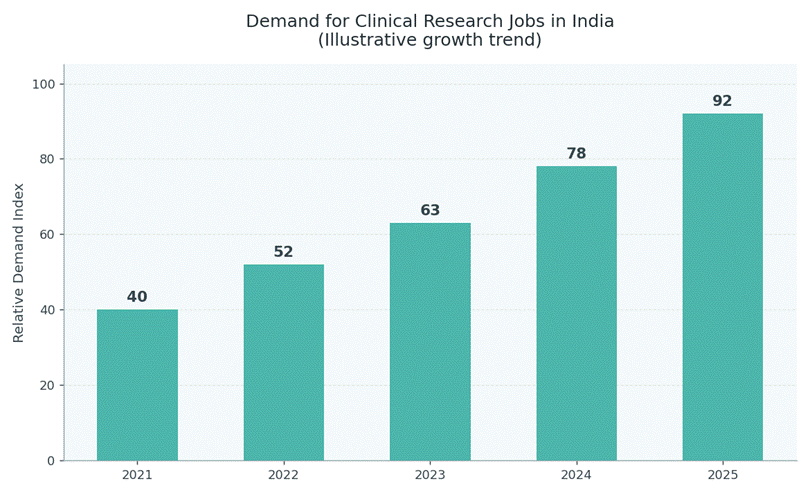
An illustrative look at how demand for clinical research roles has been moving up in recent years.
Skills You Will Need for Clinical Research
You don’t need to be a genius scientist to do well here. What really helps is:
- Basic knowledge of biology, pharmacology, or healthcare.
- Attention to detail — even small mistakes in trial data can cause big problems.
- Good communication, since you’ll talk to doctors, patients, and regulators.
- Comfort with computers and basic data tools.
- Patience, because trials can run for months or years.
The Usual Career Path for Clinical Research
Most people follow a fairly simple path to build a career in this field. Here’s what it generally looks like:
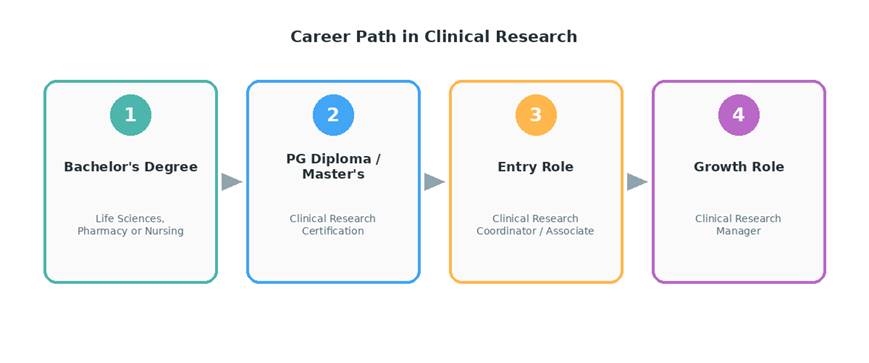
A common step-by-step path many people follow in clinical research.
You start with a bachelor’s degree in a science-related subject. After that, a short diploma or certification course in clinical research helps a lot, since it teaches the actual day-to-day work. From there, most people join as a Clinical Research Coordinator or Associate, and with a few years of experience, they can move up to manager or lead roles.
Clinical Research Job Roles
- Clinical Research Coordinator (CRC) – manages day-to-day trial work at a hospital or site.
- Clinical Research Associate (CRA) – checks that trials follow the rules and visits sites to confirm this.
- Data Manager – handles and cleans the data collected during the trial.
- Regulatory Affairs Officer – makes sure all paperwork meets government rules.
- Pharmacovigilance Officer – tracks any side effects reported during the trial.
Rules and Bodies You Should Know
Every clinical trial in India must follow guidelines set by the Central Drugs Standard Control Organisation (CDSCO), which works under India’s health ministry. Knowing how this body works is a real plus when you apply for jobs, since most companies expect you to understand basic compliance rules. You can read more about it here:
Central Drugs Standard Control Organisation (CDSCO)
How to Get Started
- Finish a bachelor’s degree in life sciences, pharmacy, nursing, or a related subject.
- Take a certificate or diploma course that focuses on clinical research basics.
- Try to get an internship at a hospital, CRO (Contract Research Organisation), or pharma company.
- Apply for entry-level roles like Clinical Research Coordinator.
- Keep learning — rules and guidelines in this field change often, so staying updated really matters.
Final Thoughts
Clinical research isn’t a flashy career, but it’s steady, meaningful, and growing every year in India. If you like the idea of helping bring new treatments to people while working in a structured, science-based environment, this field could be a strong fit for you.
Start small, get one certification, try for one internship — and the rest tends to fall into place over time.